Argumentative Essay: How to Write a Strong Evidence-Based Argument Step by Step

Posted on:

June 30, 2026

Updated on:

June 30, 2026

Share this article
how to write an argumentative essay step by step with research evidence and logical reasoning

Table of Contents

SUMMARY
An argumentative essay is a type of academic writing that uses evidence, logical reasoning, and critical thinking to support a clear position on a debatable topic. Strong argumentative essays rely on structured claims, credible research, counterarguments, and clear analysis instead of personal opinions alone. This guide explains how to write an argumentative essay step by step, including thesis writing, structure, research, rebuttals, formatting, and common mistakes students should avoid.

Key Takeaways

  • An argumentative essay is built around a clear, debatable thesis supported by evidence and logical reasoning.
  • A good argumentative writing depends on reliable research, arranged body paragraphs, counterarguments, and rebuttal techniques. 
  • A well-organized argumentative essay structure improves clarity, coherence, and overall argumentative strength.
  • Academic tone, objective language, and evidence-supported claims are essential in college-level argumentation.
  • Weak thesis statements, emotional reasoning, unsupported claims, and logical fallacies are some of the most common mistakes students make.
  • Learning how to write an argumentative essay step by step helps students build stronger analytical and critical thinking skills.

An argumentative essay is one of the most important forms of academic writing because it tests a student’s ability to think critically, analyze evidence, and defend a position using logical reasoning. Unlike opinion-based writing, a strong argumentative essay depends on credible research, structured claims, counterarguments, and clear analysis. Many students struggle with how to write an argumentative essay because they focus too much on personal opinions instead of evidence-supported arguments and formal academic structure.

When building a well-researched argument becomes challenging, some students choose to buy a custom argumentative essay that follows academic requirements and evidence-based reasoning. Understanding what makes a strong argument, however, is just as important as completing the assignment itself. With that foundation in mind, it helps to first understand what an argumentative essay is and what separates it from other forms of academic writing.

Can’t Build a Strong Argument?
Buy a professionally written argumentative essay backed by credible evidence and clear reasoning.
Order Now

What Is an Argumentative Essay?

An argumentative essay is a type of academic writing in which a student takes a clear position on a debatable topic and supports that position using evidence, logical reasoning, and analysis. The goal is not simply to share personal opinions, but to convince the reader through credible research, structured arguments, and critical thinking. This is what gives argumentative writing its academic value.

what is an argumentative essay infographic explaining structure thesis evidence and rebuttals
Understand the definition, structure, and key characteristics of an argumentative essay.

The purpose of an argumentative essay is to present a claim, support it with evidence-supported arguments, address opposing viewpoints, and explain why one position is stronger than the other. A strong argumentative essay maintains an analytical tone, uses objective language, and follows a logical progression from introduction to conclusion. Instead of emotional reasoning or unsupported opinions, argumentative essays rely on factual support, research-backed arguments, and clear interpretation of evidence.

One of the main characteristics of argumentative essays is that the topic must be debatable. This means the issue should allow more than one viewpoint. For example, “Schools should shorten homework hours for students” is a debatable claim because different people can reasonably agree or disagree with it. In contrast, a statement like “Water freezes at 0°C” is a fact, not an argument.

A well-written argumentative essay usually includes:

  • A clear thesis statement
  • Evidence-supported claims
  • Body paragraphs with analysis
  • Counterarguments and rebuttals
  • Logical transitions between ideas
  • A conclusion that reinforces the main argument

Understanding the meaning of argumentative writing is important before learning the writing process itself. Once students understand how argumentative essays work, it becomes easier to recognize how they differ from persuasive essays, which many students often confuse with argumentative writing.

Argumentative Essay vs Persuasive Essay: A Quick Difference

Students often confuse argumentative and persuasive writing because both are designed to convince the reader. However, an argumentative essay focuses more on evidence, logical reasoning, critical thinking, and balanced discussion. In academic writing, students are usually expected to support claims with credible research, explain opposing viewpoints, and maintain an objective tone throughout the essay.

Persuasive writing can also use arguments and evidence, but it generally allows more emotional appeal and personal influence. In contrast, argumentative writing depends heavily on evidence-supported claims, rebuttal structure, analytical reasoning, and formal academic voice. This is why argumentative essays are commonly assigned in schools, colleges, and universities to test structured reasoning and academic argument construction skills.

Understanding this distinction helps students follow the correct argumentative essay structure and avoid turning an academic argument into a purely opinion-based discussion. The next step is learning how the structure of an argumentative essay works and how each section supports the overall argument logically.

Basic Structure of an Argumentative Essay

A strong argumentative essay follows a clear structure that helps readers understand the argument step by step. Good argumentative writing is not just about presenting opinions. It depends on logical progression, organized body paragraphs, evidence-supported claims, and smooth transitions between ideas. A properly structured argumentative essay also improves clarity, coherence, and overall argumentative strength.

Most argumentative essays follow a five-part structure:

  1. Introduction Paragraph: The introduction presents the topic, provides background information, includes a hook, and ends with a clear thesis statement that explains the main argument.
  2. Body Paragraphs: Each body paragraph focuses on one main claim that supports the thesis. These paragraphs usually include evidence, explanation, analysis, and transitions that connect ideas logically.
  3. Counterargument Paragraph: A strong argumentative essay acknowledges opposing viewpoints instead of ignoring them. This section explains an opposing argument fairly and objectively.
  4. Rebuttal Section: The rebuttal explains why the opposing argument is weaker, less logical, unsupported, or less convincing than the main argument. This strengthens the credibility of the essay.
  5. Conclusion Paragraph: The conclusion reinforces the thesis, summarizes the main points, and leaves the reader with a final logical takeaway without repeating the introduction word for word.

Most school and college argumentative essays contain 5–7 paragraphs, but longer university-level essays may include additional sections depending on the topic depth, research requirements, and argumentative complexity. Regardless of length, every argumentative essay should maintain structured persuasion, analytical interpretation, and logical consistency from beginning to end.

Once students understand the argumentative essay structure, the next step is learning how to write a strong thesis statement and outline because the thesis acts as the foundation of the entire argument.

Thesis Statement and Outline: Building the Foundation of an Argumentative Essay

Before writing an argumentative essay, students should create a clear thesis statement and a structured outline. The thesis statement defines the main argument and gives the essay direction, while the outline organizes claims, evidence, counterarguments, rebuttals, and conclusions into a logical structure. Together, they help maintain clarity, improve argumentative flow, and prevent the essay from becoming repetitive or unfocused. A strong thesis and outline create the foundation for a well-organized argumentative essay that is easier to write, follow, and support with evidence.

Once the outline is complete, students can move into the actual argumentative essay writing process step by step, starting with topic selection and research.

How to Write an Argumentative Essay Step by Step

Writing a strong argumentative essay becomes much easier when students follow a clear process instead of trying to write everything at once. Good argumentative writing is built through planning, research, structured reasoning, drafting, and revision. Each step helps strengthen the argument, improve clarity, and maintain logical consistency throughout the essay.

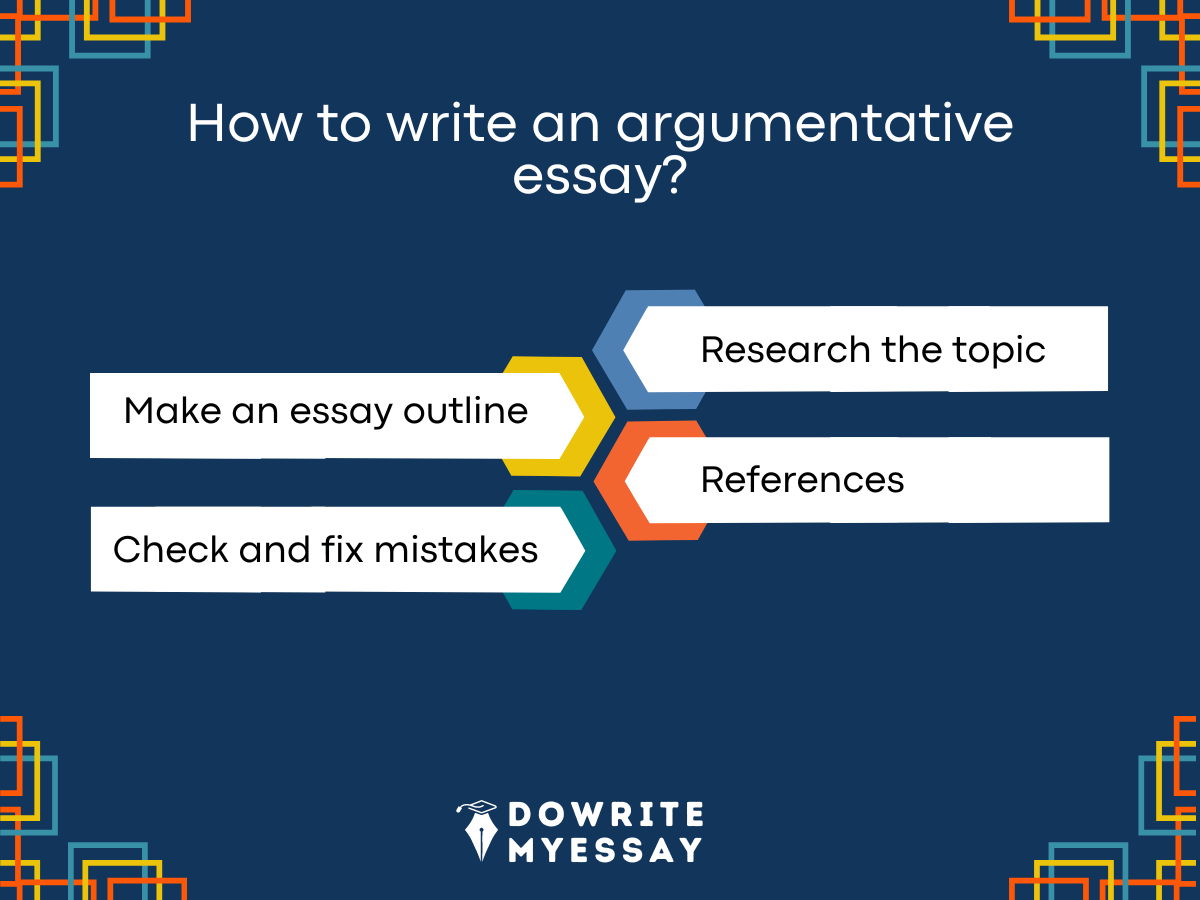
how to write an argumentative essay step by step including research thesis body paragraphs and rebuttals
Follow a structured process for planning, writing, and revising an argumentative essay.

Step 1: Choose a Strong Argumentative Essay Topic

The first step is selecting a debatable topic that allows multiple viewpoints. A good argumentative essay topic should be clear, researchable, and important enough to support evidence-based discussion. Topics that are too broad or too simple usually lead to weak arguments and repetitive claims.

Strong argumentative essay topics often focus on:

  • Education
  • Technology
  • Social media
  • Healthcare
  • Climate change
  • Politics
  • Artificial intelligence
  • Student life

The best argumentative essay ideas for students are topics that have enough credible research available and allow balanced discussion between opposing viewpoints.

Step 2: Research Credible Sources

Research is one of the most important parts of argumentative writing. Strong argumentative essays rely on evidence-supported claims instead of personal opinions alone. Students should collect information from credible academic sources such as journals, books, government websites, research studies, and trusted news publications.

When researching argumentative essays, students should focus on:

  • Evidence credibility
  • Research-backed arguments
  • Statistics and facts
  • Expert opinions
  • Reliable academic sources

Good research improves argumentative strength and helps students develop more logical and persuasive arguments.

Step 3: Write a Clear Introduction and Thesis Statement

The introduction paragraph should grab the reader’s attention, introduce the topic, provide brief context, and end with a strong thesis statement. A good hook for an argumentative essay can be a surprising statistic, question, fact, or short statement related to the topic.

The thesis statement should clearly explain:

  • The writer’s position
  • The main argument
  • The direction of the essay

A weak introduction often leads to a weak argumentative essay, which is why the opening section is extremely important.

Step 4: Develop Strong Body Paragraphs

Each body paragraph should focus on one supporting claim connected to the thesis statement. A strong argumentative body paragraph usually includes:

  • A topic sentence
  • Evidence or examples
  • Analysis and explanation
  • A transition to the next idea

Students should avoid adding multiple unrelated arguments in the same paragraph because it weakens logical flow and coherence.

Step 5: Add Counterarguments and Rebuttals

A strong argumentative essay does not ignore opposing viewpoints. Instead, it acknowledges counterarguments fairly and then explains why the main argument is stronger. This assists in enhancing credibility and shows critical thinking ability.

A good rebuttal structure includes:

  • Presenting the opposing view clearly
  • Explaining weaknesses in the opposing argument
  • Supporting the rebuttal with evidence and logic

Counterarguments and rebuttals make argumentative writing more balanced and academically convincing.

Step 6: Write a Strong Conclusion

The conclusion paragraph should reinforce the thesis statement and summarize the main arguments without repeating the introduction word-for-word. A strong ending for an argumentative essay leaves the reader with a final logical takeaway connected to the main discussion.

Once the first draft is complete, the next step is revising and improving the essay to strengthen clarity, argument quality, and overall academic structure.

The Writing Process Behind Strong Argumentative Essays

A strong argumentative essay is rarely written perfectly in the first draft. Good argumentative writing develops through planning, drafting, revising, and improving ideas step by step. Many students focus only on finishing the essay quickly, but strong academic argumentation depends heavily on revision, clarity, and logical consistency.

During the drafting stage, students should focus on building clear claims, adding credible evidence, and maintaining smooth transitions between arguments. The first draft does not need to be perfect. Its main purpose is to organize ideas and develop the overall argumentative essay structure properly.

The revision process is where argumentative strength improves the most. Students should carefully review:

  • Thesis clarity
  • Logical reasoning
  • Evidence credibility
  • Counterargument quality
  • Paragraph coherence
  • Transition flow
  • Repetitive claims
  • Grammar and formatting issues

One of the biggest mistakes students make while revising argumentative essays is only checking grammar instead of improving argument quality. Strong revision focuses on analytical depth, evidence-supported reasoning, and clarity of interpretation rather than simple sentence correction alone.

Critical thinking also plays a major role during revision. Students should ask themselves:

  • Does each paragraph support the thesis?
  • Is the evidence reliable and relevant?
  • Are counterarguments addressed fairly?
  • Does the rebuttal logically weaken the opposing position?
  • Are there any logical fallacies or unsupported claims?

Careful revision helps transform an average argumentative essay into a stronger, clearer, and more persuasive academic argument. Once the writing process is understood, the next step is learning about the different types of argument claims used in argumentative essays and how they shape the direction of the discussion.

Types of Argument Claims Used in an Argumentative Essay

Not all argumentative essays use the same type of argument. Different topics require different claim structures depending on what the writer is trying to prove. Understanding these claim types helps students build stronger arguments, choose better evidence, and maintain clearer logical progression throughout the essay.

The three main types of arguments used in argumentative writing are factual claims, value claims, and policy claims.

Claim TypePurposeExample
Factual ClaimArgues whether something is true or falseSocial media negatively affects student concentration.
Value ClaimArgues whether something is good, bad, ethical, or importantSchool uniforms are beneficial for student discipline.
Policy ClaimArgues what should or should not be doneColleges should reduce tuition fees for low-income students.

Factual Claims

Factual claims focus on proving whether information is accurate using evidence, research studies, statistics, or verified data. These arguments depend heavily on factual support and evidence credibility rather than personal beliefs.

Value Claims

Value claims focus on judgment, importance, morality, or effectiveness. These arguments often involve discussing whether something is right, wrong, beneficial, harmful, fair, or unfair. Strong analytical reasoning and explanation are important in this type of argumentative essay.

Policy Claims

Policy claims argue for change or action. These arguments usually include words like “should” or “should not” because they recommend a solution, policy, or decision. Policy-based argumentative essays often require strong rebuttals, practical reasoning, and research-backed arguments.

Understanding these argument types helps students choose the right argumentative approach for their topic and improve overall argumentative strength. Regardless of claim type, every argumentative essay still depends on credible evidence, logical reasoning, and clear analysis to convince the reader effectively.

How Evidence Strengthens an Argumentative Essay

Evidence is the foundation of every strong argumentative essay. Without credible evidence, arguments become opinions instead of logical academic discussions. Evidence-supported claims help students prove their position clearly, improve argumentative strength, and make the essay more convincing to the reader.

Strong argumentative writing usually includes:

  • Research studies
  • Statistics and data
  • Expert opinions
  • Academic journals
  • Historical examples
  • Real-world case studies

The quality of evidence matters just as much as the quantity. Reliable academic sources improve credibility, while weak or unsupported claims reduce the effectiveness of the argument. This is why students should always evaluate the credibility of evidence before adding information to their argumentative essays.

For example:

Weak EvidenceStrong Evidence
“Many people think social media is harmful.”“A 2024 study found that excessive social media use reduced student attention span by 27%.”

Strong evidence should always be followed by analysis. Students should explain:

  • How the evidence supports the claim
  • Why the evidence is important
  • What the evidence proves
  • How it connects to the thesis statement

Simply adding quotes or statistics without explanation weakens analytical depth and logical reasoning. Evidence becomes valuable only when it is properly interpreted and connected to the overall argument.

Students should also avoid:

  • Emotional reasoning
  • Unverified internet claims
  • Outdated sources
  • One-sided evidence
  • Unsupported arguments

Using research-backed arguments and factual support makes argumentative essays more balanced, persuasive, and academically credible. However, even strong evidence can fail if students make reasoning errors or use weak logic, which is why understanding logical fallacies is equally important in argumentative writing.

Common Logical Fallacies in Argumentative Essays

Logical fallacies are reasoning mistakes that weaken an argumentative essay and reduce the credibility of the argument. Many students include strong opinions in their essays, but weak logic, unsupported claims, or emotional reasoning can make the argument less convincing even when the topic itself is strong. Understanding logical fallacies helps students build clearer, more balanced, and more persuasive academic arguments.

Some of the most common logical fallacies in argumentative writing include:

Logical FallacyMeaningExample
Strawman FallacyMisrepresenting an opposing argument“People who support online learning want schools to disappear completely.”
Hasty GeneralizationMaking broad conclusions from limited evidence“One student cheated online, so online education is ineffective.”
Ad HominemAttacking the person instead of the argument“His opinion is wrong because he is inexperienced.”
False DilemmaPresenting only two extreme choices“Either schools ban phones completely, or students will never focus.”
Slippery SlopeAssuming one action will automatically cause extreme consequences“If students use AI tools once, education will completely fail.”

Logical fallacies often appear when students rely too heavily on emotional bias instead of evidence-supported reasoning. They can also appear through weak rebuttals, one-sided arguments, exaggerated claims, or poor analytical interpretation.

To avoid logical fallacies in essays, students should:

  • Use credible evidence
  • Maintain objective language
  • Analyze opposing viewpoints fairly
  • Avoid emotional exaggeration
  • Support claims with clear reasoning
  • Focus on facts instead of personal attacks

A well-written argumentative essay relies on an argument that is logically consistent, logically balanced, and applies critical thinking, rather than using emotion only to persuade. Avoiding these reasoning errors will help students develop more credible and academically supported arguments.

Common Mistakes Students Make in Argumentative Essays (And How to Avoid Them)

Many argumentative essays become weak not because the topic is bad, but because students make common writing and reasoning mistakes during the drafting process. These mistakes reduce clarity, weaken argumentative strength, and make the essay less convincing academically.

Weak Thesis Statements

A vague or overly broad thesis statement makes the entire argumentative essay unfocused. A strong thesis should present a clear, debatable position that can be supported with evidence and logical reasoning.

Emotional Reasoning Instead of Evidence

Many students rely too much on personal opinions or emotional language instead of research-backed arguments. Strong argumentative writing depends on factual support, analytical reasoning, and objective language.

Unsupported Claims

Arguments that do not use supportive evidence typically devalue the argument very quickly. Every major point in an argumentative essay should include examples, research, statistics, or expert support that directly connect to the thesis.

Ignoring Counterarguments

Many students often do not address the opposition and make the argumentative paper seem very one-sided. Addressing counterarguments and rebuttals improves credibility and demonstrates critical thinking skills.

Poor Paragraph Structure

Body paragraphs that fail to contain only one main idea and have several unrelated ideas can confuse the reader. Each paragraph should focus on one main claim supported by evidence and explanation.

Weak Transitions Between Ideas

Poor transitions between ideas in argumentative papers create a very disjointed feel and can create difficulty with coherence in each argument. Clear transition words and logical connections help maintain coherence between arguments.

Repeating the Same Argument

Repeating similar claims throughout the essay reduces analytical depth. Strong argumentative essays develop new supporting points instead of restating the same idea repeatedly.

Weak Conclusions

A conclusion should reinforce the main argument logically instead of simply repeating earlier sentences. Strong endings leave readers with a final analytical takeaway connected to the thesis.

Avoiding these common mistakes helps students create clearer, more persuasive, and academically stronger argumentative essays. Once the argument itself is strong, students must also ensure the paper follows proper academic formatting guidelines, such as MLA or APA style.

MLA vs APA Format for Argumentative Essays

Proper formatting is an important part of argumentative essay writing because it improves clarity, organization, and academic credibility. The two most commonly used formatting styles in argumentative essays are MLA format and APA format. The style required usually depends on the subject area, school guidelines, or university instructions.

MLA FormatAPA Format
Common in humanities subjectsCommon in social sciences
Uses author-page citationsUses author-date citations
Usually no separate title pageOften requires a title page
Works Cited pageReferences page
Focuses more on authorshipFocuses more on publication date

MLA Argumentative Essay Format

MLA format is commonly used for English, literature, and humanities-based argumentative essays. In-text citations usually include the author’s last name and page number, such as:
(Smith 24)

MLA formatting typically includes:

  • 12-point readable font
  • Double spacing
  • 1-inch margins
  • Header with page number
  • Works Cited page

APA Argumentative Essay Format

APA format is often used in psychology, education, healthcare, and social science argumentative essays. APA citations include the author’s last name and publication year, such as:
(Smith, 2024)

APA formatting usually includes:

  • Title page
  • Running head (sometimes required)
  • Double spacing
  • References page
  • Author-date citation style

Regardless of the formatting style, students should maintain citation accuracy, logical organization, and clear academic presentation throughout the argumentative essay. Correct formatting also helps avoid plagiarism issues and improves the professionalism of the final paper.

After understanding formatting requirements, it becomes much easier to analyze how a complete argumentative essay actually looks in practice through a real argumentative essay example.

Argumentative Essay Example (Annotated)

Below is a short argumentative essay example that shows how different parts of an argumentative essay work together, including the hook, thesis statement, evidence-supported claims, counterargument, rebuttal, and conclusion.

📝 EXAMPLE ESSAY
Topic: Should Schools Limit Student Homework?
Introduction Paragraph Many students spend several hours every night completing homework after school. While homework is designed to improve learning, excessive homework can negatively affect student health, sleep, and academic balance. Schools should limit homework hours because too much homework increases stress levels, reduces sleep quality, and limits time for extracurricular development.
Annotation: Hook: “Many students spend several hours…” | Background Context: Explains the issue briefly | Thesis Statement: Schools should limit homework hours
Body Paragraph 1 One major reason schools should reduce homework is that excessive academic workload increases student stress. According to educational research, students who regularly receive large amounts of homework report higher anxiety and lower motivation levels. Long homework hours can also reduce concentration and negatively affect classroom performance the next day.
Annotation: Main Claim: Homework increases stress | Evidence: Educational research | Analysis: Explains the impact on students
Body Paragraph 2 Too much homework also affects students’ sleep schedules. Many students stay awake late at night to complete assignments, especially in high school and college environments. Poor sleep can lower memory retention, reduce focus, and negatively impact academic performance over time.
Annotation: Second Supporting Claim | Logical Progression from stress → health impact | Evidence-Supported Reasoning
Counterargument and Rebuttal Some people argue that homework teaches discipline and responsibility. While moderate homework can improve time management skills, excessive homework creates unnecessary pressure and reduces the effectiveness of learning. Students learn better when they have enough time for rest, personal development, and balanced study schedules.
Annotation: Counterargument: Homework teaches discipline | Rebuttal: Excessive homework becomes harmful | Balanced Discussion: Acknowledges both viewpoints
Conclusion Paragraph In conclusion, schools should limit excessive homework because it increases stress, reduces sleep quality, and negatively affects student well-being. A balanced academic workload allows students to perform better both academically and personally. Strong educational systems should focus on effective learning rather than overwhelming students with unnecessary assignments.
Annotation: Restated Thesis | Summary of Main Arguments | Final Logical Takeaway

This argumentative essay sample demonstrates how structured reasoning, evidence-supported claims, counterarguments, and logical progression work together to create a clear and persuasive academic argument.

Good Argumentative Essay Topics for Students

Choosing the right topic is one of the most important parts of writing a strong argumentative essay. A weak topic can make the essay repetitive, confusing, or difficult to support with evidence. A good argumentative essay topic should be debatable, researchable, and specific enough to allow logical discussion from multiple viewpoints.

Many students struggle during topic selection because they choose topics that are either too broad or too simple to analyze deeply. Reviewing well-structured argumentative essay topics can help students find ideas that are easier to research, organize, and support with credible evidence. Below are some strong argumentative essay ideas for students

Some popular argumentative essay ideas include:

  • Should college education be free for all students?
  • Should schools reduce homework hours?
  • Should students be allowed to use AI tools in academics?
  • Is social media doing more harm than good?
  • Should mobile phones be banned in classrooms?
  • Should voting be mandatory in democratic countries?
  • Should healthcare be considered a basic human right?
  • Should governments regulate fast food advertising?
  • Should plastic products be banned to protect the environment?
  • Is artificial intelligence helping or harming education?

The best argumentative essay topics usually involve current issues, balanced viewpoints, and enough available research to support evidence-based discussion. Once students choose a strong topic, the next step is understanding what actually makes an argumentative essay effective, persuasive, and academically strong overall.

What Makes a Strong Argumentative Essay?

A strong argumentative essay is not built on opinions alone. It depends on logical reasoning, credible evidence, structured organization, and clear analytical writing. The most effective argumentative essays present a clear thesis statement, support claims with reliable research, address counterarguments fairly, and maintain a formal academic tone from beginning to end.

Teachers and professors usually evaluate argumentative essays based on several important factors:

CriteriaWhat Professors Look For
Thesis StatementClear, specific, and debatable argument
Evidence QualityCredible research and factual support
Logical ReasoningClear explanation and analytical depth
OrganizationStrong argumentative essay structure
CounterargumentsBalanced discussion and rebuttal quality
Academic ToneObjective language and formal writing
CoherenceSmooth transitions and logical progression
ConclusionStrong reinforcement of the main argument

One of the biggest signs of a strong argumentative essay is clarity. Readers should easily understand the main argument, supporting points, and logical flow without confusion. Strong argumentative writing also avoids emotional bias, unsupported claims, and repetitive ideas that weaken credibility.

Good argumentative essays also demonstrate:

  • Critical thinking
  • Evidence-supported reasoning
  • Analytical interpretation
  • Logical consistency
  • Clear paragraph structure
  • Strong rebuttal techniques
  • Proper citation and formatting

Many students believe that a persuasive writing style makes for an effective Argument; however, academic argumentation is more reliant on reasoning and evidence than it is on using emotional appeal. Even a simple topic can become a strong argumentative essay when the claims are organized clearly and supported with credible research.

Once students understand these qualities, writing argumentative essays becomes much more structured, logical, and manageable from the introduction to the conclusion.

Library Background
Still Struggling With Your Argument?
Work with academic writers who understand structure, rebuttals, and evidence-based writing.
Place Your Order

Final Thoughts on Writing a Strong Argumentative Essay

An argumentative essay is more than simply expressing an opinion. It is a structured form of academic writing that depends on logical reasoning, evidence-supported claims, critical thinking, and balanced discussion. From choosing a strong topic and writing a clear thesis statement to building rebuttals and analyzing evidence, every part of an argumentative essay works together to create a persuasive and academically credible argument.

Students who learn how to write an argumentative essay properly develop stronger analytical reasoning, research, and communication skills that are useful far beyond the classroom. By focusing on clear structure, credible evidence, logical consistency, and objective language, students can create argumentative essays that are more organized, convincing, and effective in academic settings.

Frequently Asked Questions About Argumentative Essays

Master the art of argumentative writing. These quick answers cover the most common questions students ask when structuring and writing an argumentative essays.

What is an argumentative essay?
An argumentative essay is a type of academic writing where the writer takes a clear position on a debatable issue and supports that position using logical reasoning, evidence, research, and analysis. Instead of relying only on personal opinions, argumentative essays focus on evidence-supported claims and structured argument development. A strong argumentative essay also includes counterarguments and rebuttals to create a balanced and academically credible discussion.
How do you start an argumentative essay?
A strong argumentative essay usually begins with a hook that captures the reader’s attention. This can be a surprising fact, statistic, question, or statement related to the topic. After the hook, students should provide brief background information to introduce the issue clearly before ending the introduction with a strong thesis statement. The thesis should explain the writer’s position and the main argument that will be discussed throughout the essay.
What is the purpose of an argumentative essay?
The purpose of an argumentative essay is to convince the reader using logic, evidence, and critical thinking rather than emotion alone. Schools and universities use argumentative writing to evaluate how well students can analyze information, organize claims, support arguments with research, and respond to opposing viewpoints logically. Argumentative essays also help students develop academic reasoning, analytical interpretation, and persuasive communication skills.
How many paragraphs are in an argumentative essay?
Most argumentative essays contain between 5 and 7 paragraphs. A basic argumentative essay structure usually includes an introduction paragraph, three body paragraphs, a counterargument or rebuttal section, and a conclusion paragraph. However, longer college and university assignments may include additional body paragraphs depending on the complexity of the topic, research depth, and assignment requirements.
What makes a strong thesis statement in an argumentative essay?
A strong thesis statement is clear, specific, debatable, and focused on one main argument. It should explain the writer’s position directly while also guiding the direction of the essay. Weak thesis statements are usually vague, overly broad, or based only on opinion. Strong argumentative thesis statements create a foundation for evidence-supported reasoning, body paragraph organization, and logical progression throughout the paper.
What is a counterargument in argumentative writing?
A counterargument is an opposing viewpoint included within the argumentative essay. Instead of ignoring different perspectives, strong argumentative writing addresses opposing arguments fairly and then responds to them through rebuttal and evidence-based reasoning. Including counterarguments improves argumentative strength because it demonstrates critical thinking, balanced discussion, and deeper analytical understanding of the topic.
Can you use “I” in an argumentative essay?
In most academic argumentative essays, students are encouraged to maintain a formal and objective writing style. While some instructors may allow limited use of first-person language like “I,” excessive personal language can weaken the analytical tone of the essay. Argumentative writing usually sounds stronger when claims are supported with evidence, logical analysis, and research instead of personal opinion alone.
What are common mistakes students make in argumentative essays?
Some of the most common mistakes include weak thesis statements, emotional reasoning, unsupported claims, poor paragraph organization, weak transitions, and a lack of credible evidence. Many students also ignore counterarguments or rely too heavily on personal opinions instead of analytical reasoning. Logical fallacies, repetitive arguments, and unclear rebuttals can also reduce the overall effectiveness of an argumentative essay.
Picture of Elowen Rose
Elowen Rose
I am Elowen Rose, an expert essay writer. I ensure that each student receives valuable insights for crafting A-grade essays. I work closely with students to make writing easier and more enjoyable for them.