
Key Takeaways
- An essay is built on a clear structure: introduction, body paragraphs, and conclusion
- The introduction sets the topic and presents the thesis (~10% of the essay)
- The body paragraphs develop ideas using evidence and explanation (~70–80%)
- The conclusion summarizes the main points and closes the discussion (~10–15%)
- A strong thesis statement gives direction to the entire essay
- Each paragraph should focus on one main idea to maintain clarity
- Effective essay writing follows a process:
- brainstorming
- outlining
- drafting
- revising
- editing and proofreading
- Good essays focus on:
- clarity
- logical flow
- coherence
- readable language
- Common mistakes to avoid:
- weak or unclear thesis
- poor structure
- repetition
- informal tone
- grammar errors
Many students struggle with essay writing, not because they lack ideas, but because they don’t know how to organize them clearly.
Writing an essay requires more than just ideas; it demands structure. Your introduction sets the direction, the body develops your points, and the conclusion ties everything together.
When students can’t maintain that structure, our custom essay writing service offers a practical solution by delivering clear, logically organized essays that meet academic standards.
In this guide, you’ll learn how to write an essay step by step, from planning to final revision.

What Is an Essay?
An essay is a structured piece of writing that explains, analyzes, or argues an idea. It focuses on one main point and supports it with clear reasoning and evidence.
The purpose of an essay depends on the task. You may be asked to:
- Explain a concept
- Describe a topic
- Present an argument
- Analyze information
No matter the type, every essay follows the same basic approach. It presents a clear idea, develops it step by step, and keeps the writing focused and easy to follow.
You will usually come across common types like narrative, expository, argumentative, and descriptive essays. But the core writing process stays the same for all of them.
Once you understand what an essay is, the next step is to see how it is structured so your ideas are organized properly.
Standard Essay Structure
Every essay follows a clear structure. This structure helps you organize your ideas so the reader can follow your argument without confusion.
An essay has three main parts:
- Introduces the topic
- Provides brief context
- Ends with a clear thesis statement
- Each paragraph focuses on one main idea
- Includes: topic sentence, supporting evidence, and explanation
- Uses transitions to maintain logical flow
- Restates the main idea
- Summarizes key points
- Ends the essay clearly
Most essays have around 3–5 paragraphs or more, depending on the length and complexity of the topic.
If you don’t follow a clear structure, your ideas may feel scattered. To understand how these sections work together in detail, it helps to follow a clear breakdown of the essay structure and how each part supports the overall argument.
Now that you know how an essay is structured, the next step is to learn how to actually write one from start to finish.
How to Write an Essay Step by Step
Writing an essay becomes much easier when you follow a clear process. Instead of trying to write everything at once, you move step by step. Each stage has a specific purpose, and skipping one usually leads to weak structure or unclear ideas.
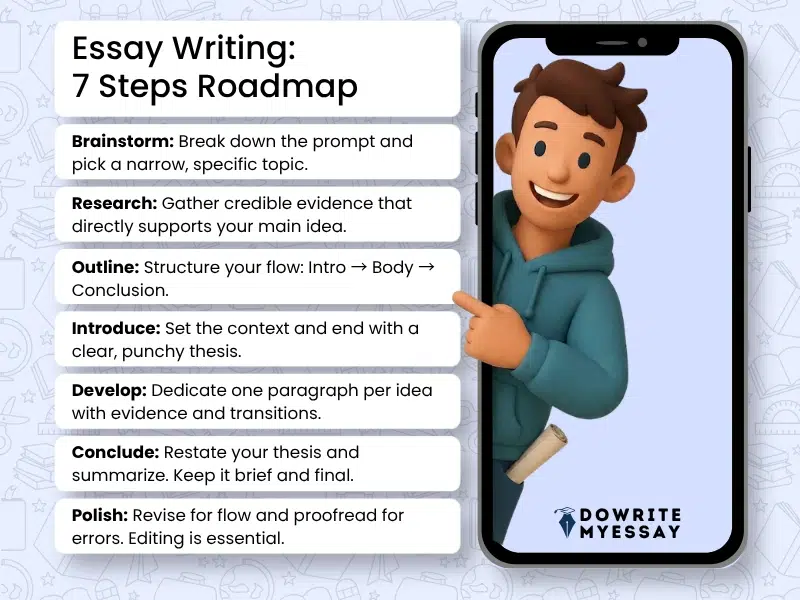
Step 1: Brainstorm and Choose a Topic
Start by understanding the topic properly. If you are given a question, break it down and identify what it is asking. If you can choose your own topic, pick something that is specific and manageable.
At this stage, your goal is not to write perfectly. Your goal is to generate ideas.
- Write down everything that comes to mind
- Look for patterns or repeated ideas
- Narrow your focus to one clear direction
A weak topic leads to a weak essay, so take time here.
Step 2: Research and Gather Information
Once your topic is clear, collect information that supports your main idea. This is especially important for academic essays where arguments must be backed by evidence.
- Use reliable sources (books, academic sites, journals)
- Note important facts, examples, and explanations
- Ignore information that does not directly support your point
Do not try to include everything you find. Focus only on what strengthens your argument.
Step 3: Create an Essay Outline
Before writing, organize your ideas into a clear structure. This step saves time later and prevents your essay from becoming disorganized.
A simple outline looks like this:
- Introduction → topic + thesis
- Body Paragraph 1 → first main idea
- Body Paragraph 2 → second main idea
- Body Paragraph 3 → third main idea
- Conclusion → summary
A clear essay outline allows you to map your introduction, main points, and conclusion before you start drafting, which reduces confusion later.
Step 4: Write the Introduction
The introduction sets the direction of your essay. It should be clear and direct, not overly detailed.
- Start with a simple opening sentence
- Give a brief context so the reader understands the topic
- End with a strong thesis statement that clearly states your main point
Avoid vague openings. The reader should understand what your essay is about within a few lines.
Step 5: Write the Body Paragraphs
This is where you develop your ideas in detail. Each paragraph should focus on one main point.
A strong body paragraph includes:
- A topic sentence (main idea of the paragraph)
- Supporting evidence (facts, examples, data)
- Explanation (how the evidence supports your idea)
Keep your paragraphs connected using simple transitions so the essay flows naturally from one idea to the next.
Most of your essay will be here, so clarity and organization matter more than length.
Step 6: Write the Conclusion
The conclusion brings your essay to a clear end. It should not introduce new ideas.
- Restate your thesis in different words
- Summarize the main points from the body
- End with a final statement that closes the discussion
Keep it concise. A long or repetitive conclusion weakens the overall impact.
Step 7: Revise, Edit, and Proofread
This step is where many students lose marks by rushing.
First, revise your essay:
- Check if your ideas are clear
- Make sure your argument makes sense
Then edit:
- fix sentence structure
- remove repetition
- improve clarity
Finally, proofread:
- correct grammar, spelling, and punctuation
A well-edited essay often performs much better than a rushed one, even if the ideas are similar.
Now that you understand the full writing process, the next step is to focus on the key principles that make an essay clear, structured, and effective.
Key Rules of Good Essay Writing
Knowing the steps is not enough. To write a strong essay, you also need to follow a few core writing principles. These rules help you keep your ideas clear and your structure consistent.

The 5 C’s of Essay Writing
These are the basic standards of good writing:
- Clarity: Your ideas should be easy to understand. Avoid complicated sentences that confuse the reader.
- Coherence: Your essay should flow logically from one point to the next. Each paragraph should connect to the previous one.
- Consistency: Stick to one tone and style throughout the essay. Do not switch between formal and informal language.
- Correctness: Your grammar, spelling, and punctuation should be accurate.
- Concise: Avoid unnecessary words. Say what you need to say clearly and directly.
The Six Traits of Effective Writing
These traits focus on how your writing is presented:
- Ideas → clear and focused main point
- Organization → logical structure and order
- Voice → appropriate academic tone
- Word Choice → precise and simple language
- Sentence Fluency → smooth and readable sentences
- Conventions → correct grammar and formatting
The Golden Rule of Essay Writing
Your essay should always stay focused on one main idea.
Everything you write should support your thesis. If a sentence or paragraph does not add value to your main point, remove it.
Even when students understand these rules, they often make avoidable mistakes. Recognizing them early can help you improve your writing quickly.
Common Essay Writing Mistakes to Avoid
Even when students understand the structure and process, certain mistakes keep appearing. These issues weaken clarity, reduce marks, and make the essay harder to follow.
Weak or Unclear Thesis Statement
If your thesis is vague, the entire essay loses direction. The reader should know exactly what your main point is.
- Avoid general statements
- Make your position clear and specific
Lack of Structure
Jumping between ideas without clear paragraphs makes the essay confusing.
- follow introduction → body → conclusion
- keep one main idea per paragraph
Repetition of Ideas
Repeating the same point in different words does not strengthen your argument. It makes your writing feel limited.
- Add new points instead of rephrasing the same idea
- Make each paragraph contribute something different
Informal Language
Using casual words or slang reduces the quality of academic writing.
- Avoid contractions (like “don’t,” “can’t”)
- Avoid conversational phrases
Poor Grammar and Sentence Errors
Grammar mistakes distract the reader and reduce clarity.
- Check sentence structure
- Fix punctuation and spelling errors
Missing Transitions Between Paragraphs
Without transitions, your essay feels disconnected.
- Use simple linking words (however, therefore, in addition)
- Make sure each paragraph connects logically
Writing Without Planning
Starting without an outline often leads to disorganized writing.
- Plan your ideas before writing
- Follow a clear structure
Avoiding these mistakes improves your writing, but to get better results consistently, you also need to apply a few practical strategies while writing.
Essay Writing Tips for Better Results
Once you understand the structure and avoid common mistakes, the next step is to improve how you write. These practical tips help you produce clearer and more effective essays.

1. Start with a Clear Plan
Before writing, take a few minutes to organize your ideas.
- Decide on your main argument
- List your key points
- Follow a simple structure
A clear plan reduces confusion during writing.
2. Keep Your Writing Simple and Direct
Complex sentences do not make your essay better. They often make it harder to understand.
- Use clear and straightforward language
- Avoid unnecessary words
- Focus on one idea at a time
3. Focus on One Idea Per Paragraph
Each paragraph should serve a clear purpose.
- Start with a topic sentence
- Support it with evidence
- Explain your point
This keeps your essay organized and easy to follow.
4. Use Evidence Carefully
Strong essays are supported by facts and examples, not just opinions.
- Include relevant evidence
- Explain how it supports your idea
- Avoid adding unrelated information
5. Revise Your Work Properly
Your first draft is rarely your best work.
- Check if your ideas are clear
- Improve weak sentences
- Remove repetition
6. Proofread Before Submitting
Small errors can affect the overall quality of your essay.
- Check grammar and spelling
- Read your essay slowly
- Fix minor mistakes
Now that you know how to improve your writing, let’s look at a complete example to see how all these parts work together in a real essay.
Example Essay (With Breakdown)
Below is a short example to show how a complete essay is written and structured.
Breakdown of the Essay
Introduction
- Clearly introduces the topic
- Provides context (student challenges)
- Ends with a clear thesis
Body Paragraphs
- Each paragraph focuses on one idea:
- completing work on time
- reducing stress
- improving performance
- Uses simple explanation instead of unnecessary detail
Conclusion
- Restates the main idea
- Summarizes key points
- Ends the essay clearly without adding new information
Now that you’ve seen how a complete essay works, the next step is to use a simple checklist to make sure your own essay meets all the key requirements.
How Many Paragraphs Should an Essay Have?
There is no fixed number of paragraphs for every essay. The length depends on the topic, assignment, and required word count.
- A basic essay usually has 3–5 paragraphs
- A standard academic essay often has 5 or more paragraphs
What matters is not the number, but the structure:
- One introduction paragraph
- Several body paragraphs (each focused on one idea)
- One conclusion paragraph
If your topic is more complex, you’ll naturally need more body paragraphs to explain your argument clearly.
Essay Writing Checklist
Before submitting your essay, go through this checklist to make sure everything is in place:
- Clear thesis statement: Does your essay have one main idea that is easy to understand?
- Proper structure: Introduction, body paragraphs, and conclusion are clearly defined
- Logical flow: Do your ideas connect smoothly from one paragraph to the next?
- Strong body paragraphs: Each paragraph focuses on one idea and includes an explanation
- Relevant supporting evidence: Are your points backed by examples or facts where needed?
- Consistent tone: Is your writing formal and free from informal language?
- No repetition: Are you avoiding repeating the same idea in different words?
- Grammar and spelling checked: Have you corrected sentence errors and typos?
- Proper conclusion: Does your essay end clearly without introducing new ideas?
With everything checked and in place, you’re in a much better position to submit a well-structured essay. If you’re running short on time or need an essay that meets academic standards from the start, you can order an essay written from scratch to match your topic, instructions, and deadline.
Conclusion: Building a Strong Essay Step by Step
Writing an essay becomes much easier when you treat it as a process instead of a single task. Once you understand how to plan your ideas, structure your paragraphs, and revise your work, the entire process becomes more manageable.
A strong essay is not about using complex words or writing long paragraphs. It is about presenting one clear idea, supporting it with relevant points, and organizing everything in a logical way.
If you follow the steps consistently and avoid common mistakes, your writing will improve over time. Like any skill, essay writing gets better with practice and careful revision.
Frequently Asked Questions About Essay Introductions
Still unsure about essay writing? These quick answers clarify structure, format, and common mistakes.