

Key Takeaways
- Essay structure is the framework that organizes ideas into a clear and logical flow
- Understanding how to structure an essay helps improve clarity, coherence, and readability
- The structure of an essay depends on proper sequencing, grouping of arguments, and smooth transitions
- Different essay organization strategies, like chronological, cause and effect, and compare and contrast, shape how ideas are presented
- Strong structure leads to better understanding, while weak structure results in poor organization and disconnected ideas
Essay structure is the way ideas are arranged to create a clear and logical flow from start to finish. A strong essay structure helps readers understand your argument without confusion by organizing points in a meaningful sequence. When students think about how to structure an essay, they are really focusing on clarity, coherence, and the logical progression of ideas.
Many students struggle to organize their thoughts effectively, which is why they often need support to write their essays with proper structure and clear flow. That is where our write my essay service comes in. We provide custom essays to students based on their requirements. The structure of an essay is not just about having sections; it is about how well those sections connect and build on each other.
A well-structured essay groups related ideas, maintains consistency, and ensures that each point supports the overall purpose. Without a clear structure, even strong arguments can feel scattered or difficult to follow.

Core Principles of a Strong Essay Structure
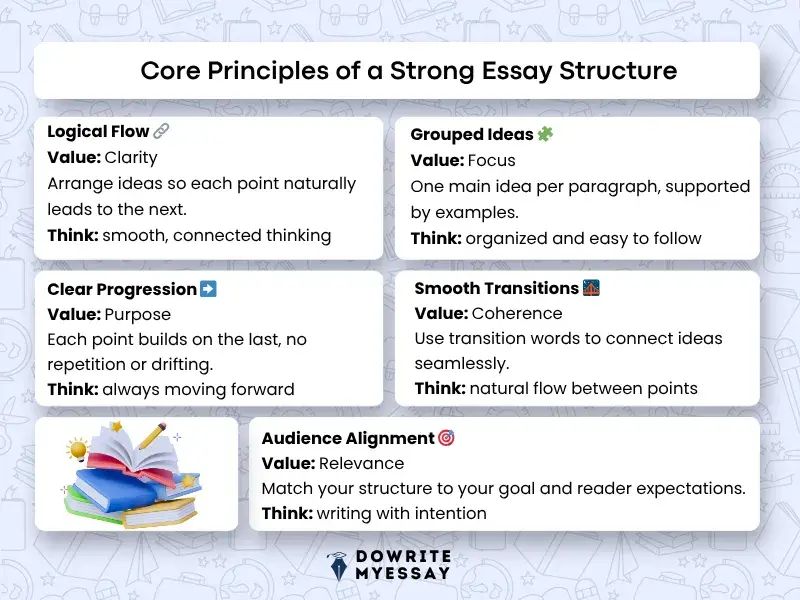
1. Logical Flow and Sequencing
A strong essay structure depends on how ideas move from one point to the next. Logical flow means each argument builds naturally on the previous one. When structuring an essay, focus on arranging ideas in a clear, intentional sequence, not a random one.
2. Grouping of Ideas and Arguments
It is easier to create an effective essay when similar ideas are grouped together. Each article or paragraph should contain only one main idea that is supported by specific examples. By grouping your ideas in a logical way, you will help your reader follow your argument without losing track of what you are trying to say.
3. Clear Progression of Points
Any good essay moves in a forward direction with a defined purpose. A well-organized structure within the essay helps to ensure that each new piece of information will build upon the previous one and not repeat or diverge from its logical progression. This method of continuous progress will keep your essay on topic, easy to read, and understandable.
4. Coherence and Transitions
Using transition words and signs is the best way to achieve coherence, by making it possible to move from one point to another smoothly. This method of conditional organization of your essay will give your essay the feeling that it is a complete work and not something that is incomplete.
5. Alignment with Purpose and Audience
The way you organize your essay should match its goal. Whether you are explaining, comparing, or arguing, the structure of an essay should support that purpose while keeping the reader’s expectations in mind.
While these principles define a strong essay structure, they become more practical when applied through specific organization patterns.
Common Essay Structure Types (Organization Patterns Explained)
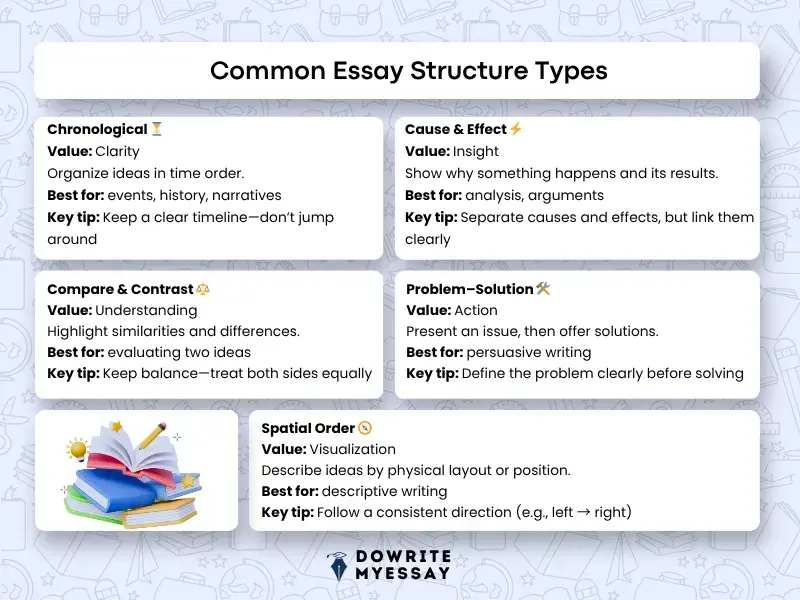
1. Chronological Structure
This pattern organizes ideas in time order, making it useful for narratives, historical topics, or any essay that explains a sequence of events. A strong essay structure here depends on maintaining a clear timeline so each point builds on the previous one. If events are presented out of order, the flow breaks and the reader struggles to follow the progression.
2. Cause and Effect Structure
This structure focuses on relationships between actions and outcomes. It answers why something happens and what results from it, which makes it useful in analytical and argumentative writing. When applied correctly, the structure of an essay clearly separates causes and effects while still showing how they connect.
One common mistake here is mixing multiple causes and effects without clear grouping, which weakens clarity.
3. Compare and Contrast Structure
This pattern is used to examine similarities and differences between subjects. It can follow a block structure (one subject at a time, then the other) or an alternating structure (point-by-point comparison). A strong essay structure here depends on balance, where each subject is discussed equally.
If the comparison is uneven or repetitive, the structure becomes weak and confusing.
4. Problem-Solution Structure
This structure presents a clear issue and then offers one or more solutions. It is commonly used in persuasive and argumentative essays where the goal is to guide the reader from understanding a problem to evaluating possible solutions. The essay’s structure must clearly define the problem before introducing solutions; the argument lacks direction.
5. Spatial Order Structure
Spatial organization arranges ideas according to their physical positions or layouts. It is often used in descriptive writing where clarity depends on how well the reader can visualize the subject. A strong essay structure here follows a consistent path, such as left-to-right or top-to-bottom.
If the order shifts randomly, the description feels scattered.
Choosing the right pattern is a key part of structuring an essay, because it directly affects clarity and logical flow. Applying these patterns correctly is just as important. This is where learning how to write an essay properly helps you connect the structure with actual execution.
Once the structure type is clear, the next step is to ensure ideas flow smoothly within it.
How Essay Organization Patterns Shape Logical Flow
1. What Logical Flow Really Means
Logical flow is how ideas connect and move across the essay. A strong essay structure ensures that each point follows naturally from the previous one, so the reader can understand the argument without confusion. When students struggle with how to structure an essay, the issue is usually not missing sections but weak connections between ideas.
2. Role of Topic Sentences and Paragraph Focus
Each paragraph should introduce one clear idea and stay focused on it. This builds the structure of an essay at a deeper level, where every paragraph has a defined role. When paragraphs include multiple unrelated points, the flow breaks and the argument becomes difficult to follow.
A clear topic sentence helps the reader understand what the paragraph will explain, while the supporting details develop that idea without drifting away.
3. Transitions and Signposting
Transitions are what connect one idea to the next. Without them, even a well-planned essay structure can feel disjointed. Words like “however,” “in contrast,” and “as a result” help show relationships between points, while signposting makes the direction of the argument clear.
Strong essay organization strategies use transitions to guide the reader step by step, rather than forcing them to figure out the connection on their own.
4. Maintaining Coherence Across the Essay
Coherence means that all parts of the essay work together toward the same goal. A clear structure of an essay ensures that each paragraph supports the main argument instead of introducing unrelated ideas.
When coherence is strong, the essay feels consistent and easy to follow. When it is weak, the writing feels scattered, even if the ideas themselves are strong.
5. Common Breaks in Logical Flow
Logical flow is often disrupted by:
- sudden shifts between topics
- weak or missing transitions
- repetition of ideas without progression
- unrelated supporting details
These issues weaken the essay’s structure and make the writing harder to understand.
In academic writing, logical flow is not optional. It is expected in structured formats like APA essay format, where clarity, consistency, and organization directly affect readability.
Once the flow is clear, the next step is identifying the common mistakes that weaken essay structure.
Common Essay Structure Mistakes to Avoid
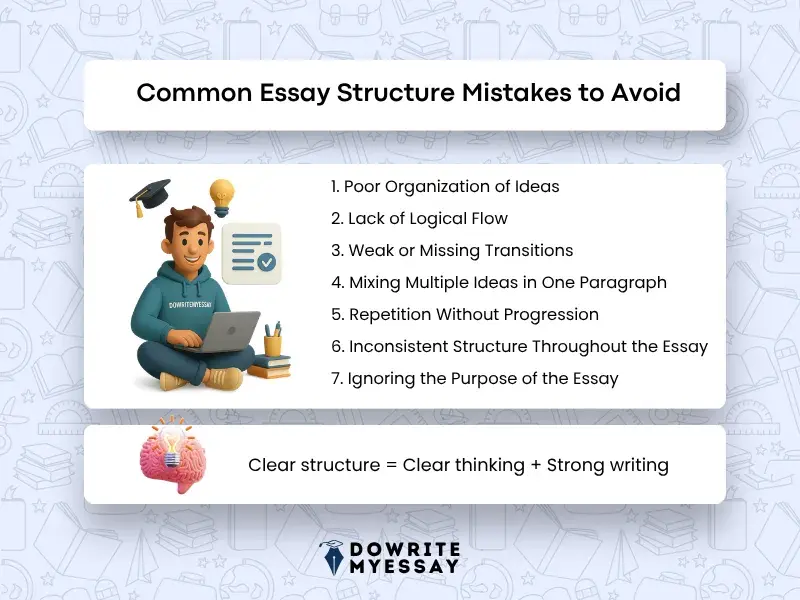
1. Poor Organization of Ideas
One of the most common problems in an essay structure is placing ideas without a clear plan. When points are not grouped properly, the essay feels scattered and difficult to follow. This often happens when students focus on writing quickly instead of organizing their thoughts first.
2. Lack of Logical Flow
Even when ideas are relevant, they can still feel disconnected. A weak structure of an essay often shows up as abrupt shifts between paragraphs or points that do not build on each other. This breaks the reader’s understanding and weakens the overall argument.
3. Weak or Missing Transitions
Transitions are important to connect the points in your paper. Without them, the essay reads like a list of points rather than a continuous argument. When thinking about how to structure an essay, transitions are what turn structure into flow.
4. Mixing Multiple Ideas in One Paragraph
Each paragraph should focus on one main idea. When multiple arguments are placed in a single paragraph, the structure becomes unclear. This weakens both clarity and readability, even if the ideas themselves are strong.
5. Repetition Without Progression
This problem occurs when you repeat something you’ve already said, but in such a way that there isn’t any new information to be gained from the second instance. A strong essay structure moves forward with each paragraph, while repetition makes the writing feel stagnant and unfocused.
6. Inconsistent Structure Throughout the Essay
Switching between different organizational patterns without reason can confuse the reader. In general, the entire essay should have a constant pattern of organisation so that the argument develops in a systematic and orderly manner.
7. Ignoring the Purpose of the Essay
Structure should always match the goal of the writing. Using the wrong pattern or organizing ideas poorly can weaken the message, even if the content is relevant. Strong essay organization strategies align structure with purpose.
Avoiding these mistakes makes it easier to evaluate whether your essay structure is clear and effective.
Essay Structure Checklist (Quick Evaluation Tool)
1. Logical Flow
- Do your ideas follow a clear and natural sequence?
- Does each point build on the previous one?
A strong essay structure should guide the reader step by step without confusion.
2. Clear Paragraph Focus
- Does each paragraph focus on one main idea?
- Are topic sentences clearly defined?
This ensures the structure of an essay remains organized at the paragraph level.
3. Proper Grouping of Ideas
- Are related arguments placed together?
- Is each section serving a clear purpose?
Good grouping improves clarity and prevents scattered writing.
4. Smooth Transitions
- Are ideas connected with clear transitions?
- Can the reader easily follow the shift from one point to another?
Transitions are essential for structuring an essay effectively.
5. Consistent Structure Pattern
- Are you using one clear organization pattern (e.g., cause-effect, comparison)?
- Is the structure consistent throughout the essay?
A consistent essay structure avoids confusion and improves readability.
6. Alignment with Purpose
- Does your structure match the goal of the essay?
- Are ideas arranged in a way that supports your argument or explanation?
Strong essay organization strategies always align with the purpose.
7. Clarity and Readability
- Is the essay easy to understand without rereading?
- Are ideas expressed clearly and directly?
A clear essay structure improves both readability and impact.
Once your structure meets these checks, you’re ready to adapt it to the specific type of essay you’re writing. If you’re working with a tight deadline and need a well-organized essay that follows the appropriate structure from the start, you can buy online essays tailored to your topic, academic level, and assignment requirements. Different essay types, however, require different organizational approaches, which we’ll explore next.
Adapting Essay Structure for Different Essay Types
1. Argumentative Essays
In argumentative writing, the essay structure focuses on presenting a clear position supported by evidence. Ideas are usually organized as claims, supporting arguments, and counterarguments. The structure of an essay here must guide the reader from understanding the issue to evaluating different viewpoints before reaching a conclusion.
2. Analytical Essays
Analytical essays break down a topic into parts and examine relationships between them. A strong essay structure in this type often follows a cause-and-effect or thematic grouping, with each section focusing on a specific aspect of the analysis. Clarity depends on how well ideas are separated and connected.
3. Narrative Essays
Narrative writing typically uses a chronological pattern. The structure of an essay here follows a sequence of events, making timing and progression important. Logical flow ensures the story is easy to follow without confusion or unnecessary jumps.
4. Descriptive Essays
Descriptive essays rely on spatial organization. A clear essay structure arranges details based on position or order, helping the reader visualize what is being described. Consistency in direction is key to avoiding scattered descriptions.
5. Compare and Contrast Essays
These essays use structured comparison patterns, either block or alternating. The structure of an essay must remain balanced so that both subjects are explored equally. This prevents bias and keeps the comparison clear.
Adapting your approach is a key part of structuring an essay, because different goals require different organizational patterns. A strong essay structure always aligns with the type of essay and the purpose behind it.
When structure matches the essay type, the writing becomes clearer, more focused, and easier to evaluate.
Essay Structure Example (Complete Breakdown)
To understand how a strong essay structure works in practice, here’s a simple example showing how ideas are organized from start to finish.
What This Example Shows
- Clear introduction with a focused topic
- Logical progression of ideas
- Consistent structure (cause → effect → solution)
- Smooth flow between paragraphs
- Strong and organized essay structure
Examples of complete papers give insight into forming structure and clarify how to create a readable and understandable essay.
Conclusion: Why Essay Structure Defines Essay Quality
A strong essay structure determines how clearly your ideas are understood. It controls the flow of arguments, the grouping of points, and the overall readability of your writing. When the structure of an essay is clear, the reader can follow your reasoning without confusion.
Understanding how to structure an essay is not just about organizing sections. It is about maintaining logical flow, using the right organization pattern, and ensuring that each idea connects to the next. Even strong arguments lose impact if the structure is weak or inconsistent.
In the end, a well-planned essay structure turns your ideas into a clear, focused, and easy-to-follow piece of writing, which is exactly what academic writing requires.
Frequently Asked Questions About Essay Structure
Need help organizing your thoughts? These quick answers cover the most common questions about building a strong and logical essay structure.