
|
SUMMARY
Argumentative essay examples help students understand how effective arguments are built and supported. By studying complete examples, you can see how thesis statements, evidence, counterarguments, and conclusions work together in a well-structured essay. This guide includes examples for different academic levels, argument styles, and citation formats, along with explanations that show why each example works.
|
Key Takeaways
- Strong argumentative essays present a clear position and support it with evidence.
- The best examples include a thesis, supporting claims, a counterargument, and a rebuttal.
- Different academic levels require different levels of analysis, research, and citation.
- Studying examples helps students understand structure, not just content.
- MLA and APA examples demonstrate how sources are integrated into academic arguments.
- Learning how an argument is developed in an example is more useful than just reading the examples.
Many students understand what an argumentative essay is but struggle when it comes to putting their ideas into a clear and convincing structure. This is where studying argumentative essay examples becomes useful. Instead of learning only from rules and definitions, you can see how successful essays introduce a position, support it with evidence, address opposing views, and reach a logical conclusion.
Reviewing strong arguments can help students recognize what makes an essay persuasive, but applying those techniques is often more difficult than it seems. Students who struggle with developing clear claims, integrating evidence, or addressing counterarguments sometimes choose to buy a custom argumentative essay to ensure their assignment meets academic expectations and presents a well-structured argument.
In this blog, you’ll find examples for different academic levels, citation styles, and argument structures, followed by expert analysis explaining why each example works.
Understanding what to look for in an example is just as important as reading the example itself.
What Makes an Argumentative Essay Example Worth Studying?
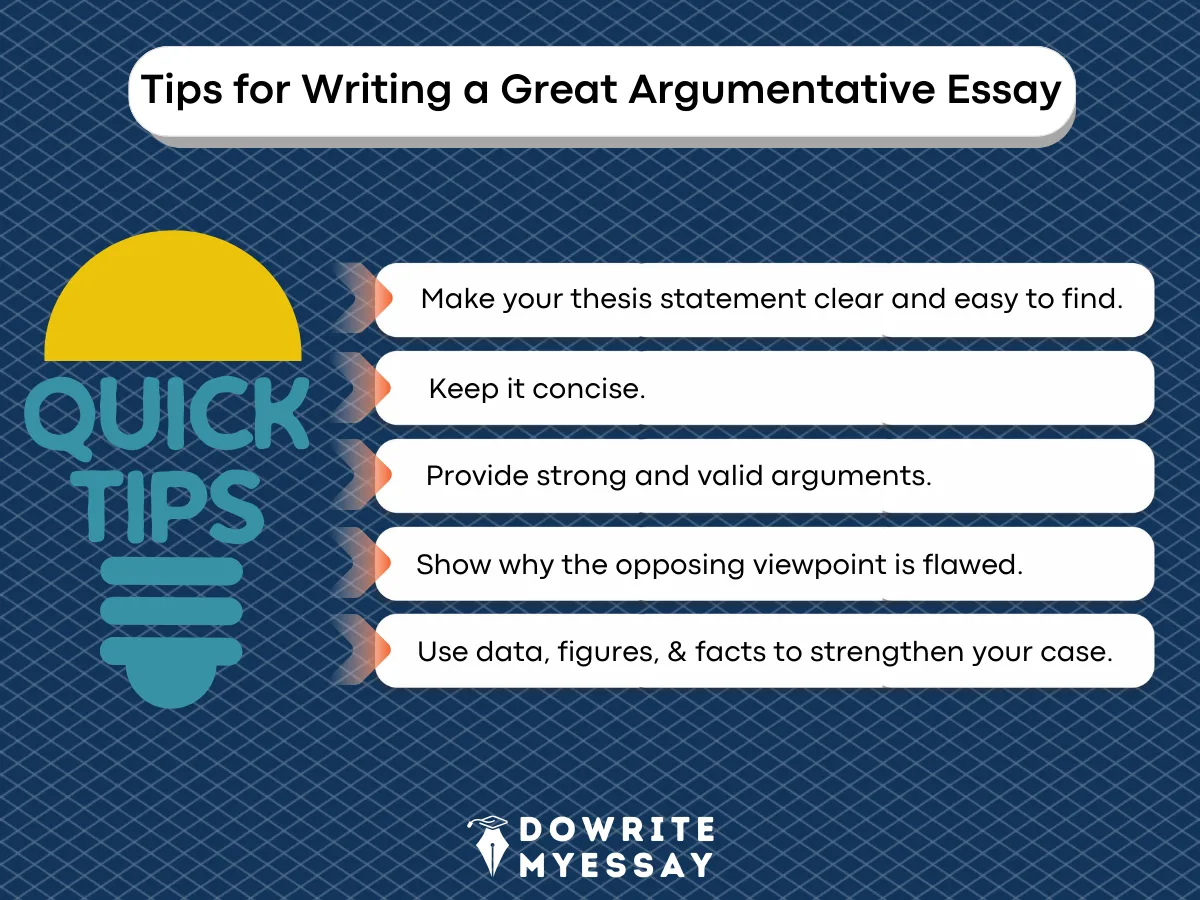
Not every argumentative essay example is equally helpful. Some examples may look polished on the surface but rely on weak evidence, vague claims, or poor reasoning. The most useful examples do more than present an opinion. They show how an argument is developed, supported, and defended from beginning to end.
When reviewing examples for an argumentative essay, focus on the quality of the reasoning rather than the topic itself. A strong example should demonstrate how each part of the essay contributes to the overall argument.
Key Elements to Look For
- A Clear Thesis Statement: The thesis should take a specific position on the issue rather than simply introducing the topic.
- Logical Supporting Claims: Each body paragraph should provide a distinct reason that supports the main argument.
- Credible Evidence: Strong examples use facts, research findings, statistics, and expert sources to support claims.
- A Fair Counterargument: Good argumentative essays acknowledge opposing viewpoints instead of ignoring them.
- An Effective Rebuttal: The writer should explain why their position remains stronger after considering the opposing side.
- A Focused Conclusion: The conclusion should reinforce the argument without introducing completely new points.
Quick Evaluation Checklist
| Element | What to Look For |
| Thesis | Clear and debatable position |
| Claims | Reasons directly support the thesis |
| Evidence | Reliable facts, studies, or examples |
| Counterargument | Opposing view is presented fairly |
| Rebuttal | Response addresses weaknesses in the opposing view |
| Conclusion | Reinforces the main argument |
The strongest argumentative essay examples combine all of these elements into a logical and easy-to-follow argument.
Once you know what makes an example effective, the next step is learning how to analyze one like an instructor or grader would.
How to Read an Argumentative Essay Example Like a Teacher
Many students read argumentative essay examples from beginning to end and focus only on the topic being discussed. Teachers read differently. Instead of concentrating on what the writer argues, they pay attention to how the argument is built. Learning to analyze examples this way can help you improve your own writing much faster.
Step 1: Identify the Thesis Statement
Start by finding the essay’s main argument. The thesis usually appears near the end of the introduction and tells readers exactly what position the writer will defend.
Ask yourself:
- What is the writer’s position?
- Is the claim specific and debatable?
- Does the rest of the essay support this claim?
Step 2: Find the Supporting Claims
Next, look at the body paragraphs. Each paragraph should provide a separate reason for supporting the thesis.
Ask yourself:
- How many main points support the argument?
- Does each paragraph focus on one idea?
- Do the claims directly connect to the thesis?
Step 3: Examine the Evidence
Strong arguments rely on evidence rather than opinion alone. Pay attention to how the writer supports each claim.
Look for:
- Statistics
- Research findings
- Expert opinions
- Real-world examples
- Academic sources
Step 4: Locate the Counterargument
A well-written argumentative essay recognizes that reasonable people may disagree.
Ask yourself:
- What opposing viewpoint is presented?
- Is it represented fairly?
- Does it strengthen the discussion?
Step 5: Evaluate the Rebuttal
The rebuttal is where the writer responds to the opposing argument.
Consider:
- Does the response directly address the counterargument?
- Is the reasoning convincing?
- Does the writer provide evidence to support the rebuttal?
Step 6: Assess the Conclusion
Finally, examine how the essay ends. Effective conclusions reinforce the argument and leave readers with a clear takeaway.
Example Analysis Framework
| Essay Component | Questions to Ask |
| Thesis | What position is being defended? |
| Claims | What reasons support the position? |
| Evidence | What proof supports each claim? |
| Counterargument | What opposing view is acknowledged? |
| Rebuttal | How is the opposing view challenged? |
| Conclusion | How is the argument reinforced? |
Using this approach turns argumentative essay examples into learning tools rather than simple reading material. Instead of only seeing what was written, you begin to understand why the argument works.
Now let’s look at a complete example and break down how these elements work together in practice.
Example 1: Beginner Argumentative Essay Example
Introduction:
Many students feel overwhelmed by the amount of homework they receive each week. While homework can reinforce lessons taught in class, excessive work often creates unnecessary stress and reduces the time available for other important activities. Students should receive less homework because it can improve their well-being, support better learning habits, and allow for a healthier balance between school and personal life.
Body Paragraph 1: Less Homework Can Reduce Stress
One reason students should have less homework is that heavy workloads can increase stress levels. Many students spend several hours each evening completing assignments from multiple classes. As deadlines pile up, they may feel pressure to finish everything quickly while still maintaining good grades. This stress can affect concentration, motivation, and overall academic performance.
Body Paragraph 2: Students Need Time for Personal Development
A reduced homework load can also give students more time to participate in activities outside the classroom. Sports, music, volunteering, and family responsibilities all contribute to personal growth. When students spend most of their free time completing assignments, they have fewer opportunities to develop practical skills and interests that are valuable beyond school.
Body Paragraph 3: Better Sleep Supports Better Learning
In addition, less homework may lead to better sleep habits. Students who stay up late to finish assignments often arrive at school tired and less prepared to learn. Adequate sleep improves focus, memory, and classroom participation. By assigning a reasonable amount of homework, schools can help students maintain healthier routines.
Counterargument + Rebuttal
Some people argue that homework is necessary because it helps students practice what they learn in class. Practice is important, but students do not need excessive amounts of homework to reinforce learning. Shorter and more meaningful assignments can provide the same educational benefits without creating unnecessary pressure.
Conclusion:
In conclusion, students should have less homework because it reduces stress, creates more time for personal development, and supports healthier sleep habits. A balanced approach to homework can help students succeed academically while maintaining their overall well-being.
Why This Example Works
Essay Snapshot
| Component | Analysis |
| Thesis Statement | Students should receive less homework because it improves well-being and balance |
| Main Claim 1 | Less homework reduces stress |
| Main Claim 2 | More time for personal development |
| Main Claim 3 | Better sleep and focus |
| Counterargument | Homework helps students practice concepts |
| Rebuttal | Smaller assignments can provide the same benefits |
| Academic Level | Beginner |
Key Lessons From This Example
- The thesis takes a clear position.
- Each body paragraph focuses on one supporting reason.
- The counterargument is acknowledged rather than ignored.
- The rebuttal directly responds to the opposing view.
- The conclusion reinforces the main argument without repeating every point word for word.
This example demonstrates the basic structure of an argumentative essay. As academic expectations increase, writers are expected to support their claims with research and properly cited evidence.
Research and citations become much more important at the high school level. The next example shows how evidence can strengthen an argument and how MLA sources are integrated into an argumentative essay.
Example 2: High School Argumentative Essay Example (MLA Format)
Introduction:
Social media has become a regular part of daily life for many teenagers. It allows young people to communicate with friends, share experiences, and access information instantly. Despite these benefits, growing evidence suggests that excessive social media use can negatively affect sleep, mental well-being, and academic performance. Because heavy social media use is associated with several risks for adolescents, teenagers should have reasonable limits on their screen time.
Body Paragraph 1: Social Media Can Affect Sleep Quality
One of the strongest arguments for limiting social media use is its effect on sleep. Many teenagers spend time scrolling through social media before bed, which often delays sleep and reduces overall rest. A study published in BMJ Open found that social media use was associated with poorer sleep quality, shorter sleep duration, and greater sleep difficulties among adolescents (Scott et al.). Sleep is essential for healthy development, concentration, and memory. When students consistently lose sleep because of late-night screen use, their ability to perform well in school can suffer.
Body Paragraph 2: Excessive Use May Impact Mental Well-Being
Heavy social media use may also affect teenagers’ emotional health. Online platforms can expose young people to unrealistic standards, social comparison, and constant pressure to remain connected. Research published in Sleep Health found links between social media engagement, disrupted sleep patterns, and poorer health outcomes among adolescents across multiple countries (Boniel-Nissim et al.). While social media is not the only factor influencing mental health, excessive use can contribute to challenges that many teenagers already face.
Body Paragraph 3: Screen Time Can Interfere With Learning
Social media can also become a distraction from academic responsibilities. Notifications, videos, and online conversations compete for students’ attention throughout the day. As a result, many teenagers find it difficult to focus on homework, studying, or classroom tasks. Even brief interruptions can reduce productivity and make schoolwork take longer to complete. Developing healthy limits on social media use can help students manage their time more effectively and stay focused on important academic goals.
Counterargument + Rebuttal
Some people argue that social media should not be limited because it helps teenagers stay connected with friends, build communities, and access educational content. These benefits are real and should not be ignored. However, encouraging reasonable limits does not mean eliminating social media altogether. Instead, it promotes balanced use that allows teenagers to enjoy the advantages of these platforms while reducing the risks associated with excessive screen time.
Conclusion:
Social media offers many benefits, but excessive use can negatively affect sleep, well-being, and academic performance. Reasonable limits can help teenagers develop healthier habits without preventing them from staying connected online. By creating a better balance between digital activities and daily responsibilities, young people can benefit from technology while protecting their overall health.
Works Cited
Boniel-Nissim, Meyran, et al. “Adolescent Use of Social Media and Associations with Sleep Patterns Across 18 European and North American Countries.” Sleep Health, vol. 9, no. 3, 2023, pp. 314–321.
https://www.sleephealthjournal.org/article/S2352-7218(23)00005-0/fulltext
Scott, Holly, et al. “Social Media Use and Adolescent Sleep Patterns.” BMJ Open, vol. 9, no. 9, 2019, e031161.
https://bmjopen.bmj.com/content/9/9/e031161
Why This Example Works
Essay Snapshot
| Component | Analysis |
| Thesis Statement | Teenagers should have reasonable limits on social media use |
| Main Claim 1 | Social media can reduce sleep quality |
| Main Claim 2 | Excessive use may affect mental well-being |
| Main Claim 3 | Screen time can interfere with learning |
| Counterargument | Social media helps teenagers stay connected and informed |
| Rebuttal | Balanced limits are more effective than unrestricted use |
| Citation Style | MLA |
| Academic Level | High School |
Citation Breakdown
MLA In-Text Citation Example
A study published in BMJ Open found that social media use was associated with poorer sleep quality, shorter sleep duration, and greater sleep difficulties among adolescents (Scott et al.).
Corresponding Works Cited Entry
Scott, Holly, et al. “Social Media Use and Adolescent Sleep Patterns and Sleep Problems.” BMJ Open, vol. 9, no. 9, 2019, e031161.
High school essays often rely on a small number of sources to support a clear position. College-level argumentative essays usually require deeper analysis, more evidence, and a stronger examination of competing viewpoints.
Example 3: College-Level Argumentative Essay Example (MLA Format)
Introduction:
Artificial intelligence is becoming increasingly common in classrooms, schools, and universities. Students use AI-powered tools for research, tutoring, writing assistance, and personalized learning, while educators use AI to automate grading and analyze student performance. Although these technologies offer significant benefits, they also raise concerns about privacy, academic integrity, and unequal access. Because AI has the potential to reshape education in ways that affect millions of students, governments should establish clear regulations to ensure that AI is used responsibly and fairly in educational settings.
Body Paragraph 1: Student Privacy Requires Strong Protection
One of the biggest concerns surrounding AI in education is the collection and use of student data. Many AI-powered learning platforms gather information about student behavior, academic performance, and online activity. Without proper checks, this data could be stored, shared, or used in ways that students and families do not fully understand. UNESCO warns that many educational technology systems collect large amounts of learner data while existing safeguards often lag behind technological development. Clear government regulations can establish standards for transparency, consent, and data protection to ensure that student information remains secure.
Body Paragraph 2: Regulation Can Help Preserve Academic Integrity
AI tools can support learning, but they can also be misused. Students can use generative AI systems to complete assignments without demonstrating their own understanding of the material. As AI-generated content becomes more sophisticated, schools and universities face growing challenges when evaluating student work. The Organisation for Economic Co-operation and Development (OECD) notes that education systems must adapt assessment practices and governance frameworks as AI becomes more widely adopted. Government regulations can encourage responsible use policies while helping institutions maintain fair academic standards.
Body Paragraph 3: Equal Access Is an Educational Concern
Another reason regulation is necessary is the issue of educational inequality. Students in well-funded schools often have greater access to advanced technologies than students in underfunded communities. If AI becomes a central part of education without appropriate supervision, existing educational gaps may widen. Governments can help reduce these disparities by supporting equitable access initiatives and ensuring that AI resources are available across different socioeconomic groups. Educational opportunities should not depend on a student’s ability to access expensive technology.
Body Paragraph 4: Regulations Can Support Responsible Innovation
Critics sometimes argue that government regulation could slow innovation and discourage technological development. They contend that educational institutions and technology companies should have the freedom to experiment with new tools without excessive restrictions. Innovation is important, but a lack of supervision can create risks for students and educators. Effective regulations do not prevent progress. Instead, they establish clear expectations that allow innovation to continue while protecting the interests of learners. Well-designed policies can create accountability without limiting beneficial advancements.
Counterargument + Rebuttal
Opponents of regulation often claim that schools and universities are capable of creating their own policies without government involvement. Educational institutions certainly play an important role in managing technology use. However, AI systems frequently operate across regions, states, and countries. Without consistent standards, students may receive very different levels of protection depending on where they study. Government regulations can provide a common framework while still allowing institutions flexibility in implementation.
Conclusion:
Artificial intelligence is creating new opportunities for education, but it also introduces significant challenges related to privacy, academic integrity, and equal access. Governments should establish clear regulations that protect students while supporting responsible innovation. Thoughtful supervision can help ensure that AI strengthens educational outcomes without creating unnecessary risks for learners and institutions.
Works Cited
Organisation for Economic Co-operation and Development. Digital Education Outlook 2023: Towards an Effective Digital Education Ecosystem. , OECD Publishing, 2023. https://www.oecd.org/education/digital-education-outlook/
UNESCO Guidance for Generative AI in Education and ResearchUNESCO, 2023. https://unesdoc.unesco.org/ark:/48223/pf0000386693
Why This Example Works
Essay Snapshot
| Component | Analysis |
| Thesis Statement | Governments should regulate AI use in education |
| Main Claim 1 | Student privacy needs protection |
| Main Claim 2 | Regulation supports academic integrity |
| Main Claim 3 | Regulation can reduce educational inequality |
| Main Claim 4 | supervision can coexist with innovation |
| Counterargument | Schools can regulate AI independently |
| Rebuttal | Consistent standards require broader governance |
| Citation Style | MLA |
| Academic Level | College |
Citation Breakdown
MLA In-Text Citation Example
UNESCO warns that many educational technology systems collect large amounts of learner data while existing safeguards often lag behind technological development (UNESCO).
Corresponding Works Cited Entry
UNESCO. Guidance for Generative AI in Education and Research. UNESCO, 2023.
College essays often use MLA formatting, particularly in humanities courses. However, many social science and education courses require APA style, which uses a different citation system and reference format. The next example demonstrates how an APA argumentative essay is structured.
Example 4: APA Format Argumentative Essay Example
Abstract:
Financial literacy is an essential skill that affects everyday decision-making. Despite its importance, many students graduate without understanding budgeting, credit, loans, taxes, or long-term financial planning. This essay argues that financial literacy should be a required high school subject because it prepares students for adult responsibilities, helps reduce financial mistakes, and contributes to long-term economic well-being.
Introduction:
High school students spend years studying mathematics, science, history, and literature, yet many leave school without the financial knowledge needed to manage everyday responsibilities. As young adults enter college, the workforce, or independent living, they are expected to make decisions involving credit cards, loans, savings, and budgeting. Without proper financial education, many struggle to navigate these challenges. Financial literacy should be a required high school subject because it equips students with practical skills that support lifelong financial stability.
Body Paragraph 1: Financial Literacy Prepares Students for Real-World Decisions
One of the strongest arguments for financial literacy education is its practical value. Students regularly encounter financial decisions shortly after graduation, whether they are opening bank accounts, managing income, or evaluating borrowing options. According to the OECD (2023), financial knowledge is strongly connected to better financial behaviors and decision-making. Students who understand basic financial concepts are often better prepared to manage money responsibly and avoid costly mistakes.
Body Paragraph 2: Financial Education Can Help Reduce Debt Problems
Many young adults accumulate debt without fully understanding interest rates, repayment schedules, or borrowing risks. Student loans, credit cards, and consumer financing options can create long-term financial obligations. Research from the National Financial Educators Council (2023) indicates that limited financial knowledge continues to contribute to costly financial mistakes among young adults. Providing financial education before students face these decisions can help them make more informed choices and reduce avoidable debt.
Body Paragraph 3: Financial Literacy Benefits Society as a Whole
Financial literacy does not only benefit individuals. Communities and economies also benefit when citizens make informed financial decisions. People who understand budgeting, saving, and investing are more likely to build financial security and prepare for future challenges. Financial education can support stronger economic participation and reduce dependence on emergency financial assistance. Teaching these skills during high school helps establish habits that can continue throughout adulthood.
Counterargument + Rebuttal
Some critics argue that financial literacy should be taught at home rather than in schools. Families certainly play an important role in teaching financial responsibility. However, not all students have access to the same level of financial guidance outside the classroom. Schools provide an opportunity to ensure that every student receives consistent instruction on essential financial concepts. Relying solely on parents can leave many students without the knowledge they need to make informed financial decisions.
Conclusion:
Financial literacy is a practical skill that affects nearly every aspect of adult life. Requiring financial literacy courses in high school can prepare students for real-world decisions, reduce costly financial mistakes, and support long-term economic stability. By providing students with a foundation in personal finance, schools can help them enter adulthood with greater confidence and financial awareness.
References
National Financial Educators Council. (2023). Financial literacy statistics.
https://www.financialeducatorscouncil.org/financial-literacy-statistics/
Organisation for Economic Co-operation and Development. (2023). OECD/INFE 2023 international survey of adult financial literacy.
https://www.oecd.org/en/networks/infe.html
Why This Example Works
Essay Snapshot
| Component | Analysis |
| Thesis Statement | Financial literacy should be required in high school |
| Main Claim 1 | Prepares students for financial decisions |
| Main Claim 2 | Helps reduce costly debt mistakes |
| Main Claim 3 | Supports broader economic well-being |
| Counterargument | Financial education should be taught at home |
| Rebuttal | Schools provide consistent access for all students |
| Citation Style | APA |
| Academic Level | College / Early University |
Citation Breakdown
APA In-Text Citation Example
Financial knowledge is strongly connected to better financial behaviors and decision-making (OECD, 2023).
Corresponding Reference Entry
Organisation for Economic Co-operation and Development. (2023). OECD/INFE 2023 international survey of adult financial literacy.
The examples so far have focused on academic levels and citation styles. Argumentative essays can also be organized using different argument models, each designed to persuade readers in a different way.
Example 5: Toulmin Argument Example (APA Format)
The Toulmin Model helps writers develop stronger arguments by connecting claims to evidence and reasoning. It uses elements such as a claim, grounds, warrant, backing, and rebuttal to create a balanced and persuasive argument. The following example shows how this structure works in practice.
Introduction:
The rapid growth of generative artificial intelligence has created new challenges for colleges and universities. Students can now use AI tools to generate essays, discussion posts, and other assignments within minutes. While these technologies can support learning when used responsibly, they have also raised concerns about academic integrity. Colleges should use AI detection software as part of a broader academic integrity strategy because it can help identify potential misuse, support fair assessment practices, and encourage responsible use of AI tools.
Claim:
Colleges should use AI detection software to help maintain academic integrity.
Grounds (Evidence):
Generative AI tools have become widely available and are increasingly used in educational settings. UNESCO (2023) notes that educational institutions must develop policies and safeguards to address the growing influence of generative AI in teaching and learning. As AI-generated content becomes more common, instructors need tools that can help identify assignments that may require additional review.
Warrant:
If colleges are responsible for ensuring that grades reflect student learning, they need systems that help instructors evaluate whether submitted work represents a student’s own effort.
Backing:
The International Center for Academic Integrity (2021) emphasizes the importance of honesty, trust, fairness, responsibility, respect, and courage in academic communities. AI detection software can support these principles by providing instructors with additional information when evaluating student work. Although detection tools are not perfect, they can contribute to a broader framework designed to protect academic standards.
Counterargument + Rebuttal:
Critics argue that AI detection software can produce false positives and incorrectly identify human-written work as AI-generated. This concern is valid because no detection system can guarantee complete accuracy. However, colleges should not use AI detection results as definitive proof of misconduct. Instead, detection reports should serve as one piece of evidence that is considered alongside instructor judgment, student explanations, writing history, and institutional policies. When used this way, AI detection software can support academic integrity without becoming the sole basis for disciplinary decisions.
Conclusion:
Artificial intelligence is changing how students learn and complete academic work. While AI detection software cannot solve every academic integrity challenge, it can help colleges respond to emerging risks when used responsibly. Combined with clear policies, instructor supervision, and fair review procedures, AI detection tools can support honest learning environments while allowing students to benefit from new technologies.
References
International Center for Academic Integrity. (2021). The Fundamental Values of Academic Integrity (3rd ed.).
https://academicintegrity.org/aws/ICAI/pt/sp/fundamental
UNESCO. (2023). Guidance for Generative AI in Education and Research.
https://www.unesco.org/en/articles/guidance-generative-ai-education-and-research
Why This Example Works
Essay Snapshot
| Component | Analysis |
| Claim | Colleges should use AI detection software |
| Grounds | Growing use of generative AI in education |
| Warrant | Assessment systems require safeguards to verify learning |
| Backing | Academic integrity principles support accountability |
| Counterargument | Detection tools can produce false positives |
| Rebuttal | Detection reports should be used alongside human judgment |
| Argument Type | Toulmin |
| Citation Style | APA |
| Academic Level | College |
Toulmin Structure Breakdown
| Toulmin Element | Example |
| Claim | Colleges should use AI detection software |
| Grounds | AI use is increasing in academic settings |
| Warrant | Institutions need tools that support fair assessment |
| Backing | Academic integrity frameworks emphasize accountability |
| Rebuttal | Human review should accompany detection results |
The Toulmin model focuses on evidence and logical support for a claim. The Rogerian model takes a different approach by examining both sides of an issue before working toward a balanced solution.
Example 6: Rogerian Argument Example (MLA Format)
The Rogerian argument model emphasizes mutual understanding. Instead of criticising opposing views, writers acknowledge the strengths of different perspectives and work toward a solution that addresses shared concerns. The example below shows how this approach can be applied in an argumentative essay.
Introduction:
Remote learning became a major part of higher education during the COVID-19 pandemic and continues to influence how colleges and universities deliver instruction. Supporters argue that online courses provide flexibility and improve access to education, while critics believe that traditional classrooms offer stronger engagement and learning experiences. Rather than viewing these approaches as competing systems, universities should continue offering remote learning as an option while maintaining in-person instruction to meet the needs of different students.
Body Paragraph 1: The Case for Remote Learning
Supporters of remote learning believe it makes higher education more accessible. Students who work full-time jobs, care for family members, live far from campus, or face health-related challenges often benefit from flexible course options. Research published in Heliyon found that online education can improve access to learning opportunities by removing many geographic and scheduling barriers that students face (Fernández-Batanero et al.). For many learners, remote education creates opportunities that may not otherwise be available.
Body Paragraph 2: The Case for In-Person Learning
Advocates of traditional classroom instruction argue that face-to-face learning offers benefits that are difficult to replicate online. Classroom discussions, direct interaction with instructors, and opportunities for collaboration can strengthen student engagement. Many students also find it easier to remain focused in structured learning environments. Critics of remote learning point out that online courses may sometimes reduce participation and create feelings of isolation among students.
Body Paragraph 3: Finding Common Ground
Although supporters of each approach emphasize different advantages, both groups share the same objective: helping students succeed academically. Remote learning increases flexibility and access, while classroom instruction can improve engagement and interpersonal interaction. These goals do not have to conflict. Universities can support student success by providing multiple learning formats that accommodate different circumstances, learning preferences, and educational goals.
Counterargument + Rebuttal
Some university administrators argue that maintaining both online and in-person options requires additional resources, staffing, and technology investments. This concern is reasonable because supporting multiple delivery methods can increase institutional costs. However, many colleges have already developed online learning systems and digital infrastructure over the past several years. Continuing to offer remote learning options allows institutions to build on these investments while serving a broader and more diverse student population.
Conclusion:
The debate over remote learning should not be framed as a choice between online and classroom education. Both approaches provide meaningful benefits and address different student needs. By maintaining remote learning as an option while preserving traditional instruction, universities can expand access to education without sacrificing valuable in-person learning experiences.
Works Cited
Fernández-Batanero, José María, et al. “Online Education in Higher Education: Emerging Solutions in Crisis Situations.” Heliyon, vol. 8, no. 8, 2022, e10139.
https://pmc.ncbi.nlm.nih.gov/articles/PMC9364665/
Why This Example Works
Essay Snapshot
| Component | Analysis |
| Position A | Remote learning improves flexibility and access |
| Position B | In-person learning strengthens engagement and interaction |
| Common Ground | Both approaches aim to improve student success |
| Proposed Solution | Maintain both online and classroom learning options |
| Counterargument | Dual learning models require additional resources |
| Rebuttal | Existing digital infrastructure can support both formats |
| Argument Type | Rogerian |
| Citation Style | MLA |
| Academic Level | College |
Rogerian Structure Breakdown
| Rogerian Element | Example |
| Side One | Benefits of remote learning |
| Side Two | Benefits of classroom instruction |
| Shared Goal | Better educational outcomes for students |
| Balanced Solution | Offer multiple learning formats |
| Outcome | Increased flexibility without eliminating in-person learning |
Within debates like this, many students find it easier to build balanced arguments when they begin with carefully selected topics for argumentative essays that offer multiple perspectives rather than issues that naturally favor one side.
Not every argumentative essay example is equally effective. Sometimes the difference between a weak and strong argument comes down to the thesis, evidence, or reasoning. Comparing both side by side makes those differences easier to identify.
Example 7: Weak vs Strong Argumentative Essay Example
Topic: Should School Uniforms Be Mandatory?
Many students struggle with argumentative essays because they understand the topic but fail to build a strong argument. The difference often comes down to how clearly the thesis is written, how evidence is used, and how opposing viewpoints are addressed.
Introduction:
School uniforms are good for students. Many schools require students to wear uniforms, and this can be helpful. Students should wear uniforms because they are good.
Body Paragraph:
School uniforms are good because many schools use them. Students wear them every day, and they help schools look organized. Uniforms are common in many countries and schools.
Counterargument + Rebuttal:
Some people do not like school uniforms because they think students should choose their own clothes. However, they are wrong because uniforms are better.
Conclusion:
In conclusion, school uniforms are good for students. Schools should continue using them because they help students and make schools look better.
Introduction:
School uniforms remain a topic of debate in many educational systems. Supporters believe uniforms create a more focused learning environment, while critics argue that they restrict personal freedom. School uniforms should be mandatory because they reduce distractions, promote equality among students, and help create a more productive academic atmosphere.
Body Paragraph:
One of the main benefits of school uniforms is their ability to reduce visible economic differences among students. In schools without uniforms, students may feel pressure to wear expensive clothing or follow fashion trends to fit in with their peers. Uniform policies help minimize these comparisons by creating a more consistent appearance among students. As a result, students are often able to focus more on learning and less on social competition based on clothing.
Counterargument + Rebuttal:
Opponents argue that school uniforms limit students’ ability to express themselves through personal style. They believe that choosing clothing is an important form of individuality. While self-expression is valuable, students can still demonstrate their personalities through academic achievements, extracurricular activities, hobbies, and personal interests. The educational benefits of reduced distractions and increased equality may outweigh the limitations placed on clothing choices.
Conclusion:
In conclusion, mandatory school uniforms can contribute to a more focused and inclusive learning environment. By reducing social pressures related to appearance and encouraging greater attention to academics, uniforms provide benefits that support student success. Although concerns about self-expression deserve consideration, the advantages of school uniforms make them a reasonable policy for many schools.
Side-by-Side Comparison
| Essay Element | Weak Example | Strong Example |
| Introduction | Introduces the topic with a basic opinion and little context. | Establishes the debate, provides context, and leads naturally to a clear argument. |
| Thesis Statement | Lacks direction and does not explain the writer’s reasoning. | Takes a clear position and previews the main points that support the argument. |
| Body Paragraph | Relies on general statements and unsupported claims. | Develops a specific point using logical reasoning and explanation. |
| Use of Evidence | Provides little support for the argument. | Uses relevant reasoning and examples to strengthen the claim. |
| Counterargument | Dismisses opposing views without consideration. | Acknowledges opposing perspectives fairly and accurately. |
| Rebuttal | Respond with opinion rather than analysis. | Refutes the opposing view using logic and supporting reasoning. |
| Conclusion | Simply repeat the original opinion. | Reinforces the argument and summarizes the key reasons supporting it. |
| Tone & Credibility | Sounds subjective and less convincing. | Appears balanced, thoughtful, and more trustworthy. |
| Overall Persuasiveness | Struggles to convince the reader. | Presents a stronger and more convincing argument. |
What Students Can Learn From This Comparison
Strong argumentative essays do more than express opinions. They explain why a position is reasonable, support claims with evidence, and respond thoughtfully to opposing viewpoints. When reviewing argumentative essay examples, pay close attention to how successful writers develop and defend their arguments rather than focusing only on the final conclusion.
The examples so far have focused on common academic situations. At the university level, argumentative essays often become more complex and require students to evaluate ethical, social, and policy-related issues using multiple sources and perspectives.
Example 8: Advanced University-Level Argumentative Essay Example (APA Format)
Abstract:
As social media becomes a larger part of daily life, some universities have explored whether publicly available online content should be considered during admissions reviews. Supporters argue that social media can provide additional insight into applicants’ behavior and character, while critics raise concerns about privacy, bias, and fairness. This essay argues that universities should not use social media activity as a formal factor in admissions decisions because it creates ethical concerns, increases the risk of bias, and provides an incomplete picture of applicants.
Introduction:
University admissions decisions are traditionally based on academic achievement, extracurricular involvement, essays, recommendations, and other application materials. However, the widespread use of social media has led some institutions to consider whether applicants’ online activity should play a role in the admissions process. While publicly available content may seem like a useful source of information, incorporating social media into admissions reviews raises significant concerns. Universities should not consider social media activity as a formal admissions factor because it threatens fairness, creates opportunities for bias, and often fails to accurately represent applicants.
Body Paragraph 1: Social Media Reviews Can Introduce Bias
One of the strongest arguments against using social media in admissions is the potential for bias. Admissions officers may be exposed to information about an applicant’s personal background, political opinions, religious beliefs, or socioeconomic circumstances while reviewing online profiles. According to the National Association for College Admission Counseling (NACAC), admissions processes should focus on equitable evaluation practices that minimize bias and ensure fair treatment of applicants. Social media reviews may unintentionally influence decisions based on factors unrelated to academic potential.
Body Paragraph 2: Online Profiles Provide Incomplete Information
Social media content rarely presents a complete picture of an individual. Posts may be taken out of context, reflect immature behavior from earlier years, or fail to represent a person’s current character. Applicants also use social media differently. Some maintain highly active public accounts, while others rarely post or keep their profiles private. As a result, universities may have access to vastly different amounts of information about different applicants, creating inconsistencies in the evaluation process.
Body Paragraph 3: Privacy Concerns Remain Significant
Although much social media content is publicly available, applicants may not expect universities to review their online activity during admissions evaluations. The practice raises ethical questions about transparency and informed consent. Students should understand exactly what information is being considered and how it may affect admissions outcomes. Without clear standards, social media reviews may undermine trust in the admissions process.
Counterargument + Rebuttal
Supporters of social media reviews argue that universities have a responsibility to identify behavior that could threaten campus safety or violate institutional values. They believe public online activity may reveal information that is not included elsewhere in an application. While universities have legitimate safety concerns, isolated reviews of social media profiles are unlikely to provide a reliable basis for admissions decisions. More structured evaluation methods and established disciplinary records offer a more consistent and equitable approach to assessing applicants.
Conclusion:
Universities should focus admissions decisions on factors that directly relate to academic readiness, achievement, and potential. While social media activity may occasionally provide additional context, it also introduces concerns related to bias, privacy, and inconsistent evaluation. Excluding social media from formal admissions reviews helps preserve fairness and supports a more transparent admissions process.
References
National Association for College Admission Counseling. (2023). Toward a more equitable future for postsecondary access.
https://www.nacacnet.org
Why This Example Works
Essay Snapshot
| Component | Analysis |
| Thesis Statement | Universities should not use social media as a formal admissions factor |
| Main Claim 1 | Social media reviews can introduce bias |
| Main Claim 2 | Online profiles provide incomplete information |
| Main Claim 3 | Privacy concerns remain significant |
| Counterargument | Social media may reveal important behavioral information |
| Rebuttal | More reliable evaluation methods already exist |
| Citation Style | APA |
| Academic Level | Advanced University |
Citation Breakdown
APA In-Text Citation Example
Admissions processes should focus on equitable evaluation practices that minimize bias and ensure fair treatment of applicants (NACAC, 2023).
Corresponding Reference Entry
National Association for College Admission Counseling. (2023). Toward a more equitable future for postsecondary access.
After reviewing several argumentative essay examples, certain patterns begin to emerge. Strong essays tend to avoid the same common mistakes that frequently weaken otherwise promising arguments.
Common Mistakes Students Notice in Weak Argumentative Essays
After reviewing different argumentative essay examples, it becomes easier to recognize the problems that weaken an argument. Many students understand the topic they are writing about but struggle to present their ideas in a convincing and organized way. The following mistakes appear frequently in weak argumentative essays and can significantly reduce their effectiveness.
Thesis Statement Is Too Broad
A common problem is writing a thesis that is too vague or general.
Weak Thesis Statement Example
Technology is important in education.
Better Thesis Statement Example
Technology should be integrated into classrooms because it improves access to learning resources, supports personalized instruction, and helps students develop digital skills.
The stronger thesis takes a clear position and identifies specific points that will be discussed throughout the essay.
Claims Are Not Supported With Evidence
Arguments become much less persuasive when they rely entirely on personal opinions.
Weak Example
Students learn better online because many people like online classes.
Better Example
Students may benefit from online learning because it provides flexibility and increased access to educational resources, particularly for learners with work or family responsibilities.
Strong argumentative essays support claims with research, examples, statistics, or credible sources whenever possible.
Counterarguments Are Ignored
Some writers avoid discussing opposing viewpoints because they believe doing so weakens their position.
Weak Approach
Presenting only one side of the issue.
Better Approach
Acknowledging opposing arguments and responding to them with evidence and reasoning.
Addressing counterarguments often strengthens credibility because it demonstrates a deeper understanding of the issue.
Rebuttals Are Based on Emotion Instead of Logic
A rebuttal should explain why the opposing argument is less convincing, not simply dismiss it.
Weak Rebuttal
Anyone who disagrees is wrong.
Better Rebuttal
While this concern is understandable, available evidence suggests that the proposed solution addresses many of the issues raised by critics.
Logical responses are more persuasive than emotional reactions.
Conclusions Introduce New Arguments
Another common mistake is introducing completely new points in the final paragraph.
Weak Conclusion
Introducing a new claim that was never discussed in the body paragraphs.
Better Conclusion
Summarizing the main argument and reinforcing the thesis using points already covered in the essay.
The conclusion should bring the discussion together rather than expand it.
Quick Comparison
| Common Mistake | Better Approach |
| Broad thesis | Specific and debatable thesis |
| Opinion without evidence | Evidence-supported claims |
| Ignoring opposing views | Addressing counterarguments |
| Emotional rebuttal | Logical rebuttal |
| New ideas in conclusion | Reinforce existing argument |
Recognizing these mistakes can help students evaluate argumentative essay examples more effectively and avoid common weaknesses in their own writing.
Reading argumentative essay examples is helpful, but students gain the most value when they actively analyze the techniques being used rather than focusing only on the topic itself.
How to Learn From Argumentative Essay Examples Without Copying Them
The purpose of studying argumentative essay examples is to understand how effective arguments are constructed, not to reuse someone else’s ideas or wording. The most successful students use examples as learning tools that help them improve their own writing process.
Study the Structure Before the Content
When reviewing an example, start by looking at how the essay is organized.
Ask yourself:
- How does the introduction lead into the thesis?
- How are the body paragraphs arranged?
- Where does the counterargument appear?
- How does the conclusion reinforce the argument?
Understanding the structure helps you apply the same organizational principles to different topics.
Analyze How the Argument Develops
Pay attention to how the writer moves from one idea to the next.
Consider:
- How are claims introduced?
- What evidence supports each claim?
- How does the writer connect evidence to the argument?
- How are opposing viewpoints addressed?
Strong argumentative essays build ideas logically rather than simply listing opinions.
Observe How Sources Are Used
Examples can also teach valuable lessons about research and citations.
Notice:
- How evidence is introduced
- How in-text citations are incorporated
- How sources support claims
- How references are formatted
This is especially useful when learning MLA and APA citation styles.
Examine Counterarguments and Rebuttals
Many students focus only on supporting their own position. However, some of the strongest arguments come from acknowledging and responding to opposing viewpoints.
When reading examples, evaluate:
- Whether the counterargument is represented fairly
- How the rebuttal responds to the opposing claim
- Whether the response relies on logic and evidence
This can help you develop more balanced and persuasive arguments.
Apply the Techniques to Your Own Topic
The goal is not to reproduce an example but to adapt its techniques to a different subject. A strong argumentative essay example can show you how to develop a thesis, organize evidence, and address counterarguments regardless of the topic you choose.
Developing a strong argument requires more than simply presenting an opinion. It involves research, evidence evaluation, and structured reasoning to meet academic standards. While argumentative essay examples help students understand effective organization and argument flow, applying these techniques in a full-length assignment still requires time and focused effort.
In practice, students often manage multiple deadlines at once, making it difficult to complete every task thoroughly. When time is limited and submission dates are approaching, some students look for a faster way to ensure their work is completed on schedule.
In such cases, they may choose to buy an essay online tailored to their instructions, topic, and academic requirements. This helps them to get a fully written, original essay delivered within the required timeframe, ensuring the work is ready for submission and aligned with given guidelines.
Key Takeaway
The best way to use argumentative essay examples is to study the decisions made by the writer. Instead of asking, “What did this person write?” ask, “Why did this argument work?” That shift in perspective can help you become a stronger and more confident writer.
Whether you’re studying a beginner sample or a university-level paper, the most valuable lessons come from understanding the reasoning, structure, and evidence behind a successful argument.
Conclusion: What Strong Argumentative Essay Examples Teach You
Argumentative essay examples do much more than show what a finished paper looks like. They reveal how effective writers develop a clear thesis, support their claims with evidence, address opposing viewpoints, and guide readers toward a logical conclusion. By studying examples carefully, students can better understand the techniques that make arguments persuasive and academically credible.
The examples in this guide demonstrate that strong argumentative writing is not about having the strongest opinion. It is about presenting a position clearly, supporting it with reasoning and evidence, and responding thoughtfully to alternative perspectives. Whether you are writing a high school assignment, a college paper, or a university-level essay, these principles remain the foundation of effective argumentation.
Instead of treating argumentative essay examples as templates to copy, use them as learning tools. Focus on the structure, evidence, and decision-making behind each example, then apply those lessons to your own topic and assignment requirements. Doing so will help you develop stronger arguments and become a more confident academic writer.
FAQs For Argumentative Essay Example
Find answers to the most common questions about argumentative essay examples.