
Key Takeaways (TL;DR)
- A persuasive essay aims to convince readers to agree with a specific position.
- It includes a clear, debatable thesis statement.
- Arguments must be supported with credible evidence.
- Addressing counterarguments strengthens credibility.
- Effective essays balance logic, emotion, and credibility.
- Clear structure and academic tone are essential.
- Revision improves clarity, coherence, and persuasive strength.
A persuasive essay is a type of academic writing that aims to convince readers to accept a specific viewpoint or take action. It presents a clear and debatable thesis statement, supports that position with logical evidence, and addresses opposing arguments thoughtfully. Strong persuasive essays use a balanced combination of credibility (ethos), logic (logos), and emotional appeal (pathos) to influence the audience.
In schools and colleges, persuasive essays help students develop critical thinking, structured reasoning, research skills, and effective communication. Unlike casual opinion writing, persuasive essays require credible evidence, organized arguments, and careful analysis to support every major claim.
This guide explains what a persuasive essay is, how it is structured, what elements make it strong, and how to write one effectively. For students who need structured academic support or professionally developed arguments, a persuasive essay writing service can help demonstrate how strong evidence, reasoning, and structure come together in a well-written persuasive essay.

What Is a Persuasive Essay?
A persuasive essay is a structured piece of academic writing in which the writer takes a clear position on an issue and defends it using evidence, reasoning, and persuasive techniques.
The goal is not simply to express a personal opinion. Instead, the writer must present logical arguments, support them with reliable sources, and respond to opposing viewpoints. Each paragraph should connect directly to the thesis and help strengthen the overall argument.
Persuasive essays are commonly assigned at the middle school, high school, and college levels because they teach students how to analyze issues, evaluate evidence, and communicate ideas in a clear and convincing way.
What Is the Purpose of a Persuasive Essay?
The primary purpose of a persuasive essay is to influence the reader’s beliefs, attitudes, or actions through structured reasoning and credible evidence. The writer takes a clear position and supports it with logical arguments while responding thoughtfully to opposing viewpoints.
A persuasive essay goes beyond personal opinion. It requires the writer to present a reasoned argument, organize ideas clearly, and guide the reader toward a conclusion based on evidence rather than emotion alone.
Academic Purpose
In school and college settings, persuasive essays are assigned to help students:
- Develop critical thinking skills
- Practice logical reasoning
- Support claims with credible evidence
- Conduct research and use proper citations
- Analyze and respond to opposing viewpoints
Instructors typically evaluate persuasive essays based on:
- Clarity and strength of the thesis statement
- Quality and relevance of supporting evidence
- Logical organization and paragraph structure
- Effective handling of counterarguments
- Academic tone, clarity, and coherence
A strong persuasive essay demonstrates the writer’s ability to build a structured argument, support ideas with evidence, and maintain logical consistency throughout the essay.
Why Persuasion Matters Beyond the Classroom
Persuasive writing is widely used outside academic settings. It appears in speeches, editorials, policy proposals, marketing campaigns, and professional communication. These real-world applications explain why many students explore reliable essay writing service platforms to better understand structured argumentation and academic writing standards.
Learning how to persuade effectively helps individuals present ideas clearly, defend their positions responsibly, and communicate with confidence in real-world situations.
What Are the Characteristics of a Strong Persuasive Essay?
A strong persuasive essay is not defined only by its structure. It is defined by how effectively it convinces the reader. Certain characteristics make a persuasive essay clear, logical, and convincing.
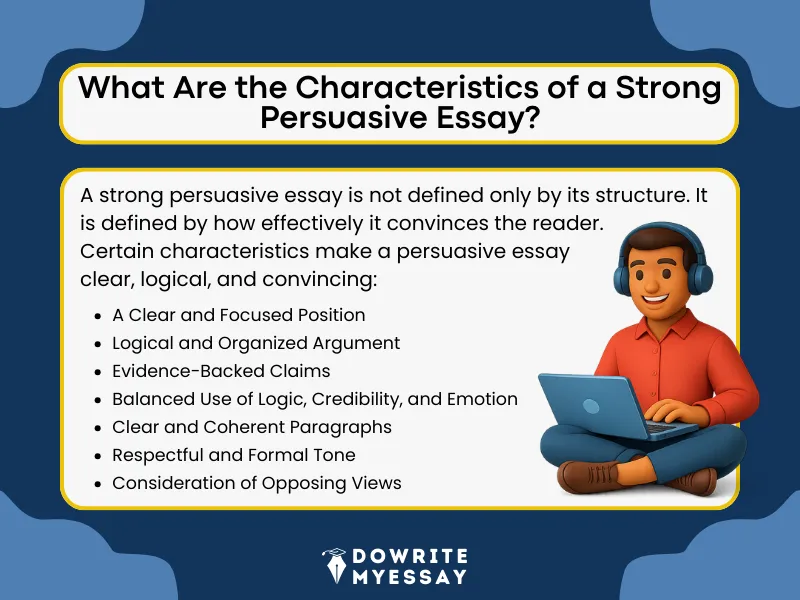
Below are the key qualities that distinguish a strong persuasive essay from a weak one.
1. A Clear and Focused Position
A strong persuasive essay takes a definite stance on an issue. The position is specific and clearly stated in the thesis.
Weak essays often present vague or overly broad claims. Strong essays clearly state what they support and why.
Clarity in position helps readers understand the argument from the beginning.
2. Logical and Organized Argument
Effective persuasive essays follow a logical order. Ideas are presented step by step, and each paragraph builds on the previous one.
Arguments should not feel random or disconnected. A strong essay guides the reader through the reasoning process smoothly.
Clear organization improves readability and strengthens persuasion.
3. Evidence-Backed Claims
Strong persuasive writing relies on credible evidence. Every major claim should be supported by:
- Research findings
- Statistics
- Expert opinions
- Real-world examples
Unsupported statements weaken credibility. Reliable evidence strengthens the argument and builds trust.
4. Balanced Use of Logic, Credibility, and Emotion
Effective persuasive essays balance:
- Logical reasoning
- Credible sources
- Appropriate emotional appeal
Too much emotion can make an argument seem biased. Too much data without explanation can confuse readers. Balance creates stronger persuasion.
5. Clear and Coherent Paragraphs
Each paragraph should focus on one main idea. It should include a clear topic sentence, supporting evidence, and explanation.
Smooth transitions between paragraphs improve coherence. When ideas flow naturally, the argument becomes easier to follow.
6. Respectful and Formal Tone
Strong persuasive essays maintain a respectful tone. They avoid insults, exaggeration, and emotional attacks.
Even when disagreeing with opposing views, the writer remains professional and focused on reasoning rather than emotion.
A respectful tone increases credibility and makes the argument more persuasive.
7. Consideration of Opposing Views
A persuasive essay becomes stronger when it acknowledges alternative viewpoints.
Recognizing counterarguments shows that the writer understands the complexity of the issue. Responding to those arguments thoughtfully strengthens the overall position.
A strong persuasive essay combines clarity, logic, evidence, structure, and credibility. When these characteristics work together, the essay becomes convincing and academically sound.
What Are the Core Elements of a Persuasive Essay?
A persuasive essay is built from specific components that work together to create a convincing argument. These elements form the foundation of the essay. Without them, the argument may feel incomplete or weak.
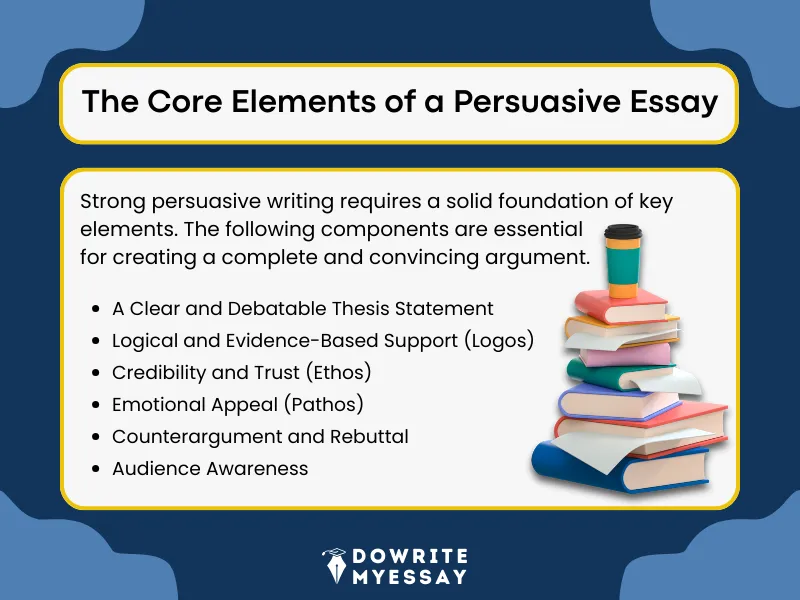
Below are the essential elements of a persuasive essay.
1. A Clear and Debatable Thesis Statement
The thesis statement is the central claim of the essay. It clearly states the writer’s position on the issue.
A strong thesis should:
- Take a clear stance
- Be specific and focused
- Be open to disagreement
- Guide the entire essay
For example, saying “Climate change is important” is too general.
A stronger thesis would be: “Governments should invest more in renewable energy to reduce the long-term economic and environmental costs of climate change.”
The thesis acts as the foundation. Every argument in the essay must connect back to it.
2. Logical and Evidence-Based Support (Logos)
Persuasive essays rely heavily on logic. This logical appeal is known as logos.
To strengthen an argument, writers use:
- Research findings
- Statistics
- Expert opinions
- Real-world examples
- Cause-and-effect reasoning
Strong evidence increases credibility and makes the argument harder to dismiss. Academic persuasive writing requires reliable sources rather than unsupported opinions.
Each body paragraph should include one main reason supported by clear evidence.
3. Credibility and Trust (Ethos)
Ethos refers to the writer’s credibility.
Writers build credibility by:
- Using trustworthy and relevant sources
- Citing information correctly
- Maintaining a professional tone
- Avoiding exaggeration
When readers trust the writer, they are more likely to accept the argument. In academic settings, credibility is especially important.
4. Emotional Appeal (Pathos)
Pathos involves appealing to the reader’s emotions.
Emotional appeal may include:
- Real-life examples
- Human impact stories
- Ethical concerns
- Descriptions of consequences
However, emotion should support logical reasoning, not replace it. Overusing emotional language can make an essay seem biased or manipulative.
Balanced use of emotion strengthens persuasion.
5. Counterargument and Rebuttal
A strong persuasive essay recognizes opposing viewpoints.
Including a counterargument shows fairness and critical thinking. After presenting the opposing view, the writer must provide a rebuttal that explains why their position remains stronger.
This element increases the essay’s logical depth and credibility.
6. Audience Awareness
Effective persuasion depends on understanding the audience.
Writers should consider:
- What the audience believes
- What objections they may raise
- What type of evidence will influence them
Adjusting tone and evidence to match the audience makes the argument more persuasive.
These core elements work together to create a persuasive essay that is logical, credible, and convincing. When each element is developed carefully, the essay becomes stronger and more effective.
What Is the Structure of a Persuasive Essay?
A persuasive essay follows a clear and organized structure. Strong organization helps the reader understand the argument step by step. When ideas are arranged logically, the essay becomes easier to follow and more convincing.

Most persuasive essays follow a three-part structure:
- Introduction
- Body Paragraphs
- Conclusion
Each part serves a specific purpose.
1. Introduction
The introduction presents the topic and establishes the writer’s position.
It typically includes:
- A brief introduction to the issue
- Necessary background information
- A clear thesis statement
The introduction should prepare the reader for the argument without going into too much detail. Its main role is to introduce the topic and clearly state the central claim.
2. Body Paragraphs
The body paragraphs develop the argument.
Each body paragraph should focus on one main supporting point. A well-structured paragraph generally includes:
- A topic sentence
- Supporting evidence
- Explanation of how the evidence supports the thesis
- A transition to the next idea
Arguments should be arranged logically. Some writers present weaker points first and stronger points later to build momentum. Others organize by importance or cause and effect. The key is consistency and clarity.
Many persuasive essays also include a paragraph that addresses a counterargument. This strengthens the essay by showing balance and critical thinking.
3. Conclusion
The conclusion reinforces the argument.
It typically:
- Restates the thesis in different words
- Summarizes the key supporting points
- Leaves the reader with a final thought or call to action
The conclusion should not introduce new arguments. Its purpose is to strengthen the impact of what has already been presented.
Typical Length and Paragraph Distribution
The length of a persuasive essay depends on the academic level and assignment requirements.
A common format includes:
- 5 paragraphs (introduction, three body paragraphs, conclusion)
- 5–7 paragraphs for more developed arguments
- Longer essays for college-level analysis
Regardless of length, the structure should remain clear, logical, and balanced.
How to Write a Persuasive Essay (Step-by-Step)
Writing a persuasive essay becomes more effective when you follow a structured and strategic process. Persuasion is not based on opinion alone. It requires careful planning, credible evidence, logical organization, and thoughtful revision. If you want to know how to write a persuasive essay effectively, then you are at the right place. The steps below guide you from topic selection to final proofreading so your argument remains clear, coherent, and convincing.
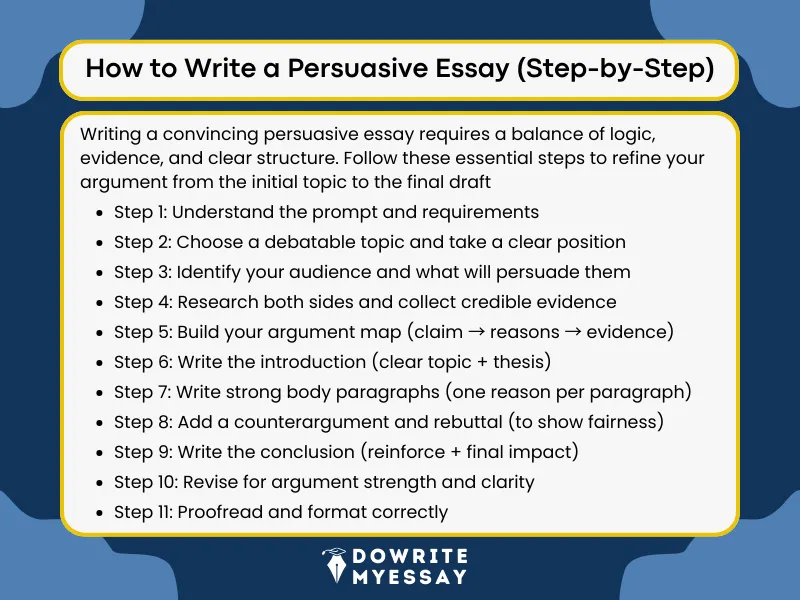
Step 1: Understand the prompt and requirements
Before choosing a position, read the assignment carefully.
Check for:
- The exact question you must answer
- Word count or page length
- Required citation style (MLA, APA, etc.)
- Number of sources needed (if any)
- Whether you must include a counterargument
Step 2: Choose a debatable topic and take a clear position
Your topic must allow disagreement. If everyone would say “yes,” it’s not persuasive.
A good persuasive topic is:
- Specific (not too broad)
- Debatable (reasonable people can disagree)
- Researchable (evidence is available)
If you’re unsure where to start, exploring well-structured persuasive essay topics can help you identify strong, debatable ideas that are easier to develop into arguments. Then choose your position clearly: for or against, or a specific policy change.
Step 3: Identify your audience and what will persuade them
Persuasion depends on the reader.
Ask:
- What does the reader already believe?
- What objections might they have?
- What evidence would they trust? (data, experts, real examples)
- What tone is appropriate? (formal, neutral, respectful)
This helps you choose the right evidence and avoid weak arguments.
Step 4: Research both sides and collect credible evidence
Strong persuasive essays are evidence-based.
Gather sources from:
- Books and academic articles
- Reliable news outlets
- Government or educational websites
- Expert organizations
Collect evidence for:
- Your main reasons
- The opposing viewpoint (counterargument)
- Your rebuttal (response)
As you research, save:
- Key quotes (with page/URL)
- Statistics and study findings
- Author names and publication dates
Step 5: Build your argument map (claim → reasons → evidence)
Before writing full paragraphs, map your argument.
A simple argument map looks like this:
- Thesis (main claim): your position
- Reason 1: supports the thesis
- Evidence: fact/statistic/example
- Reason 2: supports the thesis
- Evidence: fact/statistic/example
- Reason 3: supports the thesis
- Evidence: fact/statistic/example
- Counterargument: opposing view
- Evidence they might use
- Rebuttal: your response (why your view is stronger)
This keeps your essay organized and prevents repetition. Creating a structured persuasive essay outline can help you organize your thesis, supporting arguments, and counterarguments before writing full paragraphs.
Step 6: Write the introduction (clear topic + thesis)
Your introduction should:
- Introduce the issue
- Give brief background context
- Present your thesis clearly
Keep it focused. The goal is to set up the argument, not prove it yet.
Step 7: Write strong body paragraphs (one reason per paragraph)
Each body paragraph should include:
- Topic sentence (main reason)
- Evidence (facts, statistics, expert opinion, examples)
- Explanation (how the evidence proves your point)
- Connection to thesis (tie back to main claim)
- Transition (lead into the next point)
Step 8: Add a counterargument and rebuttal (to show fairness)
A persuasive essay becomes stronger when you address the other side.
Do this respectfully:
- Present the opposing viewpoint clearly
- Mention why some people believe it
- Respond with a rebuttal using logic and evidence
Your rebuttal should:
- Point out limits in the opposing argument
- Show why your position is more reasonable
- Use credible evidence instead of emotional attacks
Step 9: Write the conclusion (reinforce + final impact)
A strong conclusion should:
- Restate the thesis in new words
- Summarize your key reasons
- Leave a final thought or call to action
Do not introduce new evidence here.
Step 10: Revise for argument strength and clarity
Revision is where essays become strong.
Check:
- Does every paragraph support the thesis?
- Are reasons in a logical order?
- Is the counterargument handled fairly?
- Is evidence explained clearly (not just listed)?
- Are transitions smooth?
- Are there any weak or repeated points?
Step 11: Proofread and format correctly
Before submission:
- Fix grammar, spelling, punctuation
- Check sentence clarity and tone
- Confirm citations and reference list are correct
- Ensure formatting matches MLA/APA/Chicago requirements
- Remove informal language and exaggeration
Quick Checklist Before Submission
- I understood the prompt and requirements.
- My topic is debatable and focused.
- My thesis is clear and specific.
- I researched both sides using credible sources.
- Each body paragraph includes evidence and explanation.
- I included a counterargument and rebuttal.
- My conclusion reinforces the thesis without adding new points.
- I revised for clarity, logic, and academic tone.
How Do Rhetorical Appeals Strengthen a Persuasive Essay?
Persuasive essays are not built on evidence alone. They rely on different forms of appeal to influence the reader. These appeals are commonly known as ethos, pathos, and logos. They are the three principles of persuasion that have been used in argumentation for centuries.
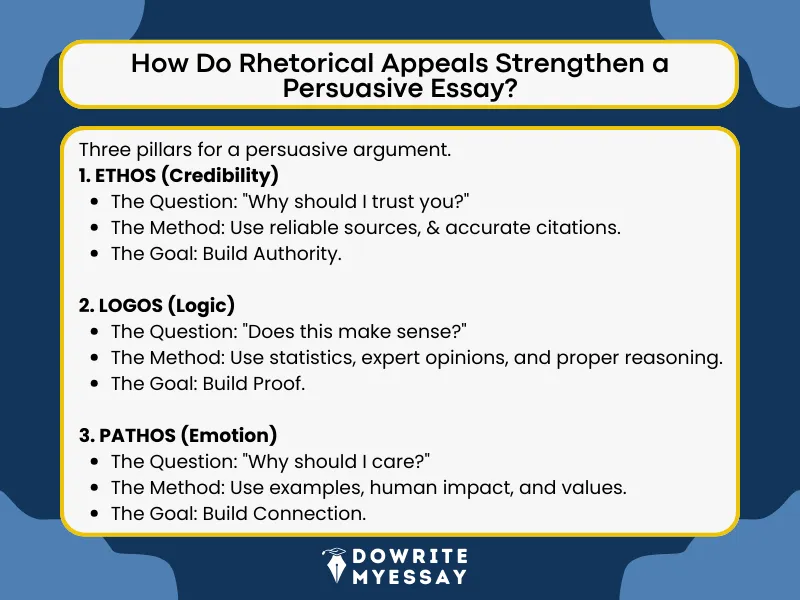
When used carefully and in balance, these appeals make an argument more convincing, credible, and engaging.
1. Ethos: Establishing Credibility and Trust
Ethos refers to credibility. It answers the question:
In academic persuasive essays, ethos is built by:
- Using reliable and relevant sources
- Citing research accurately
- Maintaining a respectful tone
- Avoiding exaggeration or emotional attacks
- Demonstrating knowledge of the topic
When readers trust the writer, they are more likely to accept the argument. A persuasive essay without credibility appears weak, even if the logic is strong.
2. Logos: Appealing to Logic and Reason
Logos refers to logical reasoning. It answers the question:
Logos is strengthened through:
- Clear cause-and-effect reasoning
- Statistics and research findings
- Expert opinions
- Well-organized arguments
- Direct connection between evidence and claim
In academic writing, logos is essential. Strong persuasive essays must show that the argument is based on facts and structured reasoning rather than personal opinion.
Without logical support, persuasion becomes unconvincing.
3. Pathos: Appealing to Emotion Responsibly
Pathos refers to emotional appeal. It answers the question:
In persuasive essays, pathos may involve:
- Real-life examples
- Ethical concerns
- Social impact
- Human consequences
However, emotional appeal must be used carefully. Overusing emotional language can weaken credibility. In academic settings, emotion should support evidence—not replace it.
Responsible use of pathos helps the reader connect with the issue while maintaining logical balance.
Why Balance Matters
Strong persuasive essays use all three appeals together:
- Ethos builds trust.
- Logos builds logical strength.
- Pathos builds emotional connection.
If one appeal dominates too heavily, the argument becomes unbalanced. Too much emotion reduces credibility. Too much data without explanation can confuse readers. Too little credibility weakens trust.
Balanced rhetorical appeals make the argument structured, persuasive, and academically sound.
How Are Persuasive Essays Graded?
Persuasive essays are evaluated using clear academic criteria. Instructors do not grade based on whether they agree with the writer’s opinion. Instead, they assess how effectively the argument is developed, supported, organized, and presented.
Most teachers use a grading rubric that divides the essay into specific evaluation categories. These categories measure both the quality of the argument and the quality of the writing.
Below are the main areas typically assessed.
1. Clarity and Strength of the Thesis
The thesis statement must clearly present the writer’s position.
Instructors look for:
- A specific and debatable claim
- A focused argument
- Clear direction for the essay
If the thesis is vague or too broad, the argument lacks focus.
2. Quality and Integration of Evidence
Strong persuasive essays rely on credible evidence.
Teachers evaluate whether:
- Reliable sources are used
- Evidence directly supports the claim
- Research is explained clearly (not just inserted)
- Examples are relevant and accurate
Evidence must be integrated and analyzed. Simply listing facts without explanation lowers the score.
3. Logical Organization and Coherence
Organization plays a major role in grading.
Instructors assess whether:
- Each paragraph focuses on one clear idea
- Arguments follow a logical order
- Transitions connect ideas smoothly
- The conclusion reinforces the thesis
Clear structure improves readability and strengthens persuasion.
4. Counterargument and Rebuttal
Addressing opposing viewpoints is often a key grading requirement.
A high-scoring persuasive essay:
- Presents the opposing view fairly
- Responds with logical reasoning
- Supports the rebuttal with evidence
Ignoring counterarguments can weaken the overall evaluation.
5. Academic Tone and Style
Tone affects credibility.
Instructors check for:
- Formal and professional language
- Respectful treatment of opposing views
- Clear and precise wording
- Absence of emotional exaggeration
An overly emotional or informal tone can reduce persuasive impact.
6. Citation, Formatting, and Academic Integrity
When research is required, proper citation is essential.
Grading may include:
- Correct use of MLA, APA, or Chicago style
- Accurate in-text citations
- Complete reference list or works cited page
- Consistent formatting
- Original work without plagiarism
Errors in citation or formatting can lower grades even if the argument is strong.
How a Typical Rubric Is Structured
Many instructors use a rubric that assigns separate scores to each category, such as:
- Thesis and argument development
- Evidence and research quality
- Organization and coherence
- Counterargument handling
- Writing mechanics and grammar
- Citation and formatting accuracy
Each category is often scored on a scale (for example, 1–5 or 1–10), and the final grade reflects overall performance across these areas.
Understanding how persuasive essays are graded helps students focus on what truly matters: building a clear, logical, well-supported, and professionally written argument.
What Academic Tone and Standards Apply to Persuasive Essays?
A persuasive essay must maintain a formal academic tone. Even though the goal is to convince the reader, the argument should remain logical, respectful, and evidence-based. Academic writing values clarity, structure, and professionalism over emotional intensity.
Below are the key tone and writing standards expected in persuasive essays.
1. Use Formal and Clear Language
Persuasive essays should avoid:
- Slang or casual expressions
- Text-message abbreviations
- Informal phrases
- Overly conversational language
Instead, use precise vocabulary and complete sentences. Clear and direct wording improves credibility and makes arguments easier to understand.
2. Avoid Emotional Attacks or Exaggeration
Persuasive writing should remain respectful, even when discussing opposing views.
Avoid:
- Insulting language
- Personal attacks
- Extreme or exaggerated claims
- Emotional manipulation
Strong arguments rely on logic and evidence, not emotional pressure.
3. Maintain Objectivity and Logical Balance
Even though the writer takes a position, the essay should not sound biased or one-sided.
Academic standards expect:
- Fair presentation of opposing viewpoints
- Logical reasoning
- Evidence-based claims
- Clear explanation of ideas
Balanced arguments are more persuasive and more academically credible.
4. Support Every Major Claim with Evidence
Academic persuasive essays require evidence for key points. Unsupported statements weaken credibility.
Make sure:
- Claims are backed by research, statistics, or expert opinion
- Evidence is explained clearly
- Sources are cited correctly
Evidence strengthens both logic (logos) and credibility (ethos).
5. Follow Proper Citation and Formatting Guidelines
Academic writing requires proper citation when using outside sources.
Common citation styles include:
- MLA (Modern Language Association)
- APA (American Psychological Association)
- Chicago Manual of Style
Consistent formatting and accurate citations demonstrate academic integrity and professionalism.
6. Ensure Clarity, Coherence, and Correct Grammar
Strong persuasive essays are:
- Clearly organized
- Free from major grammar errors
- Coherent and easy to follow
- Structured with logical paragraph flow
Errors in grammar or sentence structure can distract readers and reduce persuasive strength.
Summary of Academic Standards
To meet academic expectations, a persuasive essay should:
- Maintain a formal tone
- Use logical and respectful language
- Support claims with credible evidence
- Address opposing viewpoints fairly
- Follow proper citation rules
- Remain clear and organized
Maintaining academic tone and standards strengthens credibility and improves overall evaluation.
What Common Mistakes Should You Avoid in a Persuasive Essay?
Even strong ideas can lose impact if common mistakes weaken the argument. Many persuasive essays receive lower grades not because of poor topics, but because of avoidable errors in reasoning, structure, or tone.
Below are the most common mistakes to avoid.
1. Writing a Weak or Vague Thesis
A persuasive essay must take a clear and specific position.
Weak thesis statements are:
- Too broad
- Too general
- Not clearly debatable
- Missing a clear stance
If the thesis lacks focus, the entire essay becomes unclear.
2. Relying Too Much on Emotion
Emotional appeal can strengthen persuasion, but it should never replace logic.
Common problems include:
- Dramatic language without evidence
- Emotional exaggeration
- Manipulative tone
Persuasive essays must balance emotion with logical reasoning and credible support.
3. Ignoring Counterarguments
Some writers avoid mentioning the opposing side. This weakens the argument.
Failing to address counterarguments can make the essay appear biased or incomplete. Strong persuasive writing recognizes opposing views and responds thoughtfully.
4. Making Unsupported Claims
Every major argument must be supported with evidence.
Common errors include:
- Stating opinions as facts
- Adding statistics without explanation
- Using unreliable sources
- Failing to cite sources properly
Claims without support reduce credibility.
5. Poor Organization and Weak Transitions
Disorganized essays confuse readers.
Mistakes include:
- Jumping between ideas
- Repeating the same point
- Lacking clear topic sentences
- Missing transitions between paragraphs
Clear structure improves readability and persuasive strength.
6. Using Informal or Aggressive Language
Academic persuasive essays should avoid:
- Slang
- Personal attacks
- Insults toward opposing views
- Overly casual tone
Aggressive language reduces credibility and professionalism.
7. Logical Fallacies
Logical fallacies are errors in reasoning that weaken arguments.
Common fallacies in persuasive essays include:
- Strawman: Misrepresenting the opposing argument
- Ad Hominem: Attacking the person instead of the argument
- False Dilemma: Presenting only two extreme options
- Hasty Generalization: Making broad claims based on limited evidence
Avoiding logical fallacies strengthens the argument and improves academic quality.
How Long Should a Persuasive Essay Be?
The length of a persuasive essay depends on the academic level, assignment requirements, and topic complexity. There is no single fixed word count that applies to all persuasive essays.
However, most persuasive essays follow general length guidelines.
1. Middle School Level
At the middle school level, persuasive essays are usually shorter and focus on basic argument development.
Typical length:
- 400–600 words
- 3–5 paragraphs
The focus is on learning how to take a clear position and support it with simple evidence.
2. High School Level
High school persuasive essays require more detailed reasoning and stronger evidence.
Typical length:
- 600–1000 words
- 5–7 paragraphs
Students are expected to include clear thesis statements, organized body paragraphs, and at least one counterargument.
3. College Level
College-level persuasive essays demand deeper analysis, credible research, and stronger argument development.
Typical length:
- 1000–2000+ words (depending on the assignment)
- Multiple well-developed body paragraphs
At this level, instructors expect:
- Well-integrated academic sources
- Clear logical progression
- Thoughtful counterargument and rebuttal
- Proper citation formatting
Factors That Influence Length
The required length may vary based on:
- Instructor guidelines
- Course level
- Complexity of the topic
- Number of required sources
- Formatting expectations
Always follow the specific assignment instructions given by your instructor.
Quality Matters More Than Length
A persuasive essay should not be long just for the sake of word count. Clarity, logical development, and strong evidence are more important than length alone.
A shorter essay with a focused argument is often more effective than a long essay filled with repetition.
What Formatting and Citation Styles Apply to Persuasive Essays?
Persuasive essays often rely on research to strengthen arguments. When outside sources are used, proper formatting and citation are essential. Academic writing requires clear acknowledgment of sources to maintain credibility, support claims responsibly, and avoid plagiarism.
Correct citation does more than follow rules—it strengthens ethos (credibility). When readers can see where evidence comes from, the argument becomes more trustworthy and academically sound.
The required format usually depends on the course, subject area, or instructor’s guidelines. Different disciplines follow different citation styles, and persuasive essays must align with those expectations.
1. MLA (Modern Language Association)
MLA format is commonly used in:
- English
- Literature
- Humanities courses
Key features include:
- In-text citations with author’s last name and page number
- A “Works Cited” page at the end
- Double-spaced text
- Standard 12-point readable font (such as Times New Roman)
MLA focuses on author attribution and clear source listing.
2. APA (American Psychological Association)
APA format is often used in:
- Psychology
- Social sciences
- Education
- Business
Key features include:
- In-text citations with author’s last name and year of publication
- A “References” page
- Clear headings and structured formatting
- Title page (for many assignments)
APA emphasizes publication dates and research credibility.
3. Chicago Manual of Style
Chicago style is commonly used in:
- History
- Some social sciences
It may use:
- Footnotes or endnotes
- A bibliography page
Chicago format allows detailed source referencing, especially in research-heavy essays.
Proper In-Text Citations
When using outside information, you must:
- Cite direct quotes
- Cite paraphrased ideas
- Include complete source details
- Match in-text citations with the reference list
Failing to cite sources properly can lead to plagiarism, which may result in serious academic consequences.
Academic Integrity in Persuasive Essays
Academic integrity means presenting original work and giving credit to sources used.
To maintain integrity:
- Avoid copying text without citation
- Paraphrase correctly
- Use quotation marks for direct quotes
- Verify all references
Proper citation strengthens credibility and builds trust with readers and instructors.
Always Follow Assignment Instructions
Different instructors may have specific formatting rules. Always check:
- Required citation style
- Margin and spacing requirements
- Font size and type
- Title page instructions
Following formatting guidelines carefully can prevent unnecessary grade reductions.
Is a Persuasive Essay the Same as an Argumentative Essay?
A persuasive essay and an argumentative essay are closely related, but they are not exactly the same. Both involve taking a position on an issue and supporting it with evidence. However, their emphasis and approach can differ.
A persuasive essay focuses on convincing the reader by combining logical reasoning, credibility, and emotional appeal. It aims to influence the reader’s beliefs or encourage action.
An argumentative essay, on the other hand, places stronger emphasis on logical reasoning and research. It focuses more heavily on presenting balanced evidence and analyzing opposing viewpoints in depth.
In simple terms:
- A persuasive essay seeks to influence.
- An argumentative essay seeks to prove.
Key Differences
| Feature | Persuasive Essay | Argumentative Essay |
| Main Goal | Convince the reader | Prove a claim logically |
| Use of Emotion | Moderate and strategic | Limited |
| Evidence | Logical + emotional support | Primarily research-based |
| Tone | Convincing and assertive | Analytical and structured |
| Call to Action | Often included | Less common |
While both essay types require a clear thesis, strong evidence, and logical organization, persuasive essays may rely slightly more on rhetorical appeals, especially when aiming to influence attitudes or decisions.
Understanding this distinction helps students choose the right approach for their assignment.
Is a Persuasive Essay Different from an Opinion Essay?
Yes, a persuasive essay is different from an opinion essay, even though both involve expressing a viewpoint.
An opinion essay mainly shares personal beliefs or views about a topic. It may include simple reasons, but it does not always require detailed research or strong evidence.
A persuasive essay, however, goes beyond personal opinion. It requires the writer to:
- Take a clear and specific position
- Support that position with credible evidence
- Use logical reasoning
- Address opposing viewpoints
- Maintain an academic tone
In other words, an opinion essay expresses what the writer thinks. A persuasive essay proves why that position is reasonable and should be accepted.
Key Differences
| Feature | Persuasive Essay | Opinion Essay |
| Purpose | Convince with evidence | Share personal belief |
| Evidence | Required and research-based | Often limited |
| Counterargument | Usually included | Rarely included |
| Tone | Formal and structured | May be informal |
| Academic Level | Common in high school and college | Often elementary or early-level |
Understanding this difference is important. While opinions may start the discussion, persuasive essays require research, structure, and careful argument development.
Practical Tips for Writing a Strong Persuasive Essay
Writing a persuasive essay requires more than following a basic structure. Strong persuasion depends on how effectively you develop your argument, support your claims, and guide the reader through logical reasoning. The tips below focus on improving clarity, credibility, and overall argumentative strength.
1. Choose a Focused and Debatable Claim
Avoid broad or obvious topics. A strong persuasive essay begins with a specific claim that reasonable people can disagree with.
A focused claim makes research easier and keeps the argument clear.
2. Support Every Major Point with Evidence
Do not assume the reader will accept your statements without proof.
For each key argument:
- Provide research, data, or expert opinion
- Explain how the evidence supports your claim
- Avoid leaving evidence unexplained
Strong evidence strengthens both logic and credibility.
3. Anticipate Objections Early
Think about what critics might say against your position.
Preparing for objections helps you:
- Strengthen your rebuttal
- Avoid weak arguments
- Show fairness and critical thinking
This improves the overall persuasiveness of your essay.
4. Prioritize Clarity Over Complexity
Complex vocabulary and long sentences do not automatically make an essay stronger.
Focus on:
- Clear sentences
- Direct reasoning
- Logical paragraph flow
Clarity improves understanding and persuasive strength.
5. Use Transitions to Guide the Reader
Transitions help connect ideas smoothly.
Words like:
- Furthermore
- However
- As a result
- In contrast
They make the argument easier to follow and more organized.
6. Revise for Argument Strength
During revision, ask yourself:
- Does every paragraph support the thesis?
- Are any points repetitive or weak
- Is the evidence convincing and clearly explained?
- Does the essay address the strongest opposing argument?
Revision improves both structure and persuasive quality.
7. Remove Logical Fallacies
Check for reasoning errors such as:
- Overgeneralizing
- Presenting only two extreme options
- Attacking opposing views personally
Strong persuasive essays rely on logic, not flawed reasoning.
8. Maintain a Professional Tone
Even when discussing controversial topics, remain respectful and balanced. Professional tone strengthens credibility and makes the argument more persuasive.
These practical tips help refine a persuasive essay beyond basic structure. When applied carefully, they improve clarity, logic, and overall effectiveness.
How Do Persuasive Essays Prepare Students for Real-World Communication?
Although persuasive essays are academic assignments, the skills developed through them extend beyond the classroom.
In academic settings, persuasive essays are used to:
- Defend research positions
- Present policy proposals
- Argue theoretical viewpoints
- Participate in structured debates
These essays teach students how to:
- Evaluate evidence critically
- Organize ideas logically
- Address opposing viewpoints
- Communicate arguments clearly
The ability to build a clear, evidence-based argument is valuable in many professional fields. However, in academic contexts, the primary goal of a persuasive essay is to strengthen reasoning, research skills, and structured argument development.
By mastering persuasive essays, students learn how to think critically and defend ideas responsibly — skills that remain useful throughout higher education and professional life.

In the End
A persuasive essay is more than an expression of opinion. It is a structured academic argument designed to influence the reader through clear reasoning, credible evidence, and balanced rhetorical appeals. From developing a focused thesis to addressing counterarguments and maintaining academic tone, every part of the essay contributes to its persuasive strength.
Strong persuasive writing depends on logic, organization, and careful revision. When arguments are supported with reliable evidence and presented clearly, they become more convincing and academically sound.
Understanding how persuasive essays are structured, evaluated, and refined helps students approach assignments with confidence. By applying these principles, writers can develop stronger arguments, improve critical thinking skills, and communicate ideas more effectively in academic settings.
For students who need additional guidance, reviewing professional examples can help clarify structure, argument development, and evidence integration. In cases where time constraints or complex topics make writing difficult, a structured persuasive essay writing service can provide academic support while helping students understand how strong persuasive arguments are developed and presented.
Frequently Asked Questions About Persuasive Essays
Get quick answers to common questions about crafting effective persuasive essays.