Key Takeaways (TL;DR)
- A persuasive essay outline is a structured plan that organizes the thesis, arguments, evidence, and conclusion before writing the essay.
- It helps writers arrange ideas logically and ensures each paragraph supports the main persuasive claim.
- Most persuasive essay outlines follow three main parts: introduction, body paragraphs, and conclusion.
- Each body paragraph usually includes a topic sentence, supporting evidence, explanation, and transition.
- Strong outlines often include a counterargument and rebuttal to strengthen credibility.
- The 5-paragraph persuasive essay outline is the most commonly used structure in school and college assignments.
- Using a clear outline improves organization, argument clarity, and overall essay quality.
- Templates and examples can make outlining faster and help students avoid common structural mistakes.
A persuasive essay outline is a structured plan that organizes the main ideas of an essay before the writing process begins. Instead of starting with a blank page, the outline helps writers map out their thesis, supporting arguments, evidence, counterarguments, and conclusion in a clear and logical order. By planning these elements in advance, students can build a stronger and more coherent persuasive argument.
In academic writing, outlines act as a roadmap for the entire essay. They show how each paragraph will contribute to the overall argument and help ensure that every claim is supported with relevant evidence. A well-organized outline also makes it easier to maintain logical flow between paragraphs and prevents writers from repeating ideas or drifting away from their main point.
For students learning how persuasive essays work, outlining is an essential step. It helps break a complex assignment into manageable parts and allows writers to focus on developing clear arguments rather than struggling with structure during drafting.
In this guide, you will learn what a persuasive essay outline is, why it is important, how to create one step by step, and what a strong outline should look like. You will also find practical templates and examples that show how to organize persuasive essays for different academic levels. For students who want to see how structured arguments are applied in real academic work, a persuasive essay writing service can provide professionally developed examples with clear organization and evidence-based reasoning.
What Is a Persuasive Essay Outline?
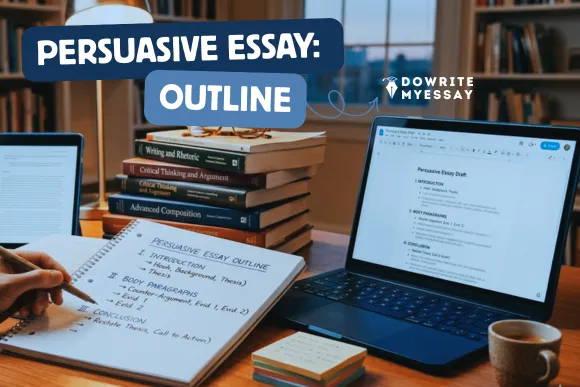
A persuasive essay outline is a structured plan that shows how a persuasive essay will be organized before the full draft is written. It lists the main sections of the essay, such as the introduction, body paragraphs, counterargument, and conclusion, and briefly describes what each part will contain. By outlining the essay in advance, writers can arrange their ideas logically and make sure their argument develops in a clear and convincing way.
In persuasive essay writing, the outline acts as a blueprint for the argument. Instead of writing paragraphs immediately, the writer first identifies the thesis statement, main supporting reasons, evidence for each point, and the placement of a counterargument. This planning step helps ensure that each paragraph contributes directly to the overall persuasive goal of the essay.
A typical outline for a persuasive essay includes three major parts:
- Introduction: introduces the topic, provides a brief context, and states the thesis.
- Body paragraphs: present the main arguments, evidence, and explanations that support the thesis.
- Conclusion: summarizes the argument and reinforces the main position.
Although outlines can be written in different formats, such as bullet points, numbered lists, or sentence outlines, the purpose remains the same: to organize ideas before drafting the full essay. If you are still learning the fundamentals, reviewing the complete persuasive essay guide can help you better understand structure, arguments, and writing principles before outlining.
Why Is a Persuasive Essay Outline Important?
A persuasive essay outline is important because it helps writers organize their ideas before starting the actual essay. Instead of trying to develop arguments while writing, an outline allows students to plan the structure of their essay in advance. This preparation makes the writing process clearer, faster, and more logical.
When a persuasive essay is written without a plan, arguments may appear in a random order, important evidence may be forgotten, and paragraphs may lose focus. A persuasive essay outline prevents these problems by showing how every part of the essay connects to the main thesis.
Below are some of the key benefits of creating a persuasive essay outline.
1. It Organizes Ideas Clearly
An outline helps writers arrange their main points in a logical order. Each argument is placed in its own paragraph, making it easier to guide the reader step by step through the reasoning behind the thesis.
2. It Improves the Logical Flow of the Essay
Persuasive writing depends on strong argument development. An outline allows writers to see how each claim connects to the next, ensuring that the essay progresses logically rather than jumping between unrelated ideas.
3. It Helps Place Evidence Effectively
Before writing the full essay, students can decide which evidence supports each argument. This helps ensure that every claim is supported with relevant facts, statistics, examples, or expert opinions.
4. It Makes Counterarguments Easier to Address
Strong persuasive essays acknowledge opposing viewpoints. When outlining the essay, writers can plan exactly where the counterargument and rebuttal will appear, making the overall argument more balanced and credible.
5. It Saves Time During Writing
With a clear outline, the drafting process becomes much easier. Instead of thinking about structure while writing, the writer simply expands each point in the outline into full paragraphs.
6. It Helps Meet Academic Expectations
Teachers and instructors often evaluate persuasive essays based on clarity, organization, and argument structure. A detailed outline helps writers meet these expectations by ensuring that every section of the essay supports the main thesis.
In short, a persuasive essay outline works as a roadmap for the entire writing process. It keeps the essay organized, strengthens argument development, and makes the final draft more persuasive and coherent. This is why many students look for reliable academic support when they think, “can someone write my essay in a properly structured way that follows academic standards?
What Does a Persuasive Essay Outline Include?
A persuasive essay outline breaks the essay into clearly planned sections before the writing process begins. Each section of the outline represents a part of the final essay and briefly describes what ideas will appear there.
Most persuasive essay outlines include four key components: the introduction, body paragraphs, a counterargument and rebuttal, and the conclusion. Planning these sections in advance helps writers organize their arguments logically and ensures that each paragraph supports the main thesis.

Below is a breakdown of what each part of a persuasive essay outline typically includes.
Introduction Section
The introduction is the first section of the outline and sets the foundation for the entire essay. In the outline stage, writers briefly note how they will introduce the topic and present their position.
A persuasive essay introduction outline usually includes:
- Hook: an engaging opening idea that captures the reader’s attention
- Background information: brief context that helps readers understand the issue
- Thesis statement: a clear statement of the writer’s main argument
At this stage, these elements do not need to be written as full sentences. Instead, writers simply outline the ideas they plan to include.
If you want to learn how to craft a strong opening paragraph, you can explore our guide on how to start a persuasive essay, which explains hooks, thesis statements, and introduction strategies in more detail.
Body Paragraph Section
The body paragraphs form the core of the persuasive essay. Each paragraph presents one key reason that supports the thesis.
A typical persuasive essay body paragraph outline includes:
- Topic sentence: introduces the main argument of the paragraph
- Supporting evidence: facts, statistics, examples, or expert opinions
- Explanation: shows how the evidence supports the claim
- Transition: connects the paragraph to the next idea
Outlining these elements helps writers maintain a clear structure where every paragraph contributes to the overall argument.
Counterargument and Rebuttal Section
Strong persuasive essays often include a counterargument that acknowledges the opposing viewpoint. Addressing opposing ideas strengthens credibility and shows that the writer has considered multiple perspectives.
An outline for the counterargument section usually includes:
- Opposing claim: the argument from the other side
- Explanation of the opposing view: why some people support it
- Rebuttal: the writer’s response explaining why the opposing argument is weaker
- Evidence supporting the rebuttal
Planning this section in advance ensures that the essay presents a balanced and thoughtful argument rather than ignoring opposing opinions.
Conclusion Section
The conclusion is the final part of the persuasive essay outline. Its purpose is to reinforce the thesis and summarize the main points of the argument.
A persuasive essay conclusion outline usually includes:
- Restated thesis: the main argument expressed in new words
- Summary of key points: brief recap of the main supporting arguments
- Final thought or call to action: a closing statement that leaves a lasting impression
The conclusion should not introduce new arguments. Instead, it should strengthen the reader’s understanding of the position presented throughout the essay.
How to Write a Persuasive Essay Outline (Step-by-Step)
Creating a persuasive essay outline becomes much easier when you follow a clear process. Instead of trying to organize arguments while drafting the essay, outlining allows you to plan the structure first and then expand each point into full paragraphs.

The steps below show how to build a persuasive essay outline from the initial idea to a complete plan.
Step 1: Understand the Assignment Requirements
Before outlining your essay, carefully review the assignment instructions. Different courses may require specific formatting, paragraph length, or citation styles.
Check for:
- Required word count
- Number of body paragraphs
- Required sources or citations
- Formatting style (MLA, APA, or Chicago)
Understanding these expectations helps you design an outline that fits the assignment guidelines.
Step 2: Choose a Clear and Debatable Topic
A persuasive essay must focus on an issue that allows for different viewpoints. If the topic is too obvious or one-sided, the essay will not be persuasive.
Choose a topic that:
- Has multiple perspectives
- Allows evidence-based arguments
- Is relevant and interesting
Step 3: Define Your Position and Thesis
Once you have selected a topic, decide which side of the issue you will support.
Then write a working thesis statement that clearly expresses your position. At the outline stage, the thesis does not need to be perfect. It simply needs to show the main argument that the essay will defend.
Schools should introduce later start times because it improves student health, academic performance, and overall well-being.
This thesis will guide the rest of the outline.
Step 4: Identify Your Main Supporting Arguments
Next, list the main reasons that support your thesis. These will become the body paragraphs of your essay.
Most persuasive essays include two to three main arguments, each supported by evidence.
Argument 1
Argument 2
Argument 3
Each argument should address a different reason supporting the thesis.
Step 5: Gather Evidence for Each Argument
Strong persuasive essays rely on credible evidence. Before finalizing the outline, note the type of evidence you will use for each argument.
Evidence may include:
- Statistics and research findings
- Expert opinions
- Real-world examples
- Historical or factual information
Adding evidence to the outline ensures that each argument will be properly supported during the writing stage.
Step 6: Plan the Counterargument
A persuasive essay becomes stronger when it acknowledges opposing viewpoints.
At this stage, decide:
- What the opposing argument might be
- Where it will appear in the essay
- How you will respond to it
Including a counterargument and rebuttal in your outline shows that you have considered multiple perspectives.
Step 7: Arrange the Outline in Logical Order
Now organize the parts of the essay in a logical sequence.
A common persuasive essay outline order looks like this:
1. Introduction
2. Body Paragraph 1 – strongest or most accessible argument
3. Body Paragraph 2 – supporting argument
4. Body Paragraph 3 – counterargument and rebuttal
5. Conclusion
Organizing the outline this way ensures that the argument develops clearly and logically.
Step 8: Review and Refine the Outline
Before writing the essay, review your outline carefully.
Ask yourself:
- Does every argument support the thesis?
- Is each paragraph focused on one main idea?
- Is there enough evidence to support each claim?
- Does the argument progress logically?
Refining the outline at this stage prevents structural problems later in the writing process.
Quick Outline Checklist
Before you begin writing your essay, make sure your outline includes:
- A clear thesis statement
- Two to three main supporting arguments
- Evidence for each argument
- A counterargument and rebuttal
- A conclusion that reinforces the thesis
Once these elements are in place, the persuasive essay becomes much easier to write because the structure of the argument is already planned.
What Is the Best Format for a Persuasive Essay Outline?
There is no single universal format for a persuasive essay outline. Different teachers and institutions may recommend slightly different outlining styles. However, most persuasive essay outlines follow a clear hierarchical structure that organizes ideas logically from introduction to conclusion.
The goal of an outline format is simple: to show how the essay will develop its argument before the full draft is written. A good outline should make it easy to see the thesis, supporting points, evidence, and conclusion at a glance.
Below are the most commonly used formats for persuasive essay outlines.
Bullet-Point Outline
A bullet-point outline is the simplest and most commonly used format. It lists the key ideas of each paragraph in short phrases rather than complete sentences.
This format works well for students who want to plan their arguments quickly without writing long explanations.
- Introduction
- Hook idea
- Background context
- Thesis statement
- Body Paragraph 1
- Main argument
- Evidence or example
- Explanation
- Body Paragraph 2
- Second supporting argument
- Evidence
- Explanation
- Conclusion
- Restated thesis
- Summary of arguments
- Final thought
Bullet outlines are easy to edit and expand during the drafting stage.
Sentence Outline
A sentence outline provides more detail than a bullet outline. Each point in the outline is written as a full sentence, which helps clarify the exact argument that will appear in the essay.
This format is often recommended for longer persuasive essays because it forces the writer to think through the logic of each claim.
- Introduction
- Hook that introduces the topic
- Background information explaining the issue
- Thesis statement presenting the main argument
- Body Paragraph 1
- First supporting reason
- Evidence supporting the reason
- Explanation of how the evidence supports the thesis
- Body Paragraph 2
- Second supporting reason
- Supporting evidence
- Explanation
- Conclusion
- Restate thesis
- Summarize key arguments
- Final thought or call to action
Sentence outlines provide a clearer roadmap for drafting the essay.
Numbered Outline
A numbered outline uses hierarchical numbering to show the relationship between ideas. This format is common in formal academic writing because it clearly separates main points from supporting details.
- Introduction
- First Argument
- Evidence
- Explanation
- Second Argument
- Evidence
- Explanation
- Counterargument and Rebuttal
- Conclusion
The numbered format helps writers see how each argument connects to the main thesis and ensures the essay remains logically organized.
Choosing the Right Outline Format
The best persuasive essay outline format is the one that clearly organizes your argument and is easy for you to follow while writing.
- Bullet outlines work best for quick planning.
- Sentence outlines provide deeper detail for complex essays.
- Numbered outlines are useful for clearly structured academic assignments.
Regardless of the format you choose, the outline should always show the introduction, supporting arguments, evidence, counterargument (if included), and conclusion.
Persuasive Essay Outline Templates
Persuasive essay outlines can vary depending on the length of the assignment and the complexity of the topic. Short assignments may require only a few paragraphs, while longer essays may include multiple arguments and a counterargument.
Below are common persuasive essay outline templates that students can adapt for different academic levels.
3-Paragraph Persuasive Essay Outline Template
A three-paragraph outline is usually used for short assignments or introductory persuasive writing tasks. It focuses on presenting one main argument supported by evidence.
- Introduction
- Hook to capture attention
- Brief background information about the topic
- Thesis statement presenting the main argument
- Body Paragraph
- Topic sentence introducing the main claim
- Supporting evidence (facts, examples, or research)
- Explanation showing how the evidence supports the argument
- Conclusion
- Restate the thesis
- Summarize the key argument
- Final thought or call to action
This format works best for short persuasive essays where the writer focuses on a single strong argument.
4-Paragraph Persuasive Essay Outline Template
A four-paragraph persuasive essay allows writers to present two supporting arguments while maintaining a concise structure.
- Introduction
- Hook
- Background information
- Thesis statement
- Body Paragraph 1
- Topic sentence presenting the first supporting argument
- Evidence supporting the claim
- Explanation of the evidence
- Transition to the next paragraph
- Body Paragraph 2
- Topic sentence introducing the second argument
- Supporting evidence
- Explanation
- Conclusion
- Restate the thesis in new words
- Summarize the key arguments
- Final statement reinforcing the writer’s position
This format works well for shorter academic essays that require more than one supporting idea.
5-Paragraph Persuasive Essay Outline Template
The five-paragraph structure is the most common persuasive essay format used in high school and many college assignments. It provides enough space to develop multiple arguments and include a counterargument.
- Introduction
- Hook that engages the reader
- Background information providing context
- Thesis statement presenting the main argument
- Body Paragraph 1
- Topic sentence introducing the first argument
- Supporting evidence
- Explanation of the evidence
- Body Paragraph 2
- Topic sentence presenting the second argument
- Supporting evidence
- Explanation
- Body Paragraph 3
- Counterargument or third supporting argument
- Explanation of the opposing view
- Rebuttal showing why the writer’s argument is stronger
- Conclusion
- Restate the thesis in new words
- Summarize the main supporting points
- Final thought, recommendation, or call to action

This structure allows the writer to present a balanced argument while still maintaining a clear and logical essay flow.
Persuasive Essay Outline Example
Below is a simple example of how a persuasive essay outline may look before the essay is written. This example demonstrates how ideas are organized logically from the introduction to the conclusion.
- Introduction
- Hook: Many students struggle to stay awake during early morning classes.
- Background Information: Research shows that teenagers naturally sleep later due to biological changes during adolescence. Early school start times may negatively affect student health and academic performance.
- Thesis Statement: Schools should start later in the morning because it improves student health, increases academic performance, and supports better mental well-being.
- Body Paragraph 1 – Improved Student Health
- Topic Sentence: Later school start times allow students to get the sleep they need for healthy development.
- Evidence: Studies from sleep researchers show that teenagers require around 8–10 hours of sleep per night.
- Explanation: Early start times often prevent students from meeting these sleep requirements, leading to fatigue and health issues.
- Body Paragraph 2 – Better Academic Performance
- Topic Sentence: Students perform better academically when they are well rested.
- Evidence: Schools that shifted to later start times reported improved attendance and higher test scores.
- Explanation: Adequate sleep improves concentration, memory, and problem-solving ability.
- Body Paragraph 3 – Counterargument and Rebuttal
- Counterargument: Some people argue that later start times would interfere with after-school activities and sports schedules.
- Rebuttal: However, schools that have adopted later schedules often adjust extracurricular activities without major disruption.
- Explanation: The academic and health benefits outweigh the scheduling challenges.
- Conclusion
- Restated Thesis: Later school start times provide significant benefits for students’ health and learning.
- Summary of Arguments: More sleep improves physical health, academic performance, and overall well-being.
- Final Thought: Adjusting school schedules could be a simple change that leads to better outcomes for students.
Common Mistakes When Creating a Persuasive Essay Outline
Creating an outline is meant to make the writing process easier, but many students make mistakes that weaken their essay structure. A poorly planned outline can lead to disorganized arguments, weak evidence, or unclear reasoning.
Understanding these common mistakes can help you build a stronger and more effective persuasive essay outline.
1. Writing a Vague or Unclear Thesis
The thesis statement is the central argument of the essay. If the thesis is unclear, the entire outline becomes weak because the supporting arguments will lack direction.
A strong thesis should:
- Clearly state the writer’s position
- Focus on a specific issue
- Be debatable rather than factual
- Weak thesis: Social media affects students.
- Strong thesis: Excessive social media use negatively affects students’ academic performance and mental health.
A clear thesis helps organize the entire outline.
2. Listing Ideas Without Logical Order
Another common mistake is listing arguments randomly without considering their logical flow. An outline should guide the reader through the argument step by step.
A well-organized persuasive essay usually:
- Begins with the strongest or most logical argument
- Builds supporting points gradually
- Addresses opposing views when appropriate
Logical order improves clarity and strengthens persuasion.
3. Including Weak or Unsupported Arguments
Some outlines include claims that are not supported with credible evidence. Persuasive essays require facts, statistics, examples, or expert opinions to support each major claim.
When outlining body paragraphs, always consider:
- What evidence supports this argument?
- Is the evidence reliable and relevant?
- Does it directly support the thesis?
Strong evidence makes the argument more convincing.
4. Ignoring Counterarguments
A persuasive essay becomes stronger when it acknowledges opposing viewpoints. Ignoring counterarguments can make the essay appear biased or incomplete.
A strong outline often includes:
- A paragraph presenting an opposing viewpoint
- A rebuttal explaining why the main argument is stronger
This approach demonstrates critical thinking and strengthens credibility.
5. Making the Outline Too Detailed or Too Short
An outline should guide the writing process, but it should not become a full essay. Some students write long paragraphs in their outline, while others include only a few vague words.
A good outline typically includes:
- Key ideas for each paragraph
- Main evidence or examples
- Logical transitions between sections
This balance keeps the outline clear and useful during drafting.
6. Forgetting the Connection to the Thesis
Every argument in the outline should support the thesis statement. If a paragraph does not directly strengthen the main argument, it should be revised or removed.
Before finalizing the outline, ask:
- Does each paragraph support the thesis?
- Are the arguments relevant to the topic?
- Does the essay build toward a clear conclusion?
Maintaining this connection ensures that the essay remains focused and persuasive.
Tips for Writing an Effective Persuasive Essay Outline
Creating a persuasive essay outline is not just about listing paragraphs. A strong outline helps organize ideas, strengthen arguments, and make the writing process smoother. The tips below can help you create a clearer and more effective outline before you start writing the full essay.
Start With a Clear Thesis Statement
The thesis statement is the foundation of your persuasive essay outline. It defines your position on the topic and guides the arguments you will present in the body paragraphs.
Before outlining the essay, make sure your thesis:
- Takes a clear position on the issue
- Is specific and focused
- Can be supported with evidence
A clear thesis makes it easier to build logical arguments in the outline.
Choose Strong Supporting Arguments
After writing the thesis, identify the main arguments that will support your position. Each argument should address a different aspect of the topic and provide clear reasoning.
Most persuasive essays include:
- Two or three main arguments
- Supporting evidence for each argument
- Explanations that connect the evidence to the thesis
Choosing strong arguments helps create a more convincing essay.
Gather Evidence Before Finalizing the Outline
Research plays an important role in persuasive writing. Before completing the outline, gather reliable information that can support your arguments.
Useful types of evidence include:
- Statistics and research studies
- Expert opinions
- Real-life examples
- Historical or factual information
Adding evidence to the outline ensures that the essay will have credible support for each claim.
Plan a Logical Flow of Ideas
A persuasive essay should guide the reader through the argument step by step. When organizing your outline, arrange the ideas in a way that builds the argument logically.
Many writers place:
- The strongest argument first to capture attention
- Additional supporting points in the middle
- Counterarguments before the conclusion
Logical flow helps readers follow the reasoning more easily.
Include a Counterargument
Acknowledging an opposing viewpoint strengthens persuasive writing. Including a counterargument in the outline shows that the writer understands different perspectives.
In the outline, you can briefly include:
- The opposing argument
- Evidence supporting that viewpoint
- A rebuttal explaining why your argument is stronger
This approach improves the credibility of the essay.
Keep the Outline Clear and Organized
An outline should simplify the writing process, not complicate it. Use short phrases or sentences that clearly describe what each paragraph will contain.
A well-organized outline should:
- Separate introduction, body paragraphs, and conclusion
- Clearly show the thesis and supporting arguments
- Indicate where evidence and explanations will appear
When the outline is clear, writing the full essay becomes much easier.

Conclusion
A persuasive essay outline plays an important role in organizing ideas and building a strong argument before the writing process begins. By outlining the introduction, body paragraphs, supporting evidence, and conclusion in advance, writers can ensure that their essay follows a logical structure and communicates ideas clearly.
Creating an outline also helps writers identify the strongest arguments, arrange them effectively, and include counterarguments where necessary. This preparation makes the drafting process more efficient and reduces the chances of missing important points.
Whether you are writing a short classroom assignment or a longer academic paper, a well-planned outline provides a clear roadmap for your persuasive essay. With a structured outline, it becomes easier to present convincing arguments, support claims with evidence, and guide readers toward a clear and logical conclusion.
Frequently Asked Questions About Persuasive Essay Outlines
Need clarity on your outline? These quick answers cover the most common questions students ask when planning a persuasive essay.