Key Takeaways
- The persuasive vs argumentative essay comparison centers on purpose, evidence, tone, and reasoning.
- The difference between persuasive and argumentative essay writing is most noticeable in how each supports its main claim.
- Persuasive essays often combine logical arguments with rhetorical and emotional appeals.
- Argumentative essays rely more heavily on research, credible sources, and objective analysis.
- Counterarguments and rebuttals play a much larger role in argumentative writing.
- Both essay types require a clear thesis statement, organized paragraphs, and relevant supporting evidence.
- Reading the prompt carefully is the easiest way to determine which writing style your instructor expects.
- Choosing the correct approach from the beginning makes the writing process clearer and helps avoid losing marks for using the wrong format.
At first glance, persuasive and argumentative essays seem almost identical. Both ask you to take a position, develop a clear thesis statement, and convince readers that your viewpoint deserves consideration. Because they follow a similar structure and often explore the same topics, it’s easy to assume they are simply different names for the same type of writing.
They are not.
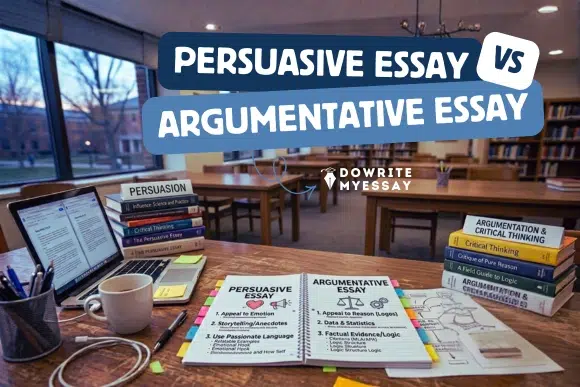
The biggest difference is how each essay builds its case. A persuasive essay encourages readers to agree with your viewpoint by combining reasoning with persuasive communication and audience-focused language. An argumentative essay, on the other hand, is expected to defend a position through logical reasoning, credible evidence, and careful analysis of multiple perspectives. The goal is not simply to persuade but to demonstrate that your claim stands up to scrutiny.
The confusion becomes even greater because some schools, textbooks, and instructors use the terms interchangeably. In one class, a prompt asking you to “write a persuasive essay” may still expect research findings and counterarguments, while another may focus more on developing a convincing opinion. Without understanding the distinction, students often use the wrong balance of evidence, tone, or reasoning even when their writing is otherwise well organized.
This guide breaks down those differences in a practical way. You’ll see how persuasive and argumentative essays compare, where they overlap, what instructors typically look for, and how to recognize which approach fits your topic before you begin writing.

Persuasive vs Argumentative Essay: Side-by-Side Comparison
Before looking at each difference in detail, it helps to compare both essay types side by side. While they share a similar structure and a common goal of convincing readers, their purpose, writing style, evidence, and expectations differ in several important ways.
| Feature | Persuasive Essay | Argumentative Essay |
| Primary Purpose | Convince readers to agree with the writer’s viewpoint. | Defend a claim using logical reasoning and credible evidence. |
| Main Objective | Influence opinions and encourage a particular perspective. | Prove that a position is well supported through analysis and research. |
| Target Audience | Readers who may be persuaded by emotion, logic, or personal values. | Neutral or skeptical readers expecting objective evaluation. |
| Writing Tone | More personal, engaging, and opinion-driven. | Formal, balanced, and analytical. |
| Type of Evidence | Personal experience, examples, facts, statistics, and expert opinions. | Research findings, scholarly sources, factual evidence, statistics, and expert testimony. |
| Research Requirements | May require research, depending on the topic. | Usually requires extensive research and credible sources. |
| Emotional Appeal | Used to strengthen the writer’s position when appropriate. | Used sparingly, with greater emphasis on logic. |
| Logical Reasoning | Supports the main opinion but may not dominate the discussion. | Forms the foundation of the entire argument. |
| Counterarguments | May acknowledge opposing views but often briefly. | Expected as a key part of the discussion. |
| Rebuttals | Optional in many cases. | Essential for addressing and refuting opposing claims. |
| Citation Expectations | Vary depending on instructor requirements. | Formal citations are commonly expected. |
| Best Used For | Opinion pieces, speeches, editorials, and viewpoint-based writing. | Research-based discussions, debates, and evidence-focused topics. |
| What Instructors Look For | Clear persuasion, audience engagement, and a convincing position. | Strong reasoning, credible evidence, critical thinking, and balanced analysis. |
Although these differences are clear on paper, real writing prompts are not always as straightforward. Some topics can be approached using either style, which is why understanding what the prompt is actually asking is just as important as knowing the characteristics of each essay type.
How Your Instructor’s Prompt Reveals Which Essay You Should Write
Many students begin writing before they fully understand what the prompt is asking. That is often where the confusion starts. Two topics may look almost identical, yet the wording of the prompt can signal completely different expectations for the evidence, reasoning, and writing style you should use.
Instead of focusing only on the topic, pay close attention to the action words and requirements. They usually reveal whether your instructor expects a persuasive or argumentative approach.
| If the prompt asks you to… | It Usually Calls For… |
| Convince readers to agree with your opinion | Persuasive essay |
| Defend a claim using research and evidence | Argumentative essay |
| Express or justify your viewpoint | Persuasive essay |
| Evaluate different perspectives before reaching a conclusion | Argumentative essay |
| Appeal to the audience or encourage action | Persuasive essay |
| Support every claim with credible sources and citations | Argumentative essay |
| Refute opposing viewpoints | Argumentative essay |
| Build a compelling case around a personal position | Persuasive essay |
Keep in mind that instructors do not always label these writing styles consistently. A prompt titled “persuasive essay” may still expect research-backed arguments, while an “argumentative essay” might allow limited rhetorical appeals alongside factual evidence. When that happens, the grading criteria and required sources usually provide the clearest indication of which approach you should follow.
Once you know what the prompt expects, comparing the two essay types becomes much easier. The biggest differences appear in how each one builds, supports, and defends its central claim.
The Biggest Differences Between Persuasive and Argumentative Essays
Although persuasive and argumentative essays share a similar structure, they are built around different priorities. The strongest writing comes from matching your approach to the purpose of the topic rather than treating both essay types as interchangeable. The following differences have the biggest impact on how your work is evaluated.

Purpose: Influencing Opinions vs. Defending a Position
A persuasive essay is written to influence the reader’s viewpoint. The writer presents a clear opinion and uses convincing language to encourage the audience to agree or take action. While facts and supporting evidence can strengthen the message, the overall focus remains on persuasion.
An argumentative essay has a different goal. Instead of simply convincing readers, it aims to prove that a claim is valid through logical reasoning and evidence. The writer builds a position, evaluates different viewpoints, and supports every major point with credible information rather than personal belief alone.
As a result, persuasive writing often asks, “Can I convince the reader?” while argumentative writing asks, “Can I prove this position with reliable evidence?”
Evidence: Emotional Appeals vs. Research-Based Support
Both essay types rely on evidence, but they do not use it in the same way.
A persuasive essay may combine facts, examples, personal experience, anecdotes, and statistics to strengthen the writer’s viewpoint. The goal is to create a convincing message that connects with the intended audience both logically and emotionally.
An argumentative essay places much greater emphasis on research evidence. Claims are expected to be supported by scholarly sources, expert opinions, research findings, historical evidence, scientific evidence, and reliable statistics. The strength of the argument depends less on how convincing the writer sounds and more on the quality and credibility of the supporting evidence.
The stronger the research, the stronger the argument becomes. Simply expressing a confident opinion is rarely enough in argumentative writing.
Audience Expectations
Another major difference between a persuasive essay vs argumentative essay is the audience each one is written for. Understanding who you’re trying to convince shapes the tone, evidence, and overall writing style.
A persuasive essay assumes the reader can be influenced through a combination of logical arguments, emotional appeal, and engaging language. The writer focuses on building a connection with the audience, encouraging them to accept a particular viewpoint or reconsider their opinion. Because of this, rhetorical devices and persuasive techniques often play a larger role.
An argumentative essay is written for a more neutral or skeptical audience. Rather than appealing to emotions, the writer is expected to anticipate questions, address doubts, and support every major claim with credible evidence. Readers are more likely to evaluate the quality of the reasoning than the strength of the writer’s opinion.
The difference is subtle but important. Persuasive writing asks readers to believe your position, while argumentative writing gives them enough reliable evidence to reach that conclusion on their own.
Counterarguments and Rebuttals
How each essay handles opposing viewpoints is one of the clearest ways to tell them apart.
In a persuasive essay, opposing opinions may be mentioned to strengthen the writer’s position, but they are often addressed briefly. The primary focus remains on reinforcing the main claim rather than examining every competing perspective.
An argumentative essay treats counterarguments as an essential part of the discussion. Before defending a position, the writer acknowledges alternative viewpoints, evaluates their strengths, and then explains why the original claim remains more convincing. A well-developed rebuttal demonstrates critical thinking and shows that the conclusion was reached after considering more than one perspective.
Because this process can be challenging, especially when balancing evidence and opposing views, learning how to develop a well-supported argumentative essay from introduction to conclusion can make it much easier to build a logical and convincing argument.
Writing Tone and Language
The language used in each essay reflects its purpose. Even when both essays discuss the same topic, the choice of words, level of objectivity, and overall tone can be noticeably different.
A persuasive essay often uses more expressive and engaging language to influence the reader. The writer may ask rhetorical questions, use vivid examples, or choose wording that creates an emotional connection. This style is effective because it encourages readers to relate to the viewpoint rather than simply evaluate it.
An argumentative essay favors a formal, analytical tone. Instead of emphasizing emotion, it presents claims objectively, supports them with evidence, and avoids unnecessary bias. The focus remains on logical reasoning and clear analysis rather than persuasive language alone.
Neither approach is inherently better. The right tone depends on what the prompt expects. Using highly emotional language in an argumentative essay can weaken its credibility, while writing a persuasive essay with an overly detached style may reduce its impact.
Research and Citation Expectations
Research is another area where the difference between persuasive and argumentative essay writing becomes clear.
A persuasive essay may include facts, statistics, expert opinions, or examples to strengthen the writer’s position, but the amount of research often depends on the topic and your instructor’s requirements. In some cases, personal observations and well-chosen examples can support the overall message alongside factual evidence.
An argumentative essay places much greater emphasis on source quality. Claims are expected to be supported by credible research, scholarly sources, and properly cited evidence that can withstand scrutiny. The writer is responsible for evaluating the reliability of each source instead of simply selecting information that supports one side.
If you want to understand how research, organization, and persuasive techniques work together throughout the writing process, learning about writing an effective persuasive essay from planning to the final draft explains each step in greater detail.
By now, the differences between persuasive and argumentative essays should be much clearer. However, focusing only on what separates them can overlook the skills they have in common. Despite their different goals and writing styles, both rely on the same core principles of effective writing.
What Persuasive and Argumentative Essays Have in Common
Focusing only on the differences can make persuasive and argumentative essays seem completely unrelated. In reality, they share many of the same writing principles. Both require clear organization, a focused argument, and enough supporting evidence to make the reader understand and accept the writer’s position.
Regardless of which style you’re using, a strong thesis statement gives the essay direction and establishes the main claim from the beginning. Each body paragraph should develop one idea with a clear topic sentence, relevant supporting details, and smooth transitions that connect each point logically.

Both essay types also depend on thoughtful planning. Brainstorming ideas, organizing an outline, evaluating evidence, revising for clarity, and editing for coherence all contribute to a stronger final draft. Skipping these steps often leads to weak arguments, repetitive paragraphs, or ideas that don’t fully support the thesis.
Finally, both persuasive and argumentative essays are written with the audience in mind. Whether you’re encouraging readers to adopt your viewpoint or defending a position through evidence, success depends on presenting ideas clearly, supporting every major claim, and maintaining a logical flow from the introduction to the conclusion.
Understanding these shared elements makes it easier to recognize why both essay types follow a similar structure. The next step is knowing when each approach is the better choice, since the right writing style often depends on the topic, purpose, and expectations outlined in the prompt.
Which Essay Type Is Better for Different Topics?
The topic alone does not determine whether you should write a persuasive or argumentative essay. In many cases, the same subject can be approached from either perspective. What matters is the objective, the level of research expected, and how you’re asked to support your position.
The table below shows which approach is generally the better fit for different types of writing.
| Topic or Writing Situation | Better Choice | Why |
| School or community speech | Persuasive Essay | Focuses on influencing the audience through compelling language and clear opinions. |
| Editorial or opinion article | Persuasive Essay | Encourages readers to agree with a viewpoint or take action. |
| Debate topic | Argumentative Essay | Requires logical reasoning, evidence, and responses to opposing viewpoints. |
| Research-based discussion | Argumentative Essay | Relies on credible sources, factual support, and objective analysis. |
| Personal opinion prompt | Persuasive Essay | Allows the writer to build a convincing case around their own perspective. |
| Evidence-heavy topic with multiple viewpoints | Argumentative Essay | Compares different perspectives before defending one with reliable evidence. |
Remember that these are general guidelines rather than fixed rules. An instructor may ask for a persuasive essay on a research-based topic or expect an argumentative approach for a question that appears opinion-based. That’s why it’s always worth reviewing the prompt, grading rubric, and source requirements before you begin writing.
Knowing when to use each essay type is only part of the process. It also helps to see how the same topic can be looked at in two different ways. Looking at side-by-side responses makes the differences in purpose, evidence, tone, and reasoning much easier to recognize.
Comparing Responses to the Same Essay Prompt for Persuasive and Argumentative Essay
One of the easiest ways to understand the persuasive essay vs argumentative essay distinction is to compare how each responds to the same topic. While the subject stays the same, the purpose, evidence, and writing approach change significantly.
Example 1: Should School Uniforms Be Mandatory?
The focus is on convincing readers that school uniforms create a better learning environment. The writer may highlight discipline, equality, and fewer distractions while using relatable examples and persuasive language to encourage agreement.
Argumentative Approach
The discussion examines research on school uniforms, compares evidence from different studies, considers opposing viewpoints, and then defends a position using facts rather than personal opinion alone.
Example 2: Should Social Media Platforms Have Stricter Age Restrictions?
The writer argues that stricter age limits protect young users from harmful content and online risks, appealing to readers through practical examples and audience-focused reasoning.
Argumentative Approach
The essay evaluates research on adolescent mental health, online safety, and digital access, considers both supporting and opposing arguments, and reaches a conclusion based on the available evidence.
Example 3: Should College Education Be Free?
The goal is to convince readers that free college would create more opportunities, reduce financial barriers, and benefit society. Emotional appeal and real-life situations may be used alongside supporting facts.
Argumentative Approach
The writer analyzes economic studies, government funding, graduation rates, and potential drawbacks before defending a position with research-backed evidence and logical analysis.
Example 4: Should Artificial Intelligence Be Used in Classrooms?
The discussion encourages readers to support or oppose classroom AI by emphasizing its impact on learning, creativity, or student success through persuasive communication and engaging examples.
Argumentative Approach
The essay examines research findings, educational outcomes, ethical concerns, and expert opinions before evaluating multiple perspectives and defending the most evidence-supported conclusion.
Seeing both approaches side by side makes the differences easier to recognize. Even so, many students still blend persuasive and argumentative techniques in the same piece, often without realizing it. These mistakes can weaken the overall argument and make it harder to meet the expectations of the prompt.
Common Mistakes Students Make When Switching Between These Essay Types
Understanding the differences between persuasive and argumentative essays is one thing. Applying them consistently from the introduction to the conclusion is another. Many students lose marks not because their ideas are weak, but because they mix techniques from both writing styles.

Treating Opinions as Evidence
A strong opinion can support a persuasive essay, but it cannot replace credible evidence in an argumentative essay. Personal beliefs should be backed by facts, research findings, or reliable sources whenever the topic requires objective analysis.
Ignoring Counterarguments
One of the most common mistakes in argumentative writing is to limit your response to one part of a discussion. Engaging with contrary viewpoints and explaining how your view is superior shows critical thinking and allows an argument to be established.
Using the Wrong Tone
Some writers use highly emotional language in argumentative essays or make persuasive essays sound overly formal and detached. Matching your tone to the purpose of the writing helps make your argument more effective and appropriate for the reader.
Weak or Unreliable Sources
Using outdated statistics, unsupported claims, or questionable websites can weaken your credibility. Whenever research is expected, choose reliable and relevant sources that directly support your position.
Misreading the Prompt
Many prompts cover similar topics but expect different approaches. Before you begin writing, identify whether the focus is on persuading readers, defending a claim with evidence,or evaluating multiple viewpoints. This simple and easy step will help you avoid big mistakes in your first draft.
Understanding the difference between persuasive and argumentative essay writing is only the first step. Applying the correct tone, evidence, and reasoning throughout an entire piece can still be challenging, especially when time is limited or grading requirements are detailed. In those situations, many students choose to buy a custom-written essay that follows the required structure and writing style from the start.
Once you know the common mistakes to avoid, the final step is making sure you’ve identified the correct writing style before you begin. A quick review of the prompt can save time, prevent unnecessary revisions, and help you stay focused from the first paragraph to the last
A Final Checklist Before You Start Writing
Before you begin, take a few minutes to review the prompt carefully. The questions below can help you identify whether a persuasive or argumentative approach is the better fit.
- Does the prompt ask you to convince readers or defend a claim with evidence?
- Are scholarly sources or formal citations required?
- Will personal opinions and rhetorical appeals strengthen your response, or should every claim be supported by research?
- Does the prompt expect you to discuss counterarguments and provide rebuttals?
- Is the focus on influencing the audience or objectively evaluating different perspectives?
- What type of evidence will carry the most weight: personal examples, logical reasoning, or research findings?
- Does your thesis statement clearly match the purpose of the prompt?
- Will your tone be more persuasive or analytical from beginning to end?
If most of your answers point toward research, analysis, and evidence, an argumentative essay is likely the right choice. If the emphasis is on influencing readers through a convincing position, a persuasive essay will usually be the better approach.
By this point, you should have a clear understanding of how persuasive and argumentative essays differ, where they overlap, and what to look for before you start writing. The key is not choosing the “better” essay type, but choosing the one that best matches the prompt and supporting it consistently throughout your response.

Final Thoughts: Choosing Between a Persuasive and Argumentative Essay
The persuasive vs argumentative essay comparison is not about deciding which writing style is better. It’s about understanding what each one is designed to achieve. While both aim to convince readers, a persuasive essay relies more on rhetorical techniques and audience engagement, whereas an argumentative essay builds its position through logical reasoning, credible evidence, and careful evaluation of opposing viewpoints.
Recognizing these differences makes it easier to choose the right approach before you begin writing. Paying attention to the prompt, evidence requirements, expected tone, and use of counterarguments helps ensure your response aligns with what your instructor is looking for.
The next time you compare a persuasive and argumentative essay, focus less on the topic itself and more on how you’re expected to develop and support your claim. That single distinction can shape the strength, clarity, and effectiveness of your writing from the introduction to the conclusion.
Frequently Asked Questions About Persuasive VS Argumentative Essays
Still unsure about the differences between these two styles? These quick answers cover the most common questions students ask.