

Key Takeaways
- Learn what makes nursing research topics focused, evidence-based, and academically strong.
- Discover research topics in nursing organized by specialty, research method, and degree level.
- Understand how to identify research gaps using current nursing literature.
- Explore current healthcare trends that can inspire original nursing research ideas.
- Learn how to narrow broad subjects into manageable research questions using the PICOT framework.
- Avoid common mistakes that often weaken nursing research projects before they begin.
- Use a practical checklist to evaluate whether your chosen topic is realistic, ethical, and supported by sufficient evidence.
Choosing the right nursing research topics is often more difficult than writing the assignment itself. A topic that is too broad can leave you overwhelmed with information, while one that is too narrow may not provide enough evidence to support a meaningful discussion. The most successful research topics in nursing strike a balance between clinical relevance, available research, and a clearly defined focus, making it much easier to build a well-supported nursing essay from the start. If you’ve already found a topic but need help developing it into a polished academic assignment, our skilled nursing essay writers can help you transform your research into a clear, evidence-based piece of academic writing.
Before exploring different nursing research topics, it’s worth understanding why some ideas lead to stronger assignments than others. Knowing what educators expect from a research topic will help you choose one that is focused, practical, and supported by enough high-quality evidence to build a convincing academic argument.

What Makes a Strong Nursing Research Topic?
Not all nursing research topics have the potential to become strong academic assignments. A good topic should answer a meaningful clinical question, address a genuine healthcare issue, and be supported by enough recent evidence to allow for critical analysis rather than simple description. Whether you’re exploring beginner or advanced research topics in nursing, choosing a subject with clear academic value makes the research process much more manageable.
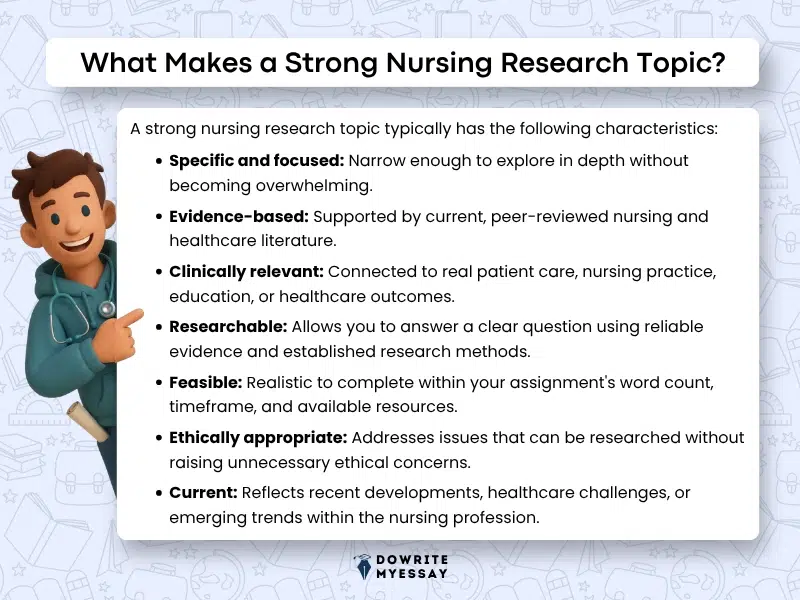
A strong nursing research topic typically has the following characteristics:
- Specific and focused: Narrow enough to explore in depth without becoming overwhelming.
- Evidence-based: Supported by current, peer-reviewed nursing and healthcare literature.
- Clinically relevant: Connected to real patient care, nursing practice, education, or healthcare outcomes.
- Researchable: Allows you to answer a clear question using reliable evidence and established research methods.
- Feasible: Realistic to complete within your assignment’s word count, timeframe, and available resources.
- Ethically appropriate: Addresses issues that can be researched without raising unnecessary ethical concerns.
- Current: Reflects recent developments, healthcare challenges, or emerging trends within the nursing profession.
Once you understand these characteristics, comparing different nursing research topics becomes much easier. Rather than choosing the first idea that sounds interesting, you can evaluate whether it offers enough depth, evidence, and practical relevance to support a well-developed nursing essay. The next step is learning how to identify and refine a topic that fits both your interests and your academic requirements.
How to Choose Nursing Research Topics
Finding the best nursing research topics starts with a structured approach rather than choosing the first idea that comes to mind. A topic should align with your assignment objectives, reflect current healthcare challenges, and provide enough reliable evidence to support a balanced academic discussion. Following the steps below will help you identify research topics in nursing that are both practical to investigate and capable of supporting a high-quality nursing essay.
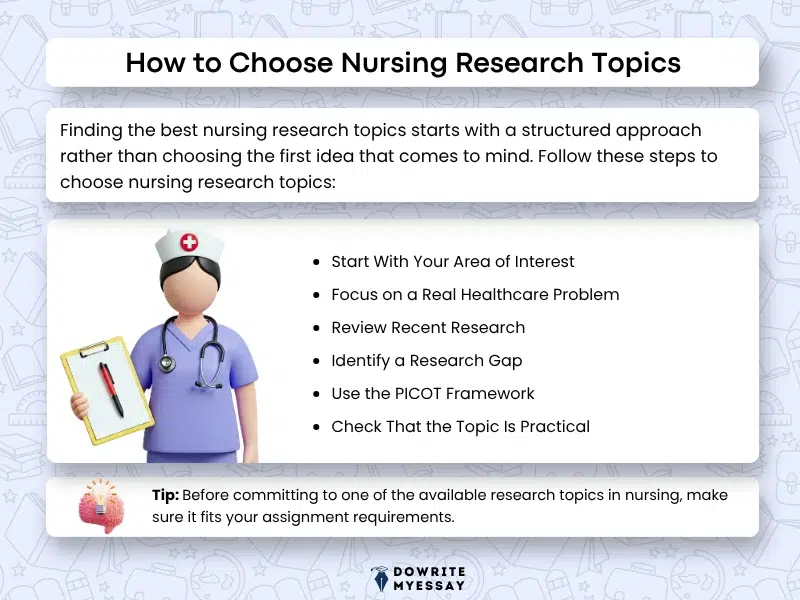
Start With Your Area of Interest
Think about the nursing specialty or healthcare setting that interests you most. Choosing nursing research topics related to areas such as adult nursing, mental health, pediatrics, community health, or critical care often makes the research process more engaging and helps you develop stronger clinical insights.
Focus on a Real Healthcare Problem
The strongest research topics in nursing are based on genuine clinical challenges rather than broad healthcare themes. Patient safety, medication adherence, infection prevention, chronic disease management, and nurse wellbeing are all examples of issues that continue to generate meaningful research and practical improvements in healthcare.
Review Recent Research
Before finalizing a topic, explore recent peer-reviewed journals and clinical guidelines to understand what has already been studied. This helps you avoid choosing outdated subjects while identifying areas where further investigation or a different perspective could add value.
Identify a Research Gap
Many excellent nursing research topics come from recognizing unanswered questions within existing literature. You might discover conflicting findings, underrepresented patient groups, emerging healthcare technologies, or changing clinical practices that create opportunities for further research.
Use the PICOT Framework
If you’re planning an evidence-based study, the PICOT framework can help transform a broad idea into a focused research question. Defining the patient population, intervention, comparison, outcome, and timeframe creates a clear direction for your research and keeps your investigation manageable.
Check That the Topic Is Practical
Before committing to one of the available research topics in nursing, make sure it fits your assignment requirements. Consider whether sufficient evidence is available, whether the topic can be covered within the required word count, and whether it is specific enough to support detailed analysis without becoming too narrow.
Once you’ve narrowed your options, the next step is to explore current trends shaping the nursing profession. These emerging areas can help you identify timely, evidence-based topics that reflect today’s healthcare priorities rather than subjects that have already been extensively researched.
Current Trends in Nursing Research
Healthcare continues to evolve as new technologies, patient needs, and clinical practices emerge, creating fresh opportunities for meaningful nursing research topics. Exploring current trends can help you identify research topics in nursing that are timely, evidence-based, and relevant to modern healthcare. These areas also offer access to recent studies, making it easier to build a well-supported nursing essay backed by up-to-date evidence.
Artificial Intelligence in Nursing
Artificial intelligence is increasingly being used to support clinical decision-making, patient monitoring, documentation, and workflow management. Research can explore how AI affects nursing efficiency, patient outcomes, ethical considerations, and the role of nurses in technology-driven healthcare.
Telehealth and Remote Patient Monitoring
The rapid growth of virtual healthcare has transformed how nurses deliver care beyond traditional clinical settings. Potential topics include patient satisfaction, chronic disease management, access to healthcare in rural communities, and the effectiveness of remote monitoring technologies.
Mental Health and Nurse Wellbeing
Growing concerns about stress, burnout, compassion fatigue, and workforce retention continue to make this one of the most important areas for nursing research topics. Research may examine workplace support, resilience strategies, leadership approaches, or interventions that improve nurses’ mental wellbeing.
Patient Safety and Quality Improvement
Improving patient outcomes remains a central focus of nursing research. Topics related to medication safety, fall prevention, infection control, pressure injury prevention, and communication during handovers continue to generate valuable evidence for clinical practice.
Nursing Informatics and Digital Health
Electronic health records, clinical decision support systems, mobile health applications, and wearable technologies are changing how patient information is collected and used. These developments create numerous research topics in nursing that examine technology adoption, data accuracy, workflow efficiency, and patient engagement.
Healthcare Equity and Cultural Competence
Reducing healthcare disparities has become an important priority across many healthcare systems. Research can investigate equitable access to care, culturally competent nursing practice, health literacy, social determinants of health, and strategies that improve outcomes for diverse patient populations.
These emerging areas highlight where nursing practice is evolving and where future research is likely to have the greatest impact. If you’re still unsure which direction to take, exploring topic ideas by nursing specialty can help you find a subject that aligns with both your academic interests and future career goals.
Nursing Research Topics by Specialty
One of the easiest ways to narrow down nursing research topics is to start with the specialty that interests you most. Different areas of nursing present different clinical challenges, patient populations, and evidence gaps, making some topics more suitable depending on your academic goals or future career plans. The research topics in nursing below are grouped by specialty to help you quickly identify ideas that are relevant, practical, and supported by current healthcare research.
Adult Nursing Research Topics
- Improving medication adherence among older adults with chronic illnesses.
- The impact of nurse-led education on diabetes self-management.
- Preventing hospital-acquired infections in adult medical wards.
- Strategies for reducing pressure injuries in hospitalized patients.
- Early recognition and management of sepsis in adult care.
- Improving pain assessment in postoperative patients.
- The role of nurses in preventing hospital readmissions.
- Fall prevention strategies for older adult patients.
- Managing multimorbidity in primary healthcare settings.
- Improving communication during patient discharge planning.
- Evidence-based approaches to wound care management.
- The effectiveness of patient education in hypertension management.
- Nursing interventions for patients with heart failure.
- Improving nutritional support for hospitalized adults.
- The role of nurses in promoting medication safety.
Mental Health Nursing Research Topics
- Reducing stigma surrounding mental health treatment.
- Nurse-led interventions for anxiety management.
- Improving therapeutic communication with psychiatric patients.
- Mental health support for adolescents.
- Burnout among mental health nurses.
- Suicide risk assessment in clinical settings.
- Trauma-informed nursing care.
- The effectiveness of cognitive behavioural interventions in nursing practice.
- Managing aggressive behaviour in psychiatric units.
- Supporting family members of patients with severe mental illness.
- Telepsychiatry and patient outcomes.
- Sleep quality among individuals with depression.
- Early intervention for eating disorders.
- Substance misuse and mental health nursing care.
- Improving patient engagement in mental health treatment.
Pediatric Nursing Research Topics
- Childhood vaccination awareness and parental decision-making.
- Pain management during pediatric procedures.
- Childhood obesity prevention through nurse-led education.
- Family-centred care in pediatric hospitals.
- Managing asthma in school-aged children.
- Early identification of developmental delays.
- Pediatric medication safety.
- Reducing anxiety before surgery in children.
- Supporting children with chronic illnesses.
- Infection prevention in neonatal and pediatric units.
- Childhood nutrition and healthy growth.
- Pediatric emergency nursing interventions.
- Improving communication with parents during hospitalization.
- Sleep disturbances in hospitalized children.
- Managing Type 1 diabetes in pediatric patients.
Community Health Nursing Research Topics
- Community-based strategies for preventing chronic diseases.
- Improving vaccination uptake in underserved communities.
- The nurse’s role in health promotion programmes.
- Addressing health literacy in vulnerable populations.
- Preventing lifestyle-related diseases through education.
- Community interventions for maternal health.
- Public health responses to infectious disease outbreaks.
- Home healthcare and patient satisfaction.
- Managing chronic diseases through community nursing.
- Rural healthcare accessibility and nursing practice.
- Health screening programmes and early detection.
- Community mental health initiatives.
- Smoking cessation programmes led by nurses.
- Reducing health inequalities through nursing interventions.
- Preventive healthcare education for older adults.
Critical Care and Emergency Nursing Research Topics
- Early recognition of patient deterioration.
- Reducing medication errors in emergency departments.
- Nurse staffing levels and patient outcomes in ICUs.
- Family involvement in critical care.
- Sepsis management protocols.
- Improving handover communication in emergency settings.
- Preventing ventilator-associated pneumonia.
- Managing compassion fatigue among ICU nurses.
- Rapid response teams and patient survival.
- Pain management in emergency care.
- Evidence-based resuscitation practices.
- Caring for critically ill older adults.
- Delirium prevention in intensive care.
- Emergency preparedness in healthcare facilities.
- Improving patient safety during emergency admissions.
The specialty you choose can significantly influence the direction of your research, but it isn’t the only factor to consider. Your level of study also affects the depth, complexity, and scope expected from your work. The next section explores nursing research topics that are better suited to undergraduate, postgraduate, and advanced nursing programmes.
Nursing Research Topics by Degree Level
The complexity of nursing research topics should reflect your academic level and the expectations of your programme. While undergraduate students are often encouraged to investigate practical clinical issues, postgraduate and doctoral students are expected to explore more complex problems, evaluate evidence critically, and contribute original insights to nursing practice. The research topics in nursing below are grouped by degree level to help you choose ideas that match your academic experience.
BSN Nursing Research Topics
Bachelor of Science in Nursing (BSN) students typically focus on evidence-based clinical practice, patient education, and quality improvement.
- The effectiveness of patient education in managing chronic diseases.
- Reducing medication errors through nurse-led interventions.
- Fall prevention strategies for older adult patients.
- Improving hand hygiene compliance in healthcare settings.
- The impact of nurse-patient communication on patient satisfaction.
- Pain management approaches in postoperative care.
- Preventing pressure injuries in hospitalized patients.
- The role of nurses in promoting healthy lifestyles.
- Improving discharge education to reduce hospital readmissions.
- Infection prevention practices in acute care settings.
- Supporting family involvement in patient care.
- Mental health awareness among nursing students.
- The effectiveness of vaccination education programmes.
- Improving patient safety through standardized nursing protocols.
- The impact of shift work on nursing performance.
MSN Nursing Research Topics
Master of Science in Nursing (MSN) students often investigate leadership, advanced clinical practice, healthcare policy, and evidence implementation.
- Leadership strategies that improve nursing team performance.
- The impact of nurse staffing on patient outcomes.
- Implementing evidence-based practice in clinical settings.
- Telehealth adoption in chronic disease management.
- Strategies for reducing nurse burnout and turnover.
- Improving interdisciplinary communication in hospitals.
- Nurse-led interventions for managing diabetes.
- Healthcare quality improvement initiatives in acute care.
- Cultural competence in advanced nursing practice.
- Evaluating patient-centred care models.
- The effectiveness of mentorship programmes for new nurses.
- Nursing leadership during healthcare emergencies.
- Improving medication safety through technology.
- Ethical decision-making in advanced nursing practice.
- Healthcare policy changes and their impact on nursing care.
DNP Nursing Research Topics
Doctor of Nursing Practice (DNP) projects usually focus on translating evidence into practice, improving healthcare systems, and leading clinical change.
- Implementing evidence-based interventions to reduce hospital-acquired infections.
- Improving patient outcomes through clinical decision support systems.
- Reducing emergency department overcrowding using quality improvement strategies.
- Evaluating nurse-led chronic disease management programmes.
- The role of artificial intelligence in clinical decision-making.
- Improving patient safety through healthcare technology.
- Developing quality improvement initiatives for medication safety.
- Enhancing transitional care to reduce readmissions.
- Leadership strategies for implementing organizational change.
- Evaluating telehealth services in rural healthcare.
- Improving sepsis recognition through standardized protocols.
- Nurse-led initiatives to improve healthcare equity.
- Strengthening patient engagement through digital health tools.
- Evaluating workforce resilience programmes for nurses.
- Evidence-based strategies to improve healthcare quality.
Final-Year Nursing Research Topics
Final-year students often benefit from choosing nursing research topics that combine clinical relevance with a manageable scope. A focused topic supported by current evidence is usually more effective than an ambitious subject that cannot be explored thoroughly.
- Improving medication adherence among older adults.
- Nurse-led interventions for hypertension management.
- Preventing falls in long-term care facilities.
- The effectiveness of patient education after surgery.
- Infection prevention in intensive care units.
- Reducing compassion fatigue among nurses.
- Telehealth for managing chronic conditions.
- Mental health support for university students.
- Improving communication during patient handovers.
- The role of nurses in promoting vaccination uptake.
- Pressure injury prevention in hospitalized patients.
- Pain assessment in older adults with dementia.
- Healthcare literacy and patient outcomes.
- Improving diabetes self-management through nursing education.
- The impact of teamwork on patient safety.
Choosing topics that match your academic level helps ensure your research is both achievable and appropriately challenging. Once you’ve identified a suitable direction, the next step is refining your idea into a focused project, whether you’re preparing a capstone, thesis, or dissertation.
Nursing Research Topics for Capstone, Thesis, and Dissertation Projects
Capstone projects, theses, and dissertations all require nursing research topics that go beyond describing a healthcare issue. They should investigate a clearly defined problem, draw on current evidence, and offer findings or recommendations that can improve nursing practice. Although the expected depth increases with each academic level, the most successful research topics in nursing remain focused, feasible, and clinically relevant.
Nursing Capstone Project Topics
Capstone projects are designed to apply evidence-based knowledge to real clinical settings and improve patient care or nursing practice.
- Reducing medication administration errors through standardized nursing protocols.
- Improving hand hygiene compliance among healthcare professionals.
- Nurse-led interventions to reduce hospital readmissions.
- Fall prevention strategies in long-term care facilities.
- Enhancing patient education for diabetes self-management.
- Improving pressure injury prevention practices.
- Evaluating bedside shift reporting and patient satisfaction.
- Reducing catheter-associated urinary tract infections.
- Promoting vaccination awareness in community healthcare.
- Improving discharge planning for older adult patients.
- Enhancing pain management through evidence-based nursing interventions.
- Nurse-led smoking cessation programmes.
- Improving communication during multidisciplinary care.
- Evaluating early sepsis screening protocols.
- Strategies to reduce burnout among newly registered nurses.
Nursing Thesis Topics
A nursing thesis usually requires more critical analysis and a stronger theoretical foundation than a capstone project, allowing students to examine complex healthcare issues in greater depth.
- The relationship between nurse staffing levels and patient safety.
- The effectiveness of telehealth in chronic disease management.
- Factors influencing medication adherence among older adults.
- The impact of cultural competence on patient outcomes.
- Nurse leadership and healthcare quality improvement.
- The effectiveness of simulation-based nursing education.
- Patient-centred approaches to chronic pain management.
- Mental health support strategies for frontline nurses.
- Healthcare disparities affecting maternal health outcomes.
- Nursing interventions that reduce hospital-acquired infections.
- Artificial intelligence and its influence on nursing practice.
- Improving healthcare communication through digital technologies.
- The role of evidence-based practice in improving clinical outcomes.
- Evaluating nurse resilience programmes in high-pressure environments.
- Strategies for improving patient engagement in long-term care.
Nursing Dissertation Topics
Dissertation-level research should contribute new knowledge or provide deeper insight into issues affecting nursing education, leadership, clinical practice, or healthcare systems.
- The long-term impact of nurse staffing policies on patient outcomes.
- Artificial intelligence in clinical decision-making and nursing practice.
- Leadership models that improve healthcare quality and patient safety.
- Digital health technologies and their effect on nursing workflows.
- Strategies for improving healthcare equity through nursing practice.
- The effectiveness of interdisciplinary collaboration in complex patient care.
- Predictors of nurse burnout and workforce retention.
- Evaluating quality improvement initiatives in acute care hospitals.
- The influence of nursing informatics on evidence-based decision-making.
- The role of advanced practice nurses in chronic disease management.
- Healthcare policy changes and their impact on nursing services.
- Ethical challenges associated with emerging healthcare technologies.
- Remote patient monitoring and long-term patient outcomes.
- Improving clinical decision support systems for nursing professionals.
- The future of evidence-based nursing practice in technology-driven healthcare.
While selecting the right project type is important, even the strongest ideas can become difficult to manage if they’re too broad. Before committing to a topic, it’s worth learning how to refine a general subject into a focused research question that is realistic to investigate and supported by sufficient evidence.
How to Narrow a Broad Nursing Research Topic
Many students begin with broad nursing research topics that seem easy to research but quickly become difficult to manage. Subjects like patient safety, diabetes, or mental health cover numerous populations, settings, and interventions, making it challenging to develop a focused argument. Narrowing your topic helps you identify a specific research problem, locate more relevant evidence, and produce a stronger nursing essay supported by meaningful analysis. The same approach applies to all research topics in nursing, regardless of your specialty or academic level.
The easiest way to refine a topic is to move from a broad healthcare issue to a specific patient group, clinical setting, intervention, or outcome.
| Broad Topic | Narrowed Research Topic |
| Patient Safety | The effectiveness of bedside shift reporting in reducing communication errors among hospital nurses. |
| Diabetes Management | Nurse-led education programmes that improve medication adherence in older adults with Type 2 diabetes. |
| Mental Health | The impact of mindfulness interventions on stress among undergraduate nursing students. |
| Infection Prevention | Hand hygiene compliance among intensive care nurses and its effect on hospital-acquired infections. |
| Telehealth | The effectiveness of remote patient monitoring for adults with chronic heart failure. |
| Pain Management | Non-pharmacological nursing interventions for postoperative pain following orthopedic surgery. |
| Nurse Burnout | Factors contributing to burnout among emergency department nurses working rotating shifts. |
| Pediatric Nursing | Parent education strategies that improve asthma management in school-aged children. |
If you’re still unsure whether your topic is focused enough, ask yourself these questions before making a final decision:
- Does the topic investigate one clearly defined healthcare issue?
- Can you identify a specific patient population or clinical setting?
- Is there enough recent, peer-reviewed evidence to support your discussion?
- Can the topic be covered within your assignment’s word count?
- Does it allow you to answer a clear research question instead of simply describing a healthcare problem?
Once you’ve refined your idea, the next step is developing a research question that guides your literature search and keeps your investigation focused. A well-defined research question provides a clear direction for gathering evidence and building a logical academic argument.
Examples of Strong Nursing Research Questions
After narrowing your nursing research topics, the next step is turning your chosen subject into a focused research question. A strong question defines exactly what you want to investigate and helps guide your literature search, evidence selection, and academic discussion. Many research topics in nursing become much easier to manage when they are framed around a specific patient population, intervention, or healthcare outcome.
The PICOT framework is widely used in evidence-based nursing to develop clear and researchable questions.
| Topic Area | Example Research Question |
| Medication Adherence | How effective are nurse-led education programmes in improving medication adherence among older adults with Type 2 diabetes? |
| Infection Prevention | Does regular hand hygiene training reduce hospital-acquired infections in intensive care units? |
| Mental Health | How does mindfulness training affect stress levels among undergraduate nursing students during clinical placements? |
| Patient Safety | What impact does bedside shift reporting have on communication errors in acute care hospitals? |
| Telehealth | Does remote patient monitoring improve self-management in patients with chronic heart failure? |
| Pediatric Nursing | How effective is parent education in reducing asthma-related hospital admissions among school-aged children? |
| Nurse Burnout | Which workplace interventions are most effective in reducing burnout among emergency department nurses? |
| Pain Management | Do non-pharmacological nursing interventions improve postoperative pain outcomes compared with standard care? |
Regardless of the specialty you choose, a strong research question should be:
- Specific enough to investigate within your assignment.
- Supported by recent, high-quality evidence.
- Focused on a measurable healthcare outcome.
- Relevant to current nursing practice.
- Practical to complete within your available time and resources.
A well-structured research question provides a clear direction for your entire assignment, but it’s only one part of selecting a successful topic. University instructors also evaluate whether your topic demonstrates academic value, critical thinking, and clinical relevance. Understanding these expectations can help you choose nursing research topics that are more likely to meet assessment criteria and produce stronger academic work.
How Professors Evaluate Nursing Research Topics
Selecting one of the many available nursing research topics is only the first step. Before approving a topic, instructors typically assess whether it is suitable for academic research, supported by credible evidence, and capable of producing meaningful analysis. The strongest research topics in nursing demonstrate a clear purpose, address a relevant healthcare issue, and provide enough scope for critical discussion rather than simple description.
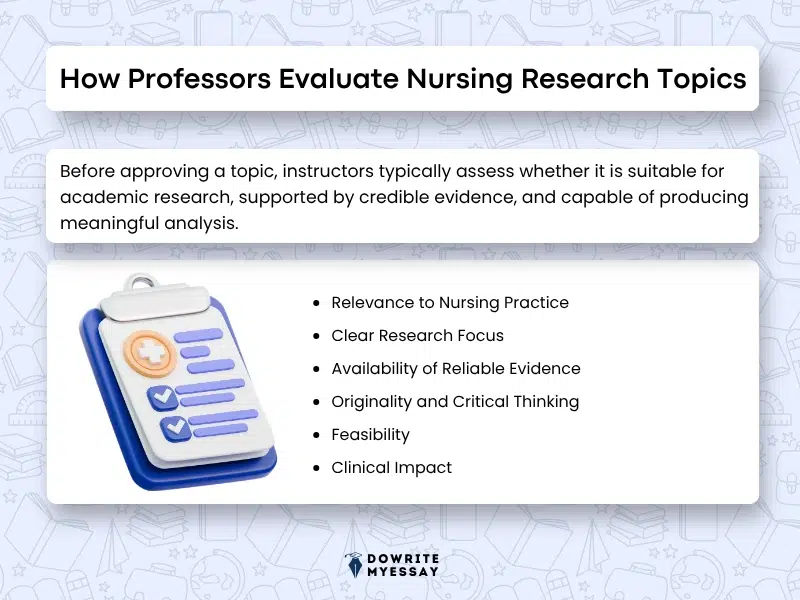
Relevance to Nursing Practice
A strong topic should address an issue that affects patient care, nursing education, healthcare delivery, or clinical decision-making. Research with practical applications is generally more valuable than topics that are purely theoretical.
Clear Research Focus
Broad subjects often lead to unfocused discussions. Professors prefer topics that investigate one specific problem, patient population, intervention, or healthcare setting, making it easier to produce a logical and evidence-based analysis.
Availability of Reliable Evidence
A research topic should be supported by sufficient peer-reviewed literature, clinical guidelines, and recent studies. Choosing a topic with limited evidence can make it difficult to develop balanced arguments or support your findings effectively.
Originality and Critical Thinking
Your topic doesn’t need to explore a completely new healthcare issue, but it should encourage critical evaluation rather than simply summarizing existing information. Examining a familiar issue from a different perspective often leads to stronger academic work.
Feasibility
One of the most overlooked aspects of choosing nursing research topics is practicality. A topic should be realistic to investigate within your assignment’s scope, available resources, and submission deadline without becoming too broad or overly complex.
Clinical Significance
The best research topics in nursing contribute to improving patient outcomes, nursing practice, healthcare quality, or evidence-based decision-making. Demonstrating why your research matters strengthens both your topic selection and your overall academic discussion.
Understanding these evaluation criteria makes it much easier to choose a topic that meets academic expectations from the beginning. Before finalizing your choice, however, it’s worth seeing how a carefully selected research topic can be developed into a well-structured nursing assignment supported by evidence and critical analysis.
From Research Topic to a Strong Nursing Essay
Choosing from a range of nursing research topics is only the beginning of the writing process. Once you’ve selected a focused topic and developed a clear research question, the next challenge is organizing your evidence into a logical academic discussion. This means evaluating research critically, connecting evidence to nursing practice, and presenting well-supported arguments instead of simply summarizing sources.
If you’re unsure how a finished assignment should bring these elements together, reviewing well-structured nursing essay examples can be a useful next step. Seeing how evidence is integrated, arguments are developed, and research findings are applied in practice can help you understand what distinguishes an average nursing essay from one that meets higher academic standards.
Before you begin writing, it’s also worth checking for common mistakes that can weaken even well-chosen research topics in nursing. Avoiding these issues early can save time and strengthen the overall quality of your assignment.
Common Mistakes Students Make When Choosing Nursing Research Topics
Even well-planned assignments can become difficult if the initial topic is poorly chosen. Many students select nursing research topics that sound interesting without considering whether they are practical, supported by evidence, or suitable for academic analysis. Recognizing these common mistakes early will help you choose research topics in nursing that are easier to research and more likely to meet your instructor’s expectations.
Choosing a Topic That Is Too Broad
Broad subjects such as patient safety or mental health cover countless issues, making it difficult to develop a focused discussion. Narrowing your topic to a specific patient group, intervention, or healthcare setting creates a much clearer direction for your research.
Ignoring Available Evidence
A good idea still needs strong academic support. Before finalizing your topic, make sure there are enough recent peer-reviewed studies, clinical guidelines, and reliable sources to build well-supported arguments.
Selecting an Outdated Topic
Healthcare practices continue to evolve, and older topics may no longer reflect current nursing standards. Choosing recent and evidence-based nursing research topics helps ensure your discussion remains relevant and supported by contemporary literature.
Making the Topic Too Narrow
A highly specific subject may leave you struggling to find enough quality research. Aim for a topic that is focused without limiting the amount of available evidence.
Overlooking Assignment Requirements
Your chosen topic should match your assignment objectives, academic level, and word count. A dissertation-level subject may not be appropriate for a short undergraduate nursing essay, while an overly simple topic may not provide enough depth for postgraduate study.
Choosing a Topic You’re Not Interested In
Research takes time, and staying engaged throughout the process makes a noticeable difference. Selecting research topics in nursing that genuinely interest you often leads to more thoughtful analysis and stronger academic writing.
Avoiding these mistakes gives you a much stronger starting point, but it’s equally important to evaluate your topic before beginning your research. The checklist below provides a quick way to determine whether your chosen idea is ready to develop into a successful nursing assignment.
Nursing Research Topic Selection Checklist
Before you begin researching, take a few minutes to evaluate your chosen topic. The best nursing research topics are not only interesting but also practical, evidence-based, and suitable for your assignment requirements. If you can answer “Yes” to most of the questions below, your topic is likely to provide a strong foundation for a well-supported nursing essay.
| Checklist | ✓ |
| Is the topic focused on one clearly defined healthcare issue? | ☐ |
| Is it relevant to current nursing practice or patient care? | ☐ |
| Can you find enough recent, peer-reviewed evidence to support it? | ☐ |
| Is the scope manageable within your assignment’s word count? | ☐ |
| Does it address a meaningful research question rather than simply describing a topic? | ☐ |
| Can the findings contribute to evidence-based nursing practice? | ☐ |
| Is the topic ethical and appropriate to investigate? | ☐ |
| Does it match your academic level and assignment objectives? | ☐ |

Conclusion: Choosing a Nursing Research Topic with Confidence
Choosing the right nursing research topics is more than simply meeting an assignment requirement. It shapes the direction of your research, influences the quality of evidence you can gather, and determines how effectively you can develop a clear, well-supported nursing essay. A carefully selected topic allows you to investigate real clinical challenges, apply evidence-based practice, and demonstrate the critical thinking that nursing educators expect at every academic level.
As you explore different research topics in nursing, focus on ideas that are specific, clinically relevant, and supported by current literature rather than choosing subjects that are overly broad or difficult to investigate. Taking the time to refine your topic, develop a focused research question, and evaluate the available evidence will make every stage of the writing process more manageable. Whether you’re preparing an undergraduate assignment or an advanced research project, a strong topic provides the foundation for meaningful analysis, stronger academic arguments, and research that reflects current nursing practice.
Frequently Asked Questions
Find quick answers to the most common questions about selecting and developing strong nursing research topics.