

Key Takeaways
- A body paragraph focuses on one main idea that supports your thesis.
- To understand how to write a body paragraph, follow a clear structure:
topic sentence → supporting evidence → analysis → linking sentence. - A strong body paragraph for an essay explains evidence instead of just presenting it.
- Use structured approaches like PEEL, TEEL, or PIE to improve clarity and flow.
- Keep paragraphs 5–8 sentences long and maintain logical progression.
- Effective paragraph development in essays depends on clarity, relevance, and coherence.
- Avoid common issues like weak topic sentences, missing analysis, and poor transitions.
A body paragraph is where you develop one main idea that supports your thesis. If you want to learn how to write a body paragraph, this is the section where your argument is built using evidence and explanation.
Each body paragraph for an essay focuses on one point, supported by relevant evidence and clear analysis. This is what drives argument development in writing and keeps your essay logical and structured.
In simple terms, your thesis presents the idea, and your body paragraphs prove it.
If you’re still struggling to connect these parts effectively, don’t worry, the experts at our essay writing service can provide fully structured essays where each paragraph clearly supports the thesis and maintains logical flow.
Now, let’s break down the key elements of a body paragraph.

What Are the Key Elements of a Body Paragraph? (Core Structure)
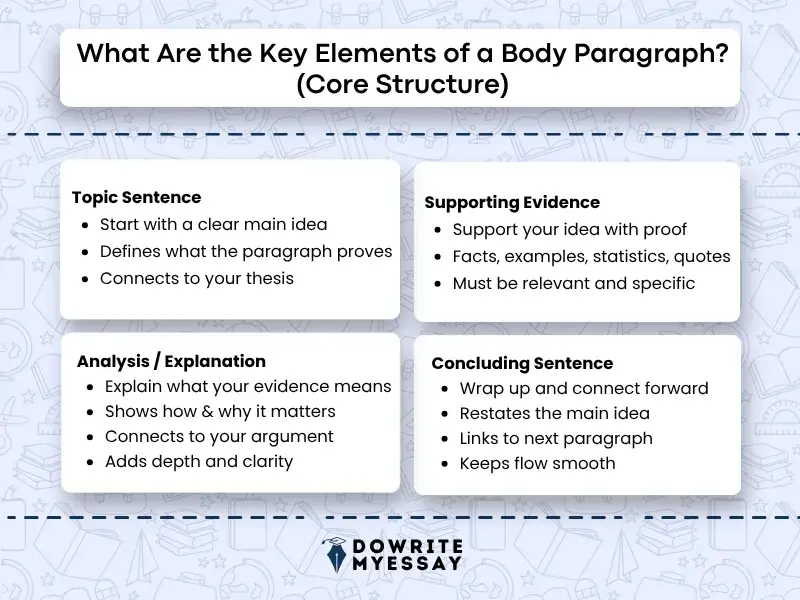
To understand how to write a body paragraph, you need to break it into clear, functional parts. A strong body paragraph for an essay is not just a block of text. It follows a structured flow that helps the reader understand your idea step by step. Each part has a specific role, and missing even one can weaken your argument.
1. Topic Sentence
The topic sentence is the starting point of your paragraph. It introduces the main idea or claim you want to explain. This sentence must be clear, specific, and directly connected to your thesis statement.
A weak topic sentence often leads to confusion because the reader does not know what the paragraph is trying to prove. On the other hand, a strong topic sentence sets direction and keeps the paragraph focused on one idea.
2. Supporting Evidence
After the topic sentence, you need proof. This is where supporting evidence in essays comes in. Evidence can include facts, statistics, examples, or quotations depending on the type of essay you are writing.
However, not all evidence is useful. Strong evidence must be:
- Relevant to your main idea
- Specific and clear
- Directly connected to your claim
Simply adding information is not enough. The evidence must actually support the point you introduced in your topic sentence.
3. Analysis / Explanation
This is the most important part of the paragraph and where most students go wrong. Many think writing a body paragraph means adding evidence, but without explanation, the paragraph remains incomplete.
In this section, you explain:
- How the evidence supports your claim
- Why it is important
- What it shows in relation to your thesis
This is what builds argument development in writing and adds depth. Good analytical paragraph writing makes your argument clear instead of leaving it for the reader to guess.
4. Concluding / Linking Sentence
All the pieces of the paragraph come together in the conclusion. A transitional sentence restates the main idea and connects the final paragraph with the following paragraph. A seamless connection between paragraphs will keep your essay cohesive and allow it to flow easily from paragraph to paragraph.
If paragraphs lack a clear finish, they may not provide a sense of completion, or they may not relate to one another properlyA good conclusion sentence will help to move your argument along in your essay.
Overall Structure You Should Follow
A well-written paragraph follows a clear and logical flow:
Topic Sentence → Evidence → Analysis → Link
This structure ensures:
- Clarity
- Logical progression
- Strong connection to the thesis
- Better paragraph organization strategies
A strong paragraph always starts with a clear idea. If the opening is weak, the entire paragraph loses direction, which is why learning how to write an essay introduction properly is important before developing your arguments.
Now that you understand the core structure, the next step is learning the common methods used to organize body paragraphs effectively.
3 Common Structures for Writing a Body Paragraph
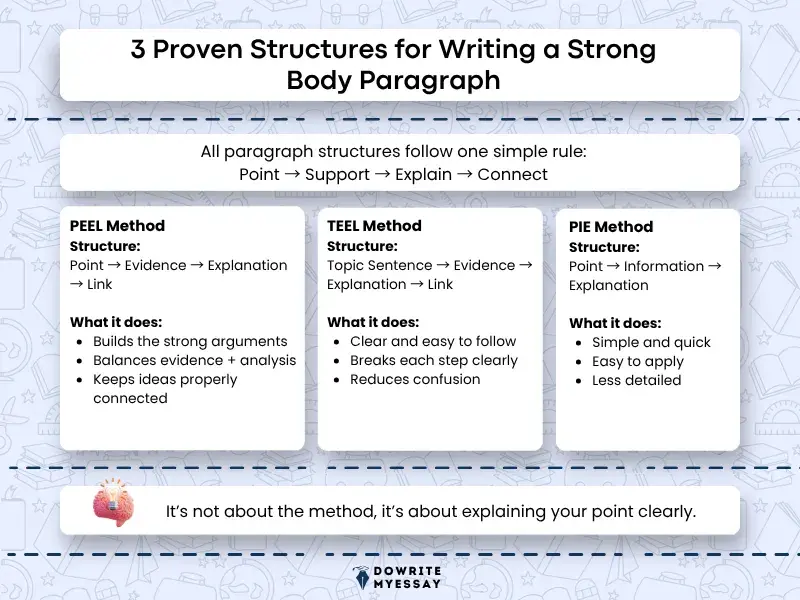
Now that you understand the core elements, the next step in learning how to write a body paragraph is choosing a structure that helps you organize those elements clearly. Different frameworks exist, but they all follow the same logic: present a point, support it, and explain it. Using a structured method improves paragraph development in essays and makes your writing easier to follow.
1. PEEL Method (Point, Evidence, Explanation, Link)
The PEEL method is one of the most widely used approaches in academic writing. It follows a simple and effective flow:
- Point → Your main idea (topic sentence)
- Evidence → Proof to support the idea
- Explanation → Analysis of the evidence
- Link → Connect back to the thesis or next paragraph
Point: Social media can negatively affect students’ focus.
Evidence: Studies show that students who frequently check social media during study sessions have lower concentration levels.
Explanation: This happens because constant notifications interrupt deep thinking and reduce the ability to stay engaged with tasks.
Link: As a result, excessive social media use weakens academic performance.
This method works well for most essay types because it ensures balance between evidence and explanation. It also supports strong argument development in writing by keeping everything clearly connected.
2. TEEL Method (Topic Sentence, Evidence, Explanation, Link)
The TEEL method is very similar to PEEL but slightly more explicit in structure:
- Topic Sentence → Introduces the idea
- Evidence → Supports the claim
- Explanation → Interprets the evidence
- Link → Connects the idea forward
Topic Sentence: Regular exercise improves mental health.
Evidence: Research indicates that physical activity reduces stress and anxiety levels.
Explanation: Exercise releases endorphins, which help improve mood and reduce negative thinking.
Link: Therefore, regular physical activity contributes to better emotional well-being.
This method is especially useful for beginners learning academic paragraph structure, as it clearly separates each part of the paragraph.
3. PIE Method (Point, Information, Explanation)
The PIE method is a simpler version:
- Point → Main idea
- Information → Supporting detail
- Explanation → Meaning and relevance
Point: Reading regularly improves vocabulary.
Information: Readers are exposed to new words in different contexts.
Explanation: This repeated exposure helps them understand and use new vocabulary naturally.
This structure is often used in shorter essays or when less detailed analysis is required. However, it still follows the same core principle of evidence-based paragraph writing.
Quick Comparison (When to Use Each)
- PEEL → Best for balanced, well-developed arguments
- TEEL → Best for learning and structured writing
- PIE → Best for shorter or simpler paragraphs
All these methods follow the same core idea:
One point → supported with evidence → clearly explained → connected to the main argument.
Now that you understand these structures, the next step is learning how to write a body paragraph step by step.
How to Write a Body Paragraph (Step-by-Step Process)
Now that you understand the structure and common frameworks, the next step in learning how to write a body paragraph is applying them in a clear, repeatable process. A strong body paragraph for an essay is not written randomly. It is built step by step, with each part serving a purpose.
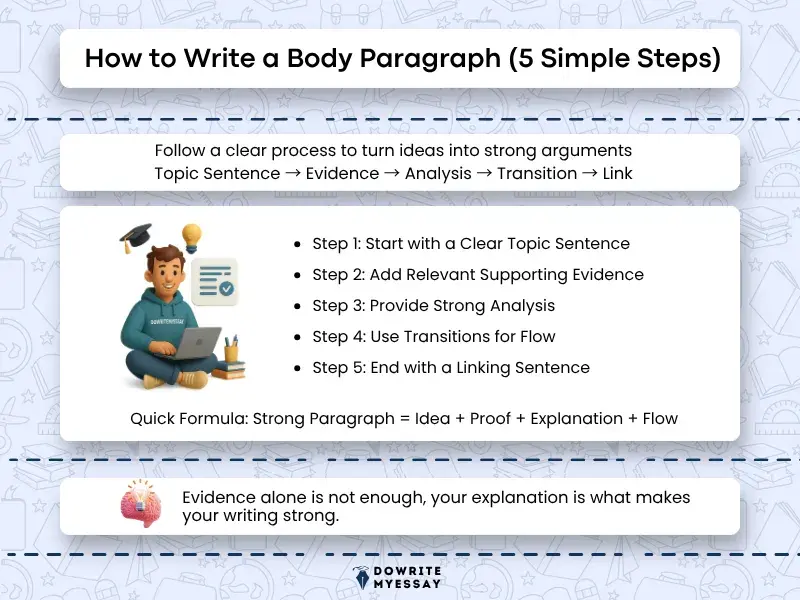
Step 1: Start with a Clear Topic Sentence
The first sentence in each paragraph should state an idea/point. The first sentence in each paragraph is called a “topic sentence”. A topic sentence must be relevant to your thesis statement and give an overview of what will be discussed in that paragraph.
A good topic sentence is:
- Specific
- Direct
- Focused on one idea
This sets the direction for the entire paragraph.
Step 2: Add Relevant Supporting Evidence
Once your idea is clear, support it with evidence. This can include facts, examples, data, or quotations depending on your essay type.
Strong supporting evidence in essays should:
- Directly support your point
- Be specific and clear
- Add real value to your argument
Avoid adding general or unrelated information.
Step 3: Provide Strong Analysis
This is where your paragraph becomes effective. After presenting evidence, you must explain it.
Your analysis should answer:
- What does this evidence show?
- Why is it important?
- How does it support the main idea?
This step builds argument development in writing and adds depth. Without it, your paragraph will feel incomplete.
Step 4: Use Transitions for Flow
To maintain paragraph cohesion, use transition words and phrases within your paragraph. This helps connect ideas and improves readability.
Examples include:
- “This shows that…”
- “As a result…”
- “In addition…”
Strong transitions improve paragraph organization strategies and make your writing smoother.
Step 5: End with a Linking Sentence
In the last sentence, you need to restate your topic and connect this paragraph to the next point or connect it back to your thesis statement.
By doing this, you are helping create a cohesive transition between paragraphs and greater cohesion in your overall essay.
Simple Example (Putting It All Together)
Topic Sentence: Technology has improved access to education.
Evidence: Online learning platforms allow students to access courses from anywhere in the world.
Analysis: This removes geographical barriers and gives more people the opportunity to learn.
Link: As a result, technology plays a key role in expanding educational opportunities.
A well-written paragraph follows this flow:
Topic Sentence → Evidence → Analysis → Link
Once your ideas are fully developed using this process, the next step is bringing them together effectively, which is where understanding how to write a conclusion for an essay becomes important.
Now that you know the process, the next step is understanding how body paragraphs support your overall thesis.
How Body Paragraphs Support Your Thesis Statement
Once you understand how to write a body paragraph, the next step is knowing what its purpose is in the full essay. A body paragraph for an essay is not written in isolation. Its main role is to support and strengthen your thesis statement.
Your thesis presents the overall argument. Each body paragraph takes one part of that argument and develops it clearly. This is how argument development in writing works:
- The thesis gives the main idea
- Each paragraph explains one piece of that idea
- Together, they build a complete argument
Connection Between Paragraph and Thesis
Every body paragraph should:
- Focus on one main claim
- Directly relate to the thesis
- Add new support without repeating earlier points
If a paragraph does not clearly connect back to the thesis, it weakens the entire essay. This is why relevance to thesis is one of the most important qualities of strong writing.
How the Structure Supports the Thesis
A well-structured paragraph follows this flow:
- Topic Sentence → introduces a point related to the thesis
- Evidence → supports that point
- Analysis → explains how it connects to the thesis
- Link → reinforces the argument
This structure ensures that every paragraph contributes to the overall argument instead of just adding information.
Example (Thesis Connection in Action)
Thesis: Technology has improved education by increasing access and flexibility.
Body Paragraph Idea: Online learning improves access
- Topic Sentence: Online learning has made education more accessible.
- Evidence: Students can now attend courses from different countries through online platforms.
- Analysis: This removes location barriers and allows more people to access education.
- Link: Therefore, online learning directly supports the idea that technology improves access.
Thesis: Technology has improved education by increasing access and flexibility.
Body Paragraph Idea: Online learning improves access
Topic Sentence: Online learning has made education more accessible.
Evidence: Students can now attend courses from different countries through online platforms.
Analysis: This removes location barriers and allows more people to access education.
Link: Therefore, online learning directly supports the idea that technology improves access.
✔ This shows how one paragraph supports one part of the thesis.
Why This Matters
Strong paragraph cohesion ensures that:
- Your essay stays focused
- Your ideas connect logically
- Your argument builds step by step
Without this connection, your essay may feel scattered or unclear, even if each paragraph is written well on its own.
Now that you understand how body paragraphs support your thesis, the next step is seeing a complete example with a detailed breakdown.
Body Paragraph Example (With Breakdown)
Understanding structure is one thing, but seeing it applied makes it much clearer. Below is a complete body paragraph for an essay, followed by a breakdown of each part so you can see exactly how it works in practice.
Breakdown of the Paragraph
1. Topic Sentence
“Technology has significantly improved access to education.”
- Clearly introduces the main idea
- Directly connects to a broader thesis about technology and education
2. Supporting Evidence
“Online learning platforms allow students to attend courses from anywhere in the world.”
- Provides a clear and relevant example
- Supports the main claim with a real-world idea
3. Analysis / Explanation
“This means that students who live in remote areas or have limited access to schools can still receive quality education.”
- Explains how the evidence supports the idea
- Adds depth and clarity to the argument
4. Concluding / Linking Sentence
“As a result, technology has made learning more inclusive and widely available.”
- Reinforces the main idea
- Connects back to the overall argument
What This Example Shows
- Clear topic → evidence → analysis → link structure
- Strong paragraph development in essays
- Logical progression of ideas
- Direct connection to the thesis
This is a simple but effective model of how to write a body paragraph. Once you can structure paragraphs like this, your writing becomes clearer, more organized, and more persuasive.
Now that you’ve seen a complete example, the next step is understanding how body paragraph formats can vary across different essay types.
Body Paragraph Formats for Different Essay Types
Now that you understand how to write a body paragraph, it’s important to know that the structure can change slightly depending on the type of essay. The core idea stays the same, but the way you present evidence and analysis may vary. Adapting your body paragraph for an essay based on the essay type improves clarity and relevance.
1. Argumentative Essay
In an argumentative essay, the goal is to prove a claim using strong evidence and reasoning.
Focus:
- Clear claim (topic sentence)
- Strong evidence
- Detailed analysis
- Logical reasoning
✔ Emphasis on argument development in writing and logical support.
2. Analytical Essay
In an analytical essay, you break down and examine an idea, text, or concept.
Focus:
- Interpretation of evidence
- Deep analysis
- Explanation of meaning
✔ Emphasis on analytical paragraph writing and interpretation.
3. Descriptive Essay
In a descriptive essay, the goal is to create a clear and vivid picture.
Focus:
- Sensory details
- Imagery
- Clear description
✔ Less focus on argument, more on description and clarity.
4. Narrative Essay
In a narrative essay, the paragraph tells part of a story.
Focus:
- Sequence of events
- Personal experience
- Clear progression
✔ Focus on flow and storytelling rather than formal analysis.
Now that you understand how body paragraphs vary by essay type, the next step is identifying common mistakes you should avoid while writing them.
Common Mistakes to Avoid in Body Paragraph Writing
Even if you understand how to write a body paragraph, certain common mistakes can weaken your writing. A strong body paragraph for an essay is not just about structure. It also depends on clarity, focus, and proper development of ideas. Avoiding these mistakes will improve your paragraph development in essays and make your argument stronger.
1. Weak or Unclear Topic Sentence
A topic sentence that is too vague or broad makes the paragraph confusing. If the reader cannot understand the main idea from the first sentence, the rest of the paragraph loses direction.
Weak:
“Technology is important.”
Strong:
“Technology has improved access to education by making online learning widely available.”
2. Adding Evidence Without Explanation
Many students use to include but fail to give what their evidence means; It is the most common mistake students make when writing analytical paragraphs. Students present facts but do not explain their meaning.
3. Including Irrelevant or Off-Topic Content
A body paragraph should focus on one idea. Adding unrelated information breaks the flow and weakens the argument.
4. Lack of Transitions and Flow
A lack of transitional sentences means a lack of flow, which results in an overall sense of disorganization.
5. Repetition Instead of Development
Repeating the same idea in different words does not add value. A strong paragraph should move forward, not stay in the same place.
6. Weak or Missing Conclusion Sentence
Ending a paragraph without a proper linking sentence makes it feel incomplete.
Why Avoiding These Mistakes Matters
These issues reduce:
- Clarity
- Logical progression
- Argument strength
Fixing them improves academic paragraph structure, making your writing more effective and easier to follow.
Now that you know what to avoid, the next step is learning the best practices that help you consistently write strong body paragraphs.
Best Practices for Writing a Strong Body Paragraph
Once you understand how to write a body paragraph, the next step is applying consistent practices that improve clarity and quality. A strong body paragraph for an essay is not just correct in structure. It is also clear, focused, and well-developed.
1. Focus on One Idea Only
Each paragraph should develop a single point. Trying to include multiple ideas weakens clarity and makes your argument harder to follow.
✔ One paragraph = one idea
2. Keep It Clear and Direct
Avoid complicated or vague sentences. Strong academic paragraph structure depends on clarity.
✔ Use simple, direct sentences that clearly explain your point
3. Use Strong Evidence and Explain It Properly
Good supporting evidence in essays should be relevant and specific. More importantly, it must be explained.
✔ Always follow evidence with clear analysis
4. Maintain Logical Progression
Your paragraph should flow naturally from one sentence to the next. Each sentence should build on the previous one.
✔ This improves paragraph cohesion and readability
5. Use Transitions Smoothly
Transitions help connect ideas and improve flow within the paragraph.
✔ Use them naturally, not excessively
6. Keep the Length Balanced
A typical body paragraph should be around 5–8 sentences, depending on the level of detail required.
✔ Too short = weak development
✔ Too long = unclear focus
7. Stay Connected to the Thesis
Every paragraph must clearly relate to the main argument. If it does not support the thesis, it should not be included.
✔ This ensures strong argument development in writing
8. Aim for Clarity, Not Complexity
Avoid overcomplicating your writing with unnecessary words or forced explanations. Clear writing is stronger than complex writing.
✔ Focus on meaning, not sounding advanced
Why These Practices Matter
Following these best practices improves:
- Clarity
- Coherence
- Logical structure
- Overall writing quality
They help you write paragraphs that are not only correct but also effective.
Now that you understand the best practices, the next step is using a quick checklist to review your body paragraphs before finalizing your essay.
Checklist: Body Paragraph Writing Quick Guide
Before you finalize your paragraph, use this checklist to make sure your body paragraph for an essay is complete and effective. This step helps you apply everything you’ve learned about how to write a body paragraph in a practical way.
Structure Check
- Does each body paragraph contain either one main idea or a broad idea and examples?
- Is there one main idea only?
- Does the paragraph follow a clear flow:
topic → evidence → analysis → link
Evidence and Analysis Check
- Have you provided enough evidence for all main ideas with at least one example for each?
- Is the evidence specific and clearly connected to the idea?
- Have you explained the evidence properly (not just stated it)?
Clarity and Coherence Check
- Are the sentences clear and easy to understand?
- Does each sentence connect logically to the next?
- Have you used transitions where needed?
Thesis Connection Check
- Does the paragraph clearly support your thesis statement?
- Is the main idea relevant to your overall argument?
Quality Check
- Is the paragraph around 5–8 sentences?
- Have you avoided repetition and off-topic content?
- Does the paragraph end with a proper linking sentence?
A strong body paragraph is not just written once. It is checked and refined to make sure every point supports the overall argument and contributes to a well-structured essay. If you’re working under a tight deadline and need a complete essay that follows the same principles of clarity, organization, and original writing, you can buy your essay online tailored to your task requirements and academic standards.
Conclusion: Build Strong Arguments One Paragraph at a Time
A strong essay is built on strong paragraphs. If you understand how to write a body paragraph, you can develop clear ideas, support them with evidence, and explain them effectively. This is what turns a basic essay into a well-structured and convincing piece of writing.
Each body paragraph for an essay should focus on one idea, follow a clear structure, and stay connected to the thesis. When you combine multiple well-written paragraphs, your argument becomes stronger, more logical, and easier to follow.
The key is consistency. Use a clear structure, support your ideas properly, and always explain your evidence. Over time, this process becomes natural and improves your overall writing quality.
Now that you understand how body paragraphs work, you’re better prepared to write essays that are clear, organized, and effective.
Frequently Asked Questions About Body Paragraphs
Mastering the structure of your body paragraphs is key to a strong argument. Here are answers to the most common questions about paragraph development.