
Key points (TL;DR)
- A persuasive essay conclusion restates the thesis statement in different words.
- The final paragraph summarizes the strongest supporting arguments from the essay.
- A strong conclusion often includes a memorable closing sentence or call to action.
- The conclusion should not introduce new evidence or new arguments.
- Most persuasive essay conclusions are 3–5 sentences long and written as a single paragraph.
- A clear and confident ending helps reinforce the writer’s position and leaves a lasting impression on the reader.
A persuasive essay ends with a clear conclusion paragraph that reinforces the main argument and leaves a strong final impression on the reader. The conclusion usually restates the thesis in different words, briefly summarizes the key arguments, and finishes with a memorable closing statement or call to action. If you find it difficult to bring all your ideas together effectively, using our persuasive essay writing service can help ensure your conclusion is clear, structured, and impactful. You can buy a persuasive essay online from our experts writers how will provide top quality essay based on your requirements.
The goal is to remind readers why the argument matters without introducing new evidence. Most persuasive essay conclusions are written as one short paragraph of about three to five sentences that clearly reinforce the writer’s position.

Understanding the Role of a Persuasive Essay Conclusion
The conclusion is the final part of a persuasive essay, and its purpose is to reinforce the writer’s main argument and leave readers with a clear understanding of the essay’s position. While the introduction presents the thesis and the body paragraphs provide supporting evidence, the conclusion brings the entire argument together.
A strong conclusion reminds readers of the key ideas discussed in the essay and shows how those ideas support the central claim. By briefly revisiting the main arguments, the writer helps readers see the overall logic of the discussion and understand why the position presented in the essay is convincing.
In persuasive writing, the conclusion also helps strengthen the impact of the argument by appealing to logic, credibility, or emotion. These persuasive techniques are commonly known as logos, ethos, and pathos, and they help writers influence how readers think about the issue.
To understand how the conclusion connects with the rest of the argument, it helps to first understand the depth of a persuasive essay, you have to understand the complete process of writing a persuasive essay including how the introduction, body paragraphs, and conclusion are developed and work together to support a clear viewpoint.
Where the Conclusion Fits in a Persuasive Essay
A persuasive essay follows a clear structure that guides the reader from the introduction of an idea to the final argument. Each section of the essay plays a specific role in presenting and supporting the writer’s viewpoint.
Most persuasive essays include three main parts:
Introduction
The introduction presents the topic, provides background information, and introduces the thesis statement, which clearly states the writer’s position on the issue.
Body Paragraphs
The body paragraphs develop the argument by presenting supporting points, evidence, and explanations. These paragraphs often include examples, facts, and logical reasoning that strengthen the writer’s claim.
Conclusion
The conclusion is the final paragraph of the essay. Its purpose is to bring the discussion together by restating the thesis, summarizing the main arguments, and leaving the reader with a clear final message.
By understanding how these parts work together, writers can create persuasive essays that guide readers logically from the introduction of an idea to a convincing conclusion.
Building a Strong Essay From the Beginning
A strong persuasive essay conclusion often depends on how clearly the essay begins. When the introduction presents a clear thesis statement, and the body paragraphs develop well-organized arguments, the conclusion becomes easier to write and more effective. To build that foundation, it’s important to understand how to start a persuasive essay so your ideas flow logically from the first sentence to the final paragraph.
The introduction sets the direction for the entire essay. It usually begins with a hook that captures the reader’s attention, followed by brief background information about the topic. The introduction then ends with a thesis statement, which clearly explains the writer’s position on the issue.
When the introduction and body paragraphs are structured clearly, the conclusion can confidently reinforce the argument without repeating the essay word for word.
Structure of a Persuasive Essay Conclusion
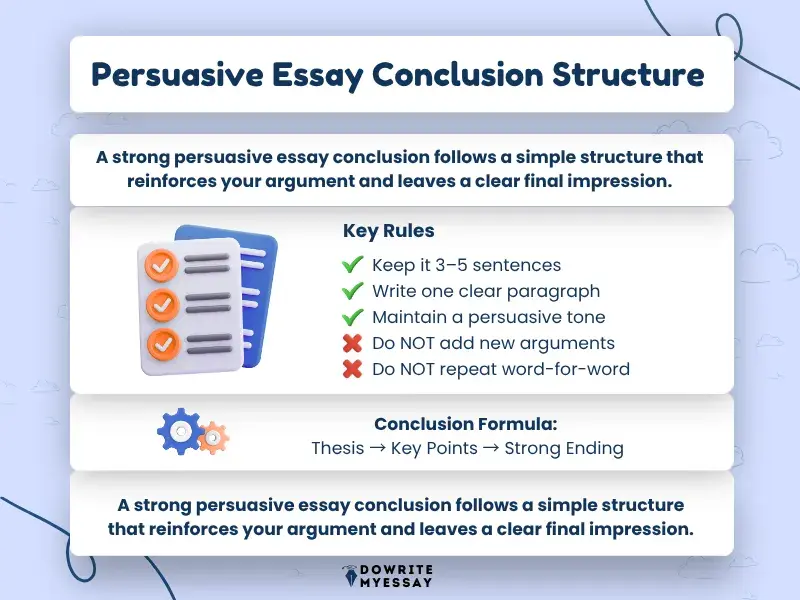
A persuasive essay conclusion follows a clear structure that helps reinforce the writer’s argument and bring the discussion to a focused ending. Even though the conclusion is short, each sentence has a specific role in guiding the reader to the final message.
Most persuasive essay conclusions follow this structure:
Restate the Thesis
The conclusion begins by restating the thesis statement in different words. This reminds readers of the writer’s position without repeating the introduction exactly.
Summarize the Main Arguments
Next, the writer briefly revisits the strongest points from the body paragraphs. This summary connects the key ideas and shows how they support the overall argument.
End With a Strong Closing Statement
The final sentence should leave a clear impression. This can be a call to action, a broader implication of the issue, or a thought-provoking idea that reinforces the argument.
What to Keep in Mind
A persuasive essay conclusion is usually written as one paragraph of three to five sentences. It should not introduce new evidence or arguments. The goal is to reinforce the existing ideas and end the essay with clarity and confidence.
How to End a Persuasive Essay: Step-by-Step Process
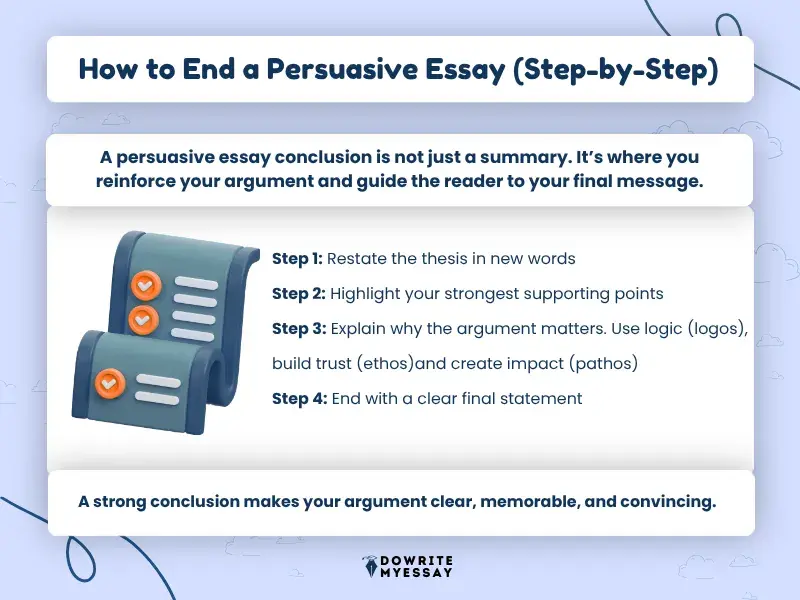
A persuasive essay conclusion is not just a summary. It is where you bring your argument together and guide the reader to your final position. Instead of repeating the essay, each part of the conclusion has a specific role: restating the thesis, connecting the main ideas, and ending with a clear final message.
When these steps are done correctly, the conclusion strengthens the argument and makes it easier for the reader to understand and remember your point. To leave a lasting impression, follow these essential steps to conclude your persuasive essay:
Step 1: Restate the Thesis Statement
Begin the conclusion by restating the thesis statement in different words. This reminds readers of the essay’s central argument without repeating the introduction exactly. A restated thesis should clearly reflect the writer’s position while sounding natural and concise.
Step 2: Summarize the Main Arguments
Next, briefly review the key points discussed in the body paragraphs. Instead of repeating every detail, highlight the strongest arguments that support the thesis. This summary helps readers see how the ideas in the essay connect to the overall claim.
Step 3: Reinforce the Persuasive Message
After summarizing, explain why the topic is important. You can use logic, trust, or emotions to make your final message stronger. This helps readers understand why your argument matters.
Step 4: End With a Strong Closing Sentence
The final sentence should leave a clear and memorable impression. A persuasive essay can end with a call to action, a thoughtful reflection, or a statement that encourages readers to consider the issue more deeply.
Following these steps helps writers create a conclusion that reinforces the argument and ends the essay in a clear and confident way.
Strong vs Weak Persuasive Essay Conclusions
Not all persuasive essay conclusions are equally effective. A strong conclusion reinforces the argument and leaves the reader with a clear final message, while a weak conclusion may repeat ideas, introduce new information, or end without impact.
The table below highlights some common differences between strong and weak persuasive essay conclusions.
| Strong Persuasive Conclusion | Weak Persuasive Conclusion |
| Restates the thesis in different words | Repeats the thesis word-for-word |
| Summarizes the key arguments briefly | Introduces new arguments or evidence |
| Maintains a clear, persuasive tone | Sounds uncertain or vague |
| Ends with a memorable closing statement | Ends abruptly or without a clear point |
| May include a call to action or reflection | Simply repeats earlier ideas |
Understanding these differences helps writers recognize what makes a persuasive essay conclusion clear and effective.
Comparison of Examples of Strong and Weak Persuasive Conclusions
Looking at examples can help writers understand how persuasive essay conclusions work in practice. A strong conclusion clearly restates the thesis, summarizes key ideas, and ends with a meaningful closing statement. A weak conclusion, on the other hand, often repeats ideas or ends without reinforcing the argument.
The table below compares examples of strong and weak persuasive essay conclusions.
| Essay Topic | Strong Persuasive Conclusion Example | Weak Persuasive Conclusion Example |
| School Uniforms | In conclusion, school uniforms can reduce distractions and promote equality among students. By creating a more focused learning environment, schools can help students concentrate on education rather than appearance. For these reasons, implementing uniform policies can support a more productive school atmosphere. | In conclusion, school uniforms are good, and schools should use them because they help students. |
| Online Learning | Ultimately, online learning provides flexibility and access to education for many students. When used effectively, digital learning platforms can support different learning styles and expand educational opportunities. Schools should continue improving online learning systems to help students succeed in modern classrooms. | Online learning has advantages and disadvantages, and some students like it while others do not. |
| Environmental Protection | Protecting the environment is essential for the well-being of future generations. By reducing pollution and supporting sustainable practices, individuals and communities can help preserve natural resources. Every responsible action today contributes to a healthier planet tomorrow. | Protecting the environment is important, and people should care about it. |
These examples show how a strong persuasive essay conclusion clearly reinforces the argument, while a weak one fails to leave a clear or convincing final impression.
Persuasive Essay Conclusion Sentence Starters
Many students find it difficult to begin the final paragraph of an essay. Using clear sentence starters can help organize ideas and create a smooth transition into the conclusion.
Below are some useful sentence starters that can be used when ending a persuasive essay.
Common conclusion starters
- In conclusion, the evidence shows that…
- Ultimately, the arguments presented demonstrate that…
- For these reasons, it is clear that…
- Considering these points, it becomes evident that…
- Therefore, the discussion supports the idea that…
Sentence starters for summarizing arguments
- The main arguments presented in this essay show that…
- The evidence discussed above supports the claim that…
- These points highlight why…
Sentence starters for strong closing statements
- For these reasons, it is important to recognize that…
- This issue requires careful attention because…
- Taking these factors into account, it is clear that…
These sentence starters can help writers organize their conclusion and clearly connect the final paragraph with the arguments discussed in the essay.
Using a Call to Action in a Persuasive Essay
A call to action is a common technique used in persuasive writing to encourage readers to think about an issue more carefully or take a specific step related to the argument. When used in a conclusion, it can strengthen the final message of the essay and make the argument more memorable.
In a persuasive essay, a call to action usually appears in the final sentence of the conclusion paragraph. Instead of simply repeating the main idea, the writer invites readers to consider the consequences of the issue or encourages them to support a particular solution.
For example, an essay about environmental protection might end by encouraging readers to adopt more sustainable habits. Similarly, an essay discussing school policies might conclude by suggesting that schools review their rules to improve student learning conditions.
A call to action should be clear and directly connected to the essay’s argument. It should not introduce new evidence or ideas but instead reinforce the position already explained in the essay. When used carefully, this technique helps the conclusion leave a stronger impression on the reader.
Common Mistakes To Avoid When Ending a Persuasive Essay
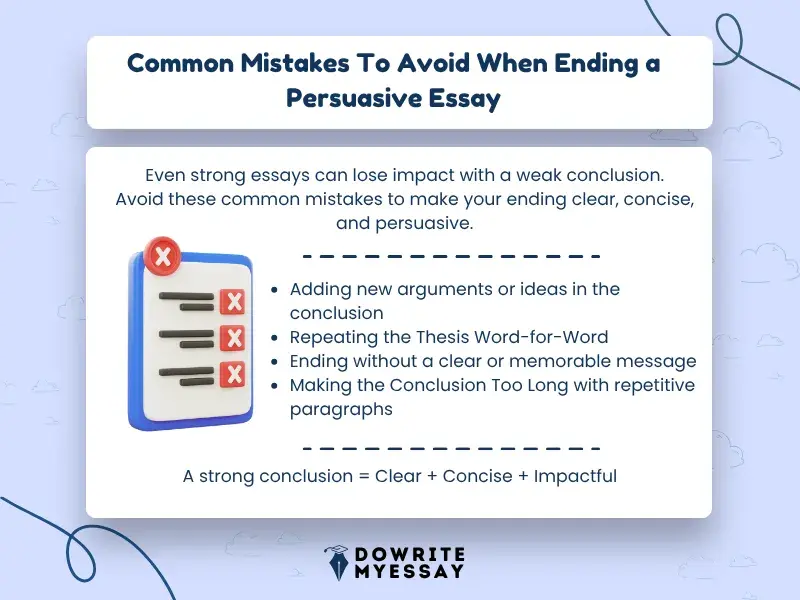
Many students understand the importance of a conclusion, but still make common mistakes when writing the final paragraph. Avoiding these errors can help make a persuasive essay ending clearer and more effective.
Introducing New Evidence
One common mistake is adding new arguments or evidence in the conclusion. The final paragraph should summarize the ideas already discussed in the essay rather than introduce completely new information.
Repeating the Thesis Word-for-Word
Some conclusions repeat the thesis statement exactly as it appeared in the introduction. Instead, the thesis should be restated in different wording so that it reinforces the argument without sounding repetitive.
Writing a Weak Closing Sentence
Ending the essay without a clear final message can reduce the impact of the argument. A persuasive essay should finish with a strong closing sentence that leaves readers with a clear understanding of the writer’s position.
Making the Conclusion Too Long
A persuasive essay conclusion should be concise. Writing long paragraphs with repeated ideas can weaken the ending. In most academic essays, the conclusion is about three to five sentences.
Avoiding these mistakes helps writers create conclusions that clearly reinforce their arguments and bring the essay to a strong finish.
Tips for Writing an Effective Persuasive Essay Ending
A well-written conclusion helps reinforce the argument and ensures that the essay ends clearly and confidently. The following tips can help students write stronger persuasive essay conclusions.
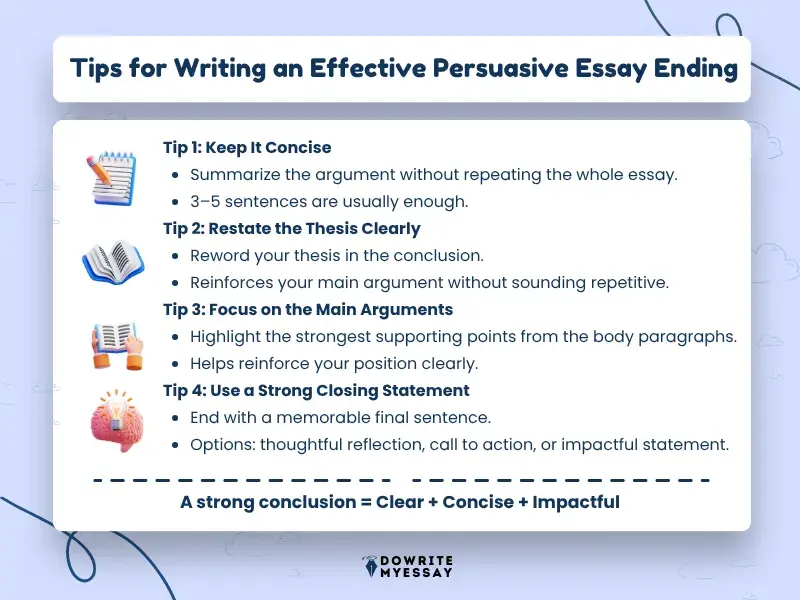
Keep the conclusion concise
The conclusion should summarize the argument without repeating the entire essay. In most cases, three to five sentences are enough to restate the thesis and highlight the main ideas.
Restate the thesis clearly
The thesis should appear again in the conclusion, but it should be rewritten in different words. This reminds readers of the essay’s main argument while avoiding repetition.
Focus on the main arguments
The conclusion should briefly remind readers of the strongest supporting points discussed in the body paragraphs. This helps reinforce the writer’s position.
Use a strong closing statement
The final sentence should leave a clear impression on the reader. A thoughtful statement, reflection, or call to action can strengthen the ending of the essay.
Following these tips helps writers create persuasive essay conclusions that reinforce the argument and bring the discussion to a clear finish.
Persuasive Essay Conclusion Templates Students Can Use
Many students find it easier to write conclusions when they follow a clear structure. The templates below show simple ways to organize a persuasive essay conclusion while restating the thesis, summarizing key points, and ending with a strong final statement.
Template 1: Standard Persuasive Essay Conclusion
This is the most common conclusion structure used in academic essays.
Template 2: Call-to-Action Conclusion
This type of conclusion encourages readers to think about a solution or take action related to the issue
Template 3: Thought-Provoking Conclusion
This conclusion ends with a bigger idea or a question to think about.
These templates help students organize their ideas and write persuasive essay conclusions that clearly reinforce the main argument.
How Teachers Evaluate Persuasive Essay Conclusions Using Rubrics
Teachers often assess persuasive essays using grading rubrics that measure how clearly the writer reinforces the argument and ends the essay. A strong conclusion shows that the students understand the topic and can summarize the discussion effectively without repeating the entire essay.
In many academic writing rubrics, the conclusion is evaluated based on several key criteria, including clarity, organization, and persuasive strength. The table below shows common elements teachers look for when reviewing persuasive essay conclusions.
| Evaluation Criteria | What Teachers Look For |
| Thesis Reinforcement | The conclusion clearly restates the thesis in different wording. |
| Summary of Arguments | The main points from the body paragraphs are briefly summarized. |
| Logical Consistency | The conclusion connects clearly with the arguments presented in the essay. |
| Clarity and Organization | The paragraph is concise, structured, and easy to understand. |
| Persuasive Strength | The final message reinforces the writer’s position. |
| Closing Impact | The essay ends with a clear and memorable final sentence. |
When a persuasive essay conclusion meets these criteria, it shows that the writer has successfully summarized the argument and brought the discussion to a strong and organized ending.
Persuasive vs Argumentative Essay Conclusions
Persuasive essays and argumentative essays both aim to convince readers, but their conclusions often differ slightly in tone and focus. Understanding these differences helps writers choose the most appropriate ending for their essay.
A persuasive essay conclusion focuses on influencing the reader’s opinion by reinforcing the writer’s viewpoint and sometimes encouraging action. An argumentative essay conclusion, on the other hand, emphasizes logical reasoning and summarizes the evidence presented throughout the discussion.
The table below highlights the main differences between persuasive and argumentative essay conclusions.
| Persuasive Essay Conclusion | Argumentative Essay Conclusion |
| Focuses on convincing the reader of a specific viewpoint | Focuses on logically evaluating an issue |
| May include emotional appeal or call to action | Usually emphasizes evidence and reasoning |
| Uses persuasive language to influence readers | Uses a more analytical tone |
| Encourages readers to consider or support a position | Summarizes arguments based on evidence |
Although both types of essays share similar structures, persuasive essay conclusions are often more focused on influencing the reader, while argumentative essay conclusions prioritize logical evaluation of the topic.
Practice Exercises for Writing Persuasive Essay Conclusions
Doing different types of conclusions helps students feel more sure of themselves in persuasive writing.
Exercise 1: Thesis Restatement Practice
Take the thesis statement from your essay introduction and rewrite it in different words for the conclusion.
Exercise 2: Write Different Types of Conclusions
Choose a persuasive essay topic and practice writing different types of endings:
- a summary-based conclusion
- a call-to-action conclusion
- a thought-provoking conclusion
This exercise helps students understand how different closing strategies influence readers.
Exercise 3: Improve a Weak Conclusion
Rewrite the following weak conclusion to make it better.
Weak version:
In conclusion, this issue is important, and people should think about it.
Improved version:
In the end, we need to take this issue seriously.
By understanding its effects and supporting real solutions, everyone can help make a positive difference.
Evaluation Checklist for a Persuasive Essay Conclusion
Before submitting a persuasive essay, students can use the following checklist to evaluate their conclusion.
| Evaluation Question | Yes / No |
| Does the conclusion restate the thesis in different wording? | |
| Are the main arguments summarized clearly? | |
| Does the paragraph avoid introducing new information? | |
| Is the persuasive tone consistent with the essay? | |
| Does the conclusion include a strong closing sentence? | |
| Is the paragraph concise (about 3–5 sentences)? | |
| Does the ending reinforce the essay’s main argument? | |
| Does the final sentence leave a clear impression on the reader? |
Students who can answer “Yes” to most of these questions are likely to write an effective persuasive essay conclusion.
Final Thoughts: Ending a Persuasive Essay Effectively
A persuasive essay conclusion plays an important role in reinforcing the writer’s argument and bringing the discussion to a clear ending. By restating the thesis, summarizing the main points, and finishing with a strong closing statement, writers can remind readers why the argument matters.
An effective conclusion does not introduce new ideas. Instead, it connects the key arguments presented in the essay and leaves readers with a clear understanding of the writer’s position. When written carefully, the final paragraph strengthens the overall impact of the essay.
Practicing persuasive writing techniques and reviewing conclusions carefully can help students develop stronger essays and communicate their ideas more effectively.
Frequently Asked Questions
Need help wrapping up your paper? These quick answers cover the most common questions about writing a powerful persuasive essay conclusion.