

Writing essays is a crucial part of any college or university curriculum. A critical thinking essay is one kind of academic work that requires the use of analytical and reflective writing abilities. Overall, these abilities highlight the most important aspects of this type of essay, which include information analysis, reflection on important results, an evaluation of the importance of the information, and the identification of any conclusions drawn by the author(s) or other scholars.
Therefore, students are required to read materials and provide their own interpretations in order to complete a critical thinking assignment. These types of essays are a great way for students to hone their analytical, creative, and introspective writing abilities.
In this article we will cover everything that you need to know about critical thinking essay writing. After reading this blog, you will be able to craft an excellent critical thinking essay.
What is Critical Thinking Essay?
The process of analyzing and evaluating the information is known as critical thinking. Critical thinkers are open to opinions because they count on logic and reason to make decisions about certain issues.
Now, let’s talk about critical thinking essays.
It is a type of paper that analyzes the problem and reflects on it to make an action plan. These essays mostly start with questions instead of a thesis. Additionally, it assists you in gaining a wide perspective on certain issues. The aim of critical thinking essay writing is to enhance your writing abilities and boost your ability to ask questions.
What is the Importance of Critical Thinking Essay?
The word “critical” is not used in a negative way when discussing critical thinking and writing. It basically means looking at, assessing, and analyzing data extensively. Students who are able to think critically are better able to communicate their thoughts in a logical and objective manner. In addition, it aids students in avoiding logical fallacies.
Critical Thinking Process
Did you know that there are eight steps to critical thinking? Here is a list of them. You could try to use them in your daily life:
| Thoughts/Reflection | Find the problem and explain it. |
| Analysis | Take a stand and decide what you will do. |
| Getting information together | Find sources, look them over, and come to the decisions you need to make. |
| Creative thinking | Use the information you’ve gathered and your mind to come up with creative arguments. |
| Structure the ideas or arguments | Put your thoughts in a way that makes sense. |
| Make a decision | Look at your choices and possibilities and pick the one you like best. |
| Commitment | Think about how you can tell other people what you think. |
| Debate | Stand up for your opinion. |
When you think critically, it’s possible that you will come across errors. Fallacies are mistakes in reasoning that lead to no good result. To give you an idea of some popular types of fallacies:
- Broad statement: It happens when you use facts that are usually true in a certain situation.
- Not clear: In this case, the arguments aren’t clear and aren’t backed up by proof.
- Use the power of authority: This mistake happens when you say something is true just because a well-known person said it.
- Use your emotions: It happens when you use strong emotional words to persuade people. Keep your cool and look at the facts.
- Bifurcation: This mistake happens when you have more than two options and can only choose between two of them.
- Incorrect analogy: This happens when the cases don’t fit together well.
Follow these steps if you want to avoid making these mistakes:
- don’t jump to conclusions too quickly;
- pay close attention,
- read all the sources carefully and
- don’t make broad statements.
Critical Thinking Essay Outline
Now, let’s focus on planning the essay. Here you will find the structure of the critical thinking essay. Like other essays, its outline consists of three main parts: introduction, body paragraphs, and conclusion. Before you begin writing your essay, you must know what to include in it. Additionally, the essay outline serves as a roadmap and also structures the paper very well.
Introduction
The introduction serves as the foundation for your argument. Start with a hook to get the audience’s attention. Then, add a quick overview of the subject to provide some background information. Discuss your essay’s thesis statement.
Body Paragraphs
Explain one idea in each body paragraph. Begin with a topic sentence that states the main points clearly, then add evidence to support your points. The evidence can be quotes, facts, or numbers. Additionally, this section shows your ability to engage with various points of view. This also demonstrates how you use logical reasons to back up your claim. Make sure that each paragraph flows smoothly to the next and maintains a coherent flow.
Conclusion
The thesis should be restated in light of the evidence given, and the main points from the body parts should be summed up briefly in the conclusion. This part shouldn’t add any new information; instead, it should summarize the essay’s results and stress how important they are. Moreover, think about what your argument means in a broader sense and suggest areas that could use more study or exploration. The reader will remember a strong ending for a long time, which will show how important your critical analysis was.
How to Write a Critical Thinking Essay?
Wondering how to write a critical thinking essay? Follow the simple steps mentioned below.

How to Write a Critical Thinking Essay
How to start a Critical Thinking Essay?
The introduction section gives a general idea of your essay’s content to the reader. Imagine this section as a map that you are drawing for your reader. This map not only provides a route but also the final destination. There are four major functions of the introduction section:
- Grab the attention of readers
- Main essay arguments
- Basic information about the subject
- Significance of the issue mentioned in question
Now, let’s look at some strategies for starting a critical thinking analysis essay.
- Provide a brief overview of your essay topic.
- Express the actual idea.
- Define the key term used in an essay.
- Highlight the problem that you are going to argue or explore.
- Craft a hook statement to get the reader’s attention.
Thesis statement for critical thinking essay
The integral part of every essay is called a thesis statement. It provides guidance to both the writer and the reader. Moreover, a good thesis
- Justify your point with logical reasoning
- Conveys your idea well
- Acts as a roadmap for essay
- states the opinion or conclusion about a subject;
To better understand the good thesis statement, you must explore examples:
| Bad thesis statement | Good thesis statement |
| Technology is changing the world. | Social media platforms have significantly impacted the way businesses interact with consumers by providing a direct channel for communication and engagement. |
| Smoking is bad for your health. | The effects of climate change on global food production will be devastating if immediate and concerted action is not taken. |
Statements written on the left are very general and do not offer any logical reasoning, but the statements on the right are clear and well explained. Readers will quickly understand what the main point of discussion is.
Write Body Paragraphs
In body paragraphs, you need to discuss the ideas and the arguments. Arguments are very important in critical thinking essays. Keep these things in mind when you build them:
- are in line with the main idea
- and backed up by sources, quotes, and examples.
It also works to use counterarguments. Moreover, it shows that you are open to different points of view and don’t give up quickly.
It’s important to show the evidence along with your arguments. Additionally, show that you can think critically by looking at each source and saying whether the author’s point of view is true.
To make your writing make sense, you can use transitions like
- Right now,
- Currently,
- Consequently,
- For example,
- Finally,
- Thus,
- On the other hand,
- In conclusion,
- Not only…
- but also,
- Without a doubt
- As well as
- Likewise
- But
- However
- Additionally
- Furthermore
Critical Thinking Essay Conclusion
The word “conclusion” in a critical thinking essay is very similar to the word “conclusion” in reasoning. A logical end is a sentence that says what the essay is arguing about or the author’s viewpoint. Moreover, there can only be one logical conclusion to each case.
They can be mixed up with buildings sometimes. Remember that the premises set the stage for the end. There can be more than one premise in a case but only one conclusion. The Stanford Encyclopedia of Philosophy has a piece on a logical consequence that can help you learn more about these ideas.
With this in mind, here are some tips to help you finish your essay:
- Shortly restate the main points.
- Give one last thought on the subject.
- Moreover, give some examples of outcomes or effects.
- In the end, ask people to do something.
Critical Thinking Essay Examples
Let’s have a look at a critical thinking essay example:
Topic: Significance of Critical Thinking in the Mass Media Era
Critical thinking has become much more important recently because of changes in technology that have made it easier to reach more content-making platforms, such as websites, online news outlets, and podcasts that often have bad information. Political and business goals use fake news to target people who don’t know much about the news. A skeptical attitude, on the other hand, can help people spot false goals and stop spreading lies.People who write fake news to make money can hurt the mental health of emotional people, who are very likely to read this kind of news. People today prefer to accept stories that are based on their own experiences over facts (Cooke 212). This is called the “post-truth era.” People help people who make up stories get more views, which they can then sell for money (Cooke 211). One way they do this is by spreading fake news on the Internet without looking for proof. Also, this kind of news could be bad for people’s mental health; for example, false information about political problems like wars and other military conflicts could make them feel a little scared (Burkhardt 6). So, people who read the news should learn how to spot false agendas and stop spreading them to avoid mental breakdowns and anxiety.
Politics can be brought up in the media for idealistic reasons that can change people’s identities. A new project called Computational Propaganda Research has looked into political bots in some states and found that they play a big part in how information gets spread on social networks (Burkhardt 18). These bots not only get people to talk about certain political issues, but they also start conversations about them, persuade people who aren’t good at critical thinking, and shape their identity (Burkhardt 18). This shows that spreading false information isn’t just a way to make money through marketing. It is also part of a policy to spread propaganda.
Being able to think critically is a way to become independent because it helps you see how the media tricks people. Scholars say that teaching critical thinking should be a part of all schools because media literacy makes people more independent, which is good for democratic states (Atar 72). But there seems to be a problem. Vraga and Tully found a link between the ability to think critically and the amount of political involvement after looking at the quantitative data. Researchers came to the conclusion that people who are better at reading the news are less likely to want to talk about and share the latest political news on social media because they are trying to find more accurate sources to back up their claims (Vraga and Tully 10). So, people who are skeptical about content stop low-quality content from growing among social media users. To avoid getting false information, everyone needs to get better at thinking critically about what they read.
We can say that because social media is free to use, there is low-quality material on it, like fake news and political bots. They are made by people who want to make money from views and further their own political goals by changing the online identities of other people. To protect themselves from the false goal, people need to learn how to think critically. They need to be wary and always try to figure out which news stories and user profiles are real and which ones are fake. They can do it by just reading the facts and skipping the emotional parts of the story.
Good Topics for Critical Thinking Essay
Have you selected the subject for your writing already? If not, feel free to use these examples of critical thinking essay topics as themes or ideas for your work. Make sure that the topic you pick is something that interests you. Here are some critical thinking essay questions.
- Why do racist things happen in health care?
- Why is it important to accept the way you are?
- Ideas behind logical reasoning and critical thinking.
- Ralf Waldo Emerson wrote poems about nature and the spirit world.
- How does technology effect modern communication?
- How are teens affected by the internet?
- Are the way kids are portrayed in popular stories true?
- Violence in the home and what happens after it.
- Why is it important for people to help each other?
- What changes when people think about stereotypes?
- How different countries think about happiness.
- What environmental art is meant to do?
- Why do people need to be praised?
- How did antibiotics change the field of health, and how did they grow?
- Is there a way to make games more fair?
- Is controlling guns a good way to stop crime?
- How have our ideas about love changed over time?
- What do older people do on social media sites?
- Graffiti is a new kind of art.
- Bad effects on health from eating a lot of sugar.
- Why do so many people like reality shows?
- Why do we need to eat well?
- How fair and useful is the US court system?
- Why Cirque du Soleil is so popular?
- How can cops stop being mean?
- Freedom of speech: Is it real?
- The effects of false beliefs about vaccinations.
- Action plan for getting rid of New Brunswick’s population gap.
- How do you make a good movie?
- Look at your favorite book with a critical eye.
- The link between style and who you are.
- There are some things that aren’t allowed to be talked about in gothic literature.
- Overpopulation is a topic that needs a critical thinking essay.
- Does the way we live affect our mental health?
- How can kids avoid eating problems by building up their self-esteem?
- Teenagers who abuse drugs.
- Arguments about helping people die.
- What happens to kids’ mental health when they play dangerous video games?
- Look at how a team member’s stress affects their work.
- Talk about why the environmental studies are important.
- How can you live a happy life and think critically?
- Human dignity and how it affects the fight for fairness.
- Look into the morality of advertising for the tobacco business.
- Why does misconduct happen in study, and how might it be fixed?
- What does it mean for kids when parents are deployed?
- How superheroes have changed American society?
- Look at the good and bad effects that technology has had on modern society.
- Examples of how to think critically about writing.
- Think about how the COVID-19 outbreak changed the economy.
- Pros and cons of making vaccinations required.
Tips for Writing Essay on Critical Thinking
Making an excellent critical thinking essay is more than just making a case. It needs a nuanced method that keeps the reader interested and shows how good an analyst you are. To do this, you need to be very clear about what to include and what not to include in your essay. This will make sure that your writing is both interesting and well-researched, which is what critical analysis is all about.
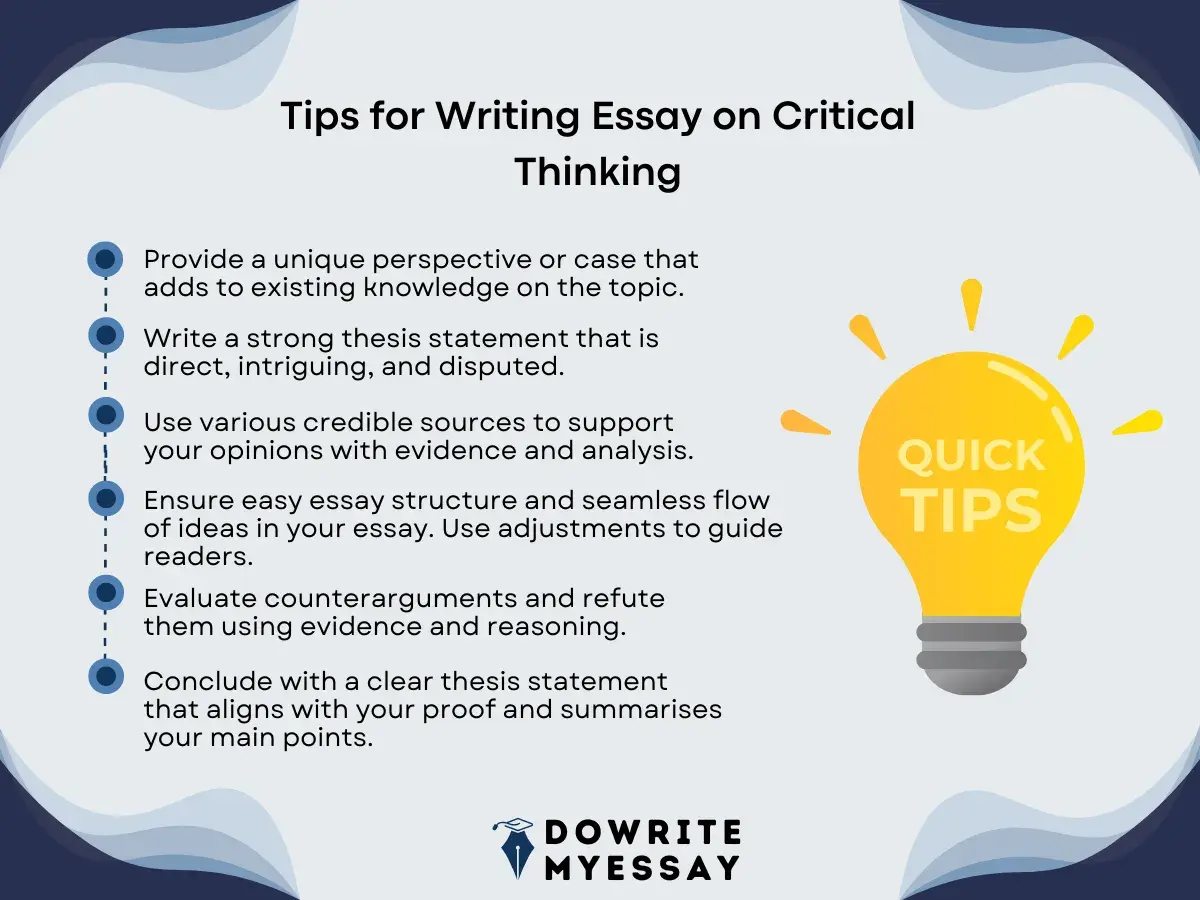
Tips for Writing Essay on Critical Thinking
- Provide a unique perspective or case that adds to existing knowledge on the topic.
- Write a strong thesis statement that is direct, intriguing, and disputed.
- Use a variety of credible sources to support your opinions with evidence and analysis. Also, analyze this evidence to demonstrate your expertise.
- Ensure easy essay structure and seamless flow of ideas in your essay. Use adjustments to guide readers.
- Evaluate counterarguments and refute them using evidence and reasoning. This shows you can see things from multiple angles.
- Conclude with a clear thesis statement that aligns with your proof and summarises your main points. Moreover, discuss how your findings affect society.
Final Thoughts
In conclusion, a great critical thinking essay depends on carefully choosing what to include and what not to include. You can write an interesting and convincing essay by giving a new point of view, making a strong thesis, proving your points with solid proof, and following a logical structure. Taking on counterarguments and coming to smart conclusions are more ways to show how analytical you are and how much you understand.
On the other hand, to make sure your work is clear and professional, stay away from biased sources, claims that can’t be backed up, overgeneralizations, and content that is repeated. To keep things academically rigorous, you need to use a formal tone and stay focused on your topic.
You now have the tools you need to write a great critical thinking essay. Take them and use them. First, make sure you know a lot about your topic and can come up with a strong theory. As you write, keep working to improve your points and make sure that every part of your essay fits together to make a strong analysis. You can also ask professional essay writers to write essays for you. Have fun writing!
Frequently Asked Questions (FAQs)
Q1: How to develop critical thinking skills in a student’s essay?
Eight excellent methods exist to improve your critical thinking skills in essay writing.
- Ask simple questions.
- Understand how your mind works.
- Change your own point of view.
- Reverse your thoughts.
- Learn to see ahead.
- Regularly question what most people think.
- Know how to spot reasoning errors.
- Find different points of view on your subject.