Key Takeaways
- A nursing reflective essay evaluates your ability to analyze clinical experiences rather than simply describe what happened.
- Reflective writing in nursing develops critical thinking, clinical judgement, professional accountability, and evidence-based decision-making.
- Using structured reflection models such as Gibbs, Johns’, or Driscoll helps organize your reflection and demonstrate deeper analysis.
- High-scoring reflections combine personal experience with research evidence, nursing theory, and professional standards.
- Strong nursing reflections always explain what was learned, how practice will improve, and why the experience matters for future patient care.
- Understanding how to write a nursing reflective essay also means knowing what lecturers assess, including reflective depth, evidence integration, ethical awareness, and professional growth.
- Reviewing your work against a checklist before submission helps ensure your reflection demonstrates genuine learning rather than simple description.
Some of the most valuable nursing lessons don’t come from textbooks. They come after a clinical shift, when you find yourself thinking about a difficult patient interaction, an unexpected decision, or a situation you wish you had handled differently. Reflecting on these experiences turns everyday clinical practice into meaningful learning.
That’s exactly what a nursing reflective essay is designed to assess. Rather than simply describing what happened, you’re expected to evaluate your decisions, connect them to professional standards, and demonstrate critical thinking backed by evidence. Many students understand the clinical experience itself but struggle to present it in a way that meets university expectations. When time is limited or the requirements feel overwhelming, purchasing a professionally written reflection from a trusted nursing essay writing service can be a practical way to receive original work tailored to your instructions and academic requirements.
Whether you’re writing after a clinical placement, a patient interaction, or an ethical dilemma, reflective writing in nursing is about showing how experience shapes your professional development. In this guide, you’ll learn how to write a nursing reflective essay, apply recognised reflection models, integrate evidence naturally, and produce a reflection that demonstrates genuine insight, critical evaluation, and continuous professional growth.

What is a Nursing Reflective Essay?
A nursing reflective essay is a structured piece of writing that examines a real clinical experience to show what you learned, how your decisions affected patient care, and how the experience will influence your future practice. Unlike research or analytical essays, its focus is on evaluating your own actions, clinical judgement, and professional development.
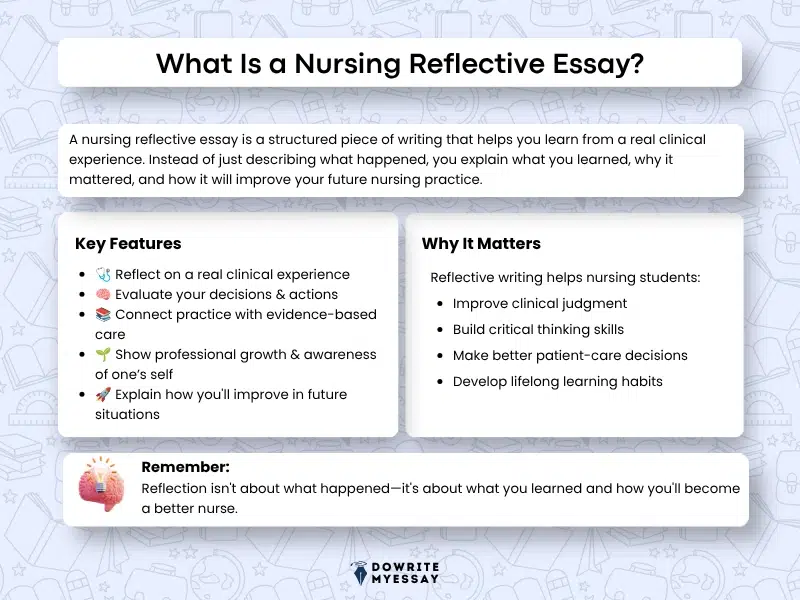
At the heart of reflective writing in nursing is critical self-evaluation. Rather than simply describing what happened, you’re expected to explain why it happened, what you learned, and how that learning will improve your future practice. This demonstrates reflective thinking, self-awareness, and the ability to learn from experience.
Whether you’re reflecting on a patient interaction, communication, medication administration, teamwork, or an ethical dilemma, your reflection should connect personal experience with professional standards and evidence-based practice. Supporting your insights with relevant literature or clinical guidelines strengthens your analysis and demonstrates academic rigour.
More importantly, reflective writing prepares you for professional practice. It helps nursing students develop stronger clinical judgement, improve decision-making, and build the habit of continuous learning that remains essential throughout a nursing career.
Once you understand what a nursing reflective essay involves, it’s easier to see why reflective writing has become such an important part of nursing education and clinical practice.
Why Reflective Writing Matters in Nursing Education and Clinical Practice
Reflection is a core part of nursing education because it helps students turn clinical experiences into meaningful learning. Every patient interaction, clinical decision, or challenging situation offers an opportunity to evaluate what went well, identify areas for improvement, and strengthen future practice. That’s why reflective writing in nursing is included throughout nursing programmes rather than treated as a one-time academic exercise.
Beyond improving academic performance, reflection develops the skills expected of every competent nurse. By critically examining your experiences, you become more confident in your clinical judgement, improve decision-making, and recognise how your actions influence patient outcomes. This process also encourages greater self-awareness, professional accountability, and ethical practice.
Reflective writing also supports evidence-based practice. Instead of relying only on personal opinions, you’re encouraged to compare your experiences with clinical guidelines, research, and professional standards. This helps bridge the gap between theory and practice while reinforcing safe, patient-centred care.
Perhaps most importantly, reflective practice doesn’t end after graduation. It remains an essential part of professional nursing development, helping nurses adapt to new clinical situations, learn from experience, and continually improve the quality of care they provide throughout their careers.
How Reflective Practice Benefits Nursing Students
- Develops critical thinking and clinical judgement.
- Strengthens communication and decision-making skills.
- Encourages evidence-based clinical practice.
- Promotes self-awareness and professional accountability.
- Helps identify learning needs and future development goals.
- Improves confidence during clinical placements and future practice.
Understanding why reflection matters is only part of the process. To produce a high-quality reflection, you also need to know the difference between simply describing a clinical experience and critically evaluating it.
Reflection vs Description: The Difference That Determines Your Grade
One of the most common reasons students lose marks is confusing reflection with description. While both involve discussing a clinical experience, they serve very different purposes. Description explains what happened, whereas reflection examines why it happened, what it means, and how it will influence future practice.
In a nursing reflective essay, simply recounting events isn’t enough. Lecturers expect you to evaluate your decisions, consider alternative approaches, connect your experience with evidence, and explain how the situation contributed to your professional development. This deeper level of analysis demonstrates critical thinking and shows that you’ve learned from the experience rather than simply recorded it.
| Description | Critical Reflection |
| Focuses on what happened | Explores why it happened and what was learned |
| Retells events in chronological order | Evaluates decisions, actions, and outcomes |
| Relies mainly on personal observations | Connects experiences with evidence and professional standards |
| Ends after describing the situation | Identifies learning outcomes and future improvements |
| Shows little analysis | Demonstrates critical thinking and self-awareness |
To strengthen your reflection, ask yourself questions such as:
- Why did I respond the way I did?
- What factors influenced my clinical judgement?
- What evidence supports or challenges my actions?
- What would I do differently in a similar situation?
- How will this experience improve my future nursing practice?
Answering these questions helps transform a descriptive account into a thoughtful reflection that demonstrates genuine learning and professional growth.
Once you understand what meaningful reflection looks like, the next step is choosing a framework that helps you organise your ideas and analyse your experience systematically.
Which Reflection Model Should You Use?
A reflection model provides a clear framework for analysing your experience instead of writing whatever comes to mind. It helps you move beyond describing events by guiding you through your thoughts, emotions, actions, and learning outcomes in a logical order. Choosing the right model can make your nursing reflective essay more focused, analytical, and easier to follow.
Several reflection models are used in nursing education, each with a different purpose. While universities may recommend a specific framework, understanding their strengths helps you choose the one that best fits your experience.
| Reflection Model | Best For | Key Focus |
| Gibbs Reflective Cycle | Most nursing reflective essays | Feelings, evaluation, analysis, learning, and action planning |
| Johns’ Model of Reflection | Complex clinical situations | Critical questioning and professional judgement |
| Driscoll Model | Short reflections | Three simple questions: What? So What? Now What? |
| Rolfe Framework | Clinical placements | Turning experience into practical improvements |
| Kolb Experiential Learning Cycle | Learning from repeated experiences | Experience, reflection, conceptualisation, and application |
| Schön’s Reflective Practice | Decision-making during practice | Reflection during and after clinical situations |
Which Model Is Most Common?
Although each framework has its strengths, Gibbs Reflective Cycle is the one most commonly used in reflective writing in nursing. Its step-by-step structure encourages students to describe the experience briefly, analyse what happened, evaluate their actions, and identify how they will improve future practice. This balanced approach makes it suitable for a wide range of clinical experiences, from patient communication to ethical dilemmas and medication administration.
That said, always follow your university’s guidance. Some nursing programmes recommend a specific model, while others allow you to choose the framework that best supports your reflection.
Choosing a reflection model gives your essay structure, but the quality of your work depends just as much on the experience you choose to reflect on. Not every clinical situation provides the same opportunity for meaningful analysis.
Before You Start Writing: Choose the Right Clinical Experience to Reflect On
Not every clinical experience makes a strong reflection. The best topics are those that challenged your thinking, influenced your decision-making, or changed how you approach patient care. Choosing a meaningful experience makes it much easier to demonstrate critical reflection rather than simply describe what happened.
A suitable experience doesn’t have to involve a major clinical incident. Even routine situations can become valuable reflections if they highlight an important lesson or professional insight.
Some common experiences include:
- Communicating with a patient or family member.
- Administering medication or assisting with treatment.
- Working within a multidisciplinary team.
- Responding to an ethical dilemma.
- Managing a challenging patient interaction.
- Observing a patient safety issue.
- Receiving feedback from a clinical supervisor.
- Taking on leadership responsibilities during placement.
When selecting your topic, ask yourself these questions:
- Did this experience teach me something new?
- Did it influence my clinical judgement or decision-making?
- Can I support my reflection with professional standards or evidence?
- Can I explain how this experience will improve my future nursing practice?
If your answer is “yes” to most of these questions, you’ve likely chosen an experience with enough depth for a strong nursing reflective essay.
Once you’ve selected a meaningful clinical experience, the next step is turning it into a structured reflection that demonstrates critical thinking, evidence-based practice, and professional growth.
How to Write a Nursing Reflective Essay Step by Step
Understanding how to write a Nursing Reflective Essay starts with recognising that reflection is a process rather than a simple writing task. Every section should demonstrate how you evaluated a clinical experience, applied professional knowledge, and identified opportunities for improvement. Following these steps will help you produce a reflection that is analytical, evidence-based, and academically strong.
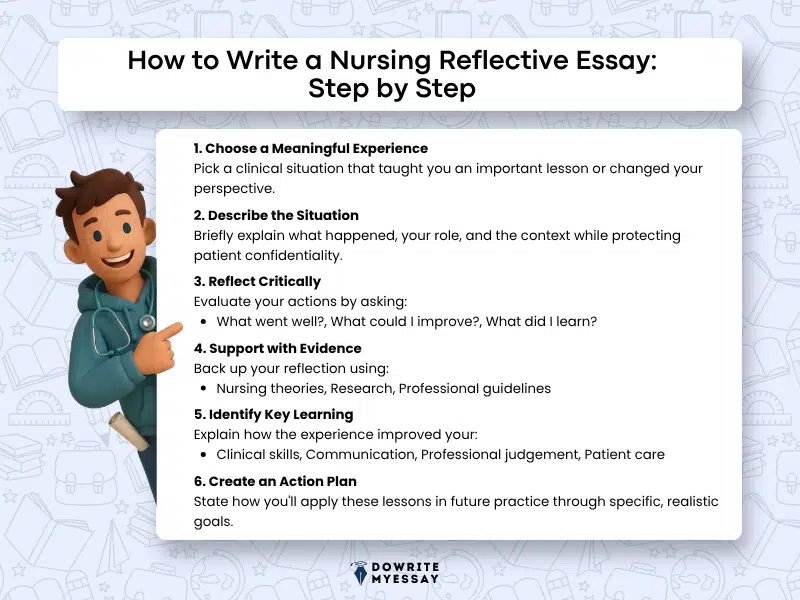
Step 1: Choose a Meaningful Clinical Experience
Begin by selecting an experience that genuinely influenced your learning or challenged your thinking. It doesn’t have to involve a major clinical incident. Everyday situations, such as communicating with a patient, responding to feedback, administering medication, or working within a multidisciplinary team, often provide excellent opportunities for reflection.
As you choose your topic, ask yourself:
- Did this experience teach me something valuable?
- Did it influence my clinical judgement or decision-making?
- Can I explain how it will improve my future practice?
The more meaningful the experience, the easier it becomes to produce a thoughtful and engaging reflection.
Step 2: Briefly Describe the Situation
Introduce the clinical experience by providing enough background for readers to understand the context. Explain where the event took place, your role, and what happened, but keep this section concise. The purpose isn’t to retell the entire story but to establish the foundation for your reflection.
Remember to maintain patient confidentiality by removing any identifying details and focusing on the learning rather than the individual involved.
Step 3: Critically Reflect on Your Actions and Decisions
This is where your reflection begins to move beyond description. Consider how you responded to the situation, what influenced your decisions, and whether your actions aligned with professional standards and best practice.
Instead of simply explaining what you did, evaluate your thinking by asking questions such as:
- Why did I respond this way?
- What assumptions influenced my decisions?
- What went well, and what could have been handled differently?
- How did my actions affect the patient or the wider healthcare team?
Demonstrating honest self-evaluation is a key part of reflective writing in nursing and shows your ability to learn from experience.
Step 4: Support Your Reflection with Evidence
Personal experiences should be supported with credible evidence whenever possible. Relate your reflection to nursing theories, professional guidelines, peer-reviewed research, or your university’s learning outcomes. This strengthens your analysis by showing that your conclusions are grounded in recognised nursing knowledge rather than personal opinion alone.
Evidence shouldn’t replace your own reflection. Instead, use it to explain why a different approach may have been more appropriate or to reinforce the lessons you’ve learned from the experience.
Step 5: Identify the Learning Outcomes
Every reflection should clearly explain what the experience taught you. Think beyond clinical skills and consider how it influenced your communication, confidence, ethical awareness, teamwork, or professional judgement.
Ask yourself:
- What have I learned about myself as a future nurse?
- How has this experience changed my understanding of patient care?
- Which skills or knowledge do I still need to develop?
Showing meaningful learning demonstrates that you’ve reflected critically rather than simply recalling an event.
Step 6: Create a Practical Action Plan
End your reflection by explaining how you’ll apply your learning in future clinical situations. Your action plan should be realistic, specific, and connected to the experience you’ve discussed.
For example, you might commit to improving communication with patients, seeking additional training in a particular clinical skill, reviewing current practice guidelines, or asking for more feedback during placements. A clear action plan shows continuous professional development and is often one of the strongest indicators of a high-quality nursing reflective essay.
Once you’ve worked through each of these steps, the next priority is organising your ideas into a logical structure. A clear layout helps readers follow your reflection while ensuring every stage of your learning is presented coherently.
Recommended Nursing Reflective Essay Structure
A clear structure makes your reflection easier to read and demonstrates that your ideas have been developed logically. While the exact format may vary between universities or the reflection model you’ve chosen, most nursing reflective essay assignments follow a similar progression. Each section should build on the previous one, showing how your experience led to meaningful learning and professional development.
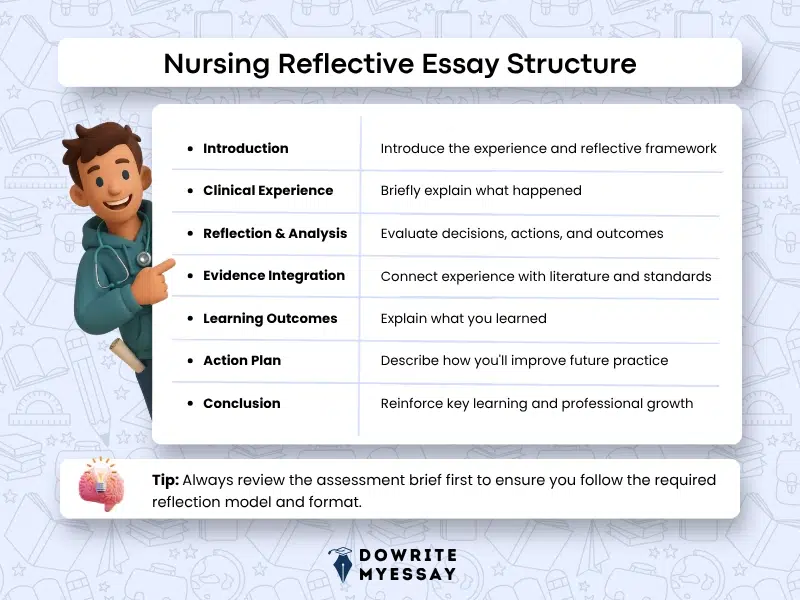
Introduction
Begin by introducing the clinical experience you’ll be reflecting on. Briefly explain the context, your role, and why the experience was significant. You can also mention the reflective model you’ll be using, such as Gibbs’ Reflective Cycle or Johns’ Model of Reflection. Keep this section concise and avoid revealing every detail at the outset.
Description of the Clinical Experience
Provide a brief overview of what happened, including only the details necessary for readers to understand the situation. Maintain patient confidentiality at all times by removing identifying information and focusing on the learning rather than the individual involved.
Reflection and Critical Analysis
This is the main body of your essay and the section where most marks are awarded. Evaluate your actions, decisions, and emotions while considering how they influenced the outcome. Rather than explaining what happened, focus on why it happened, what factors affected your judgement, and what alternative approaches could have been taken. This level of analysis demonstrates the depth expected in reflective writing in nursing.
Evidence and Professional Standards
Support your reflection with relevant nursing literature, clinical guidelines, or professional standards where appropriate. Linking your experience to evidence strengthens your evaluation and shows that your conclusions are informed by recognised nursing knowledge rather than personal opinion alone.
Learning Outcomes and Action Plan
Explain what you learned from the experience and how it has influenced your development as a nursing professional. Identify the knowledge, skills, or behaviours you plan to improve and describe the practical steps you’ll take to apply these lessons during future clinical placements or professional practice.
Conclusion
End by reinforcing the most important lesson from your reflection without introducing new information. Briefly summarise how the experience contributed to your professional growth and explain how it will shape your future approach to patient care and clinical decision-making.
Reflective Essay Structure At-a-Glance
| Section | Purpose |
| Introduction | Introduce the experience and reflective framework |
| Clinical Experience | Briefly explain what happened |
| Reflection & Analysis | Evaluate decisions, actions, and outcomes |
| Evidence Integration | Connect experience with literature and professional standards |
| Learning Outcomes | Explain what you learned |
| Action Plan | Describe how you’ll improve future practice |
| Conclusion | Reinforce key learning and professional growth |
Having a well-organised structure is important, but it’s only one part of a high-quality reflection. Lecturers also assess how deeply you evaluate your experience, apply evidence, and demonstrate professional growth. Understanding these expectations can help you write with the marking criteria in mind.
How Lecturers Assess a Nursing Reflective Essay
Writing a well-structured reflection is only part of the assessment. Lecturers look beyond grammar and formatting to evaluate how effectively you analyse your experience, apply professional knowledge, and demonstrate personal and clinical growth. A high-quality nursing reflective essay shows that you’ve learned from the experience and can apply those lessons to future nursing practice.
Although marking criteria vary between universities, most assess reflective essays using similar standards.
| Assessment Area | What Lecturers Expect |
| Reflective Depth | Goes beyond describing events to critically evaluate decisions, actions, and outcomes. |
| Critical Thinking | Explores why situations occurred, considers alternative approaches, and justifies conclusions. |
| Application of a Reflection Model | Uses a recognised framework consistently and logically throughout the essay. |
| Evidence Integration | Supports reflections with relevant literature, clinical guidelines, or professional standards. |
| Clinical Insight | Demonstrates sound clinical judgement and an understanding of patient-centred care. |
| Professional Development | Identifies meaningful learning outcomes and realistic goals for future improvement. |
| Academic Writing | Maintains a clear structure, appropriate referencing, and a professional writing style. |
Students often assume that reflecting on a successful clinical experience guarantees a higher grade, but that’s rarely the case. Lecturers are more interested in how you evaluate the experience than in what happened. A reflection that honestly examines mistakes, acknowledges limitations, and explains how those lessons will improve future practice usually demonstrates stronger critical thinking than one that only highlights success.
Another common expectation is the ability to balance personal reflection with professional evidence. Your experiences should remain at the centre of the discussion, but your conclusions should be supported by relevant nursing literature, clinical guidelines, or professional standards. This demonstrates that your reflection is informed by evidence-based practice rather than personal opinion alone.
Meeting these assessment criteria becomes much easier when your personal experiences are supported by credible evidence. The next step is learning how to integrate research and professional guidance naturally without losing your own reflective voice.
How to Integrate Evidence Without Losing Your Personal Voice
One of the biggest challenges in reflective writing in nursing is balancing personal experience with academic evidence. While your reflection should focus on your own clinical experience, it also needs to show that your learning is informed by professional knowledge and current nursing practice. The goal isn’t to replace your voice with research but to use evidence to strengthen your analysis.
Start by reflecting on the experience in your own words. Once you’ve explained what happened and evaluated your decisions, introduce relevant evidence that supports or challenges your perspective. This might include nursing theories, clinical guidelines, professional standards, or peer-reviewed studies. Using evidence in this way shows that your conclusions are based on recognised practice rather than personal opinion alone.
Ways to Integrate Evidence Naturally
- Support your observations with current nursing research.
- Refer to professional standards or clinical guidelines where appropriate.
- Explain how nursing theories relate to your experience.
- Use evidence to justify what you would do differently in the future.
- Cite all sources accurately using your required referencing style, such as APA 7th edition.
Remember that evidence should support your reflection, not dominate it. Long paragraphs summarising research can distract from the purpose of the essay. Instead, introduce a source only when it helps explain your decisions, evaluate your actions, or reinforce the lesson you’ve learned.
Too descriptive:
I realised that communication with the patient could have been better.
Evidence-based reflection:
I realised that my communication with the patient could have been clearer, particularly when explaining the care plan. Current communication guidelines emphasise the importance of using clear, patient-centred language to improve understanding and encourage shared decision-making. This highlighted the need for me to adapt my communication style to each patient’s individual needs.
This approach keeps your experience at the centre of the reflection while demonstrating that your learning is grounded in evidence-based practice.
Understanding how to combine personal experience with evidence is an important skill, but seeing how effective reflections are developed in practice can make the writing process even clearer.
Learning from Strong Nursing Reflection Examples
Reading examples can help you understand how a strong reflection is developed, but they should be used for learning rather than copying. Every nursing reflective essay is based on a personal clinical experience, so your reflection should always reflect your own observations, decisions, and learning.
Instead of focusing on the clinical scenario itself, pay attention to how the writer analyses the experience. Notice how they move beyond describing events, connect their actions to professional standards, support their reflection with evidence, and finish with clear learning outcomes and an action plan. These are the qualities lecturers look for when assessing reflective writing in nursing.
Selecting the right clinical experience often determines the quality of your reflection. Experiences involving patient communication, teamwork, ethical decision-making, leadership, or patient safety usually provide richer opportunities for critical analysis because they require you to evaluate your judgment and identify meaningful learning outcomes. If you’re still deciding what experience to write about, exploring relevant nursing essay topics can help you identify situations that provide enough depth for thoughtful reflection and meaningful analysis.
Example 1: Reflecting on Patient Communication During Clinical Placement
During my clinical placement on an adult medical ward, I cared for an elderly patient who appeared anxious before a scheduled procedure. The patient repeatedly asked whether the procedure would be painful and whether their condition was getting worse. I initially responded by giving short factual answers because the ward was busy and I was trying to complete several tasks on time. Although my answers were clinically accurate, I noticed that the patient still seemed unsettled and continued asking similar questions.
When I reflected on the interaction, I realised that I had focused more on giving information than understanding the patient’s emotional state. My communication was task-focused rather than patient-centred. At the time, I thought I was helping by answering quickly, but I did not fully assess whether the patient had understood the information or felt reassured. This made me recognise that effective nursing communication is not only about accuracy. It also involves listening, empathy, checking understanding, and allowing patients enough time to express concerns.
After discussing the situation with my mentor, I returned to the patient when the ward was quieter. I asked open questions about what was worrying them most and allowed them to explain their fears. The patient said they were not only afraid of pain but also worried that the procedure meant their illness was becoming serious. This changed how I approached the conversation. I explained what I could within my role, reassured them that the nurse in charge could answer more detailed clinical questions, and encouraged them to speak openly with the healthcare team.
This experience helped me understand the importance of therapeutic communication in nursing practice. Evidence-based patient care depends not only on completing clinical tasks but also on building trust and supporting patients emotionally. I learned that rushing communication can increase anxiety, even when the information given is correct.
In future placements, I will make a conscious effort to pause before responding to anxious patients. I will use open questions, check understanding, and involve senior staff when the patient’s concerns require further explanation. This experience improved my awareness of how communication affects patient comfort, confidence, and overall care.
Why This Reflection Works
This example works because it does not simply describe a patient interaction. It evaluates the student’s communication, identifies a weakness, connects the experience to patient-centred care, and ends with a realistic action plan for future practice.
Example 2: Reflecting on a Medication Administration Near Miss
During a hospital placement, I observed a medication administration round with my supervising nurse. I was asked to help prepare oral medication for a patient under direct supervision. I checked the medication chart, confirmed the drug name and dosage, and prepared the medication as instructed. Before administration, my mentor asked me to confirm the patient’s identity again. At that moment, I realised I had not completed the final identity check myself before preparing to give the medication.
The medication was not administered incorrectly, and the final safety check prevented any harm. However, the situation made me uncomfortable because I recognised how easily a mistake could have occurred if my mentor had not stopped me. At first, I felt embarrassed and disappointed in myself. After reflecting on the incident, I understood that the most important issue was not my embarrassment but the patient safety risk involved.
This experience made me think carefully about professional accountability. I had relied too heavily on the assumption that because the medication chart was correct and my mentor was present, the process was safe. In reality, medication administration requires active checking at every stage. Patient identity, medication name, dose, route, time, and documentation must be confirmed carefully because small lapses can lead to serious consequences.
After the incident, my mentor discussed the importance of slowing down during medication rounds, even when the ward is busy. I realised that confidence without careful checking can become unsafe. I also recognised that asking questions or taking extra time is not a weakness. It is part of safe nursing practice.
This reflection helped me understand that patient safety depends on consistent habits, not good intentions alone. In future practice, I will follow each medication safety step deliberately and avoid rushing because of time pressure. I will also seek clarification whenever I feel uncertain, rather than assuming I understand the process fully.
The experience strengthened my clinical judgement because it showed me how near misses can become valuable learning opportunities when reflected on honestly. It also reminded me that professional growth in nursing often comes from recognising small errors before they become serious incidents.
Why This Reflection Works
This example demonstrates accountability without becoming defensive. It explains what happened, evaluates the student’s thinking, connects the incident to patient safety, and shows how the experience will improve future medication practice.
What Makes a Strong Nursing Reflection?
A high-quality reflection typically demonstrates the following:
- Focuses on learning rather than simply retelling events.
- Critically evaluates decisions instead of justifying them.
- Connects personal experiences with evidence and professional standards.
- Shows honesty about strengths and areas for improvement.
- Ends with practical learning outcomes and a realistic action plan.
Once you’ve completed your reflection, take time to review it carefully. Even well-written essays can lose marks if they include common reflective writing mistakes that are easy to identify and avoid.
Common Reflective Writing Mistakes Nursing Students Make
Even students with valuable clinical experiences can lose marks if their reflection lacks analysis or structure. In most cases, the issue isn’t the experience itself but how it’s presented. Understanding these common mistakes can help you produce a nursing reflective essay that demonstrates critical thinking, professional insight, and meaningful learning.
| Common Mistake | Why It Affects Your Grade | How to Improve |
| Describing events instead of reflecting | Shows little critical thinking or learning | Analyse why the situation happened, what you learned, and how it will influence future practice |
| Using no reflection framework | Makes the essay difficult to follow | Apply one model consistently, such as Gibbs or Johns’ |
| Relying only on personal opinion | Weakens academic credibility | Support your reflection with nursing literature, guidelines, or professional standards |
| Being overly emotional | Reduces objectivity and professionalism | Acknowledge emotions but focus on analysis and evidence |
| Missing learning outcomes | Leaves the reflection incomplete | Clearly explain what the experience taught you |
| No action plan | Doesn’t show professional development | Identify realistic steps for improving future practice |
| Ignoring patient confidentiality | Raises ethical concerns | Remove all identifiable patient information |
| Poor referencing | Reduces academic quality | Follow the required referencing style consistently |
| Depending too much on AI-generated writing | Can produce generic, impersonal reflections | Use AI for brainstorming or proofreading, but ensure the reflection is based on your own clinical experience and judgement |
Several of these mistakes share the same cause: focusing too much on the clinical event and not enough on what it taught you. A strong reflection doesn’t try to prove that every decision was correct. Instead, it demonstrates honesty, self-awareness, and a willingness to learn from both successes and challenges.
Another mistake is treating evidence as an afterthought. Simply adding a few references at the end won’t strengthen your reflection. Research and professional guidance should help explain your decisions, support your evaluation, and reinforce your learning throughout the discussion.
Avoiding these common mistakes is only half the process. A final review before submission helps ensure your reflection is well-structured, evidence-based, and aligned with your assessment criteria.
Nursing Reflective Essay Checklist Before Submission
Before submitting your nursing reflective essay, take a few minutes to review your work against the assessment criteria. A final check can help you identify weak analysis, missing evidence, or structural issues that may affect your grade. The goal isn’t simply to eliminate mistakes but to ensure your reflection demonstrates meaningful learning and professional development.
Reflection Quality
- Have I analysed the experience instead of simply describing it?
- Have I explained why the situation was significant?
- Have I demonstrated critical thinking throughout the reflection?
- Have I clearly identified what I learned?
Structure and Framework
- Have I followed a logical structure?
- Have I applied one reflection model consistently?
- Does each section contribute to the overall reflection?
Evidence and Academic Standards
- Have I supported my reflection with relevant literature or professional guidance?
- Have I integrated evidence naturally rather than simply adding references?
- Are all citations and references formatted correctly?
Professional Practice
- Have I protected patient confidentiality?
- Have I maintained a professional and objective tone?
- Have I connected my experience with evidence-based nursing practice?
Learning and Future Development
- Have I identified meaningful learning outcomes?
- Have I included a realistic action plan for future practice?
- Does my reflection show how this experience will improve my clinical judgement or patient care?
A reflection doesn’t have to describe a perfect clinical experience to receive a strong grade. What matters most is showing that you’ve evaluated the situation honestly, learned from it, and can apply those lessons in future practice. Taking time to complete this checklist before submission helps ensure your work demonstrates the qualities lecturers expect from high-quality reflective writing in nursing.
Once you’ve reviewed every part of your reflection, the final step is bringing everything together with a conclusion that reinforces your learning and highlights how the experience has contributed to your development as a future nursing professional.

Final Thoughts: Learning Beyond the Clinical Experience
Writing a strong nursing reflective essay is about more than explaining what happened during a clinical experience. It’s about demonstrating your ability to think critically, evaluate your decisions, apply evidence, and identify meaningful opportunities for improvement. When approached thoughtfully, reflective writing in nursing becomes more than an academic requirement. It develops the habits of self-awareness, clinical judgement, and continuous learning that every nurse relies on throughout their career.
Whether you’re reflecting on a patient interaction, a clinical placement, or an ethical challenge, each experience offers an opportunity to strengthen your professional practice. By following a structured approach, applying an appropriate reflection model, and supporting your insights with relevant evidence, you’ll not only learn how to write a nursing reflective essay but also develop a skill that contributes to safer patient care and long-term professional growth.
Frequently Asked Questions About Nursing Reflective Essays
Navigating your reflective writing assignments? These answers cover the most common questions nursing students have about structuring and writing a high-scoring reflection.