

Key Takeaways
- A hook in an essay is the first sentence that captures attention and sets the tone
- A strong essay hook is concise, relevant, and engaging, usually 1–2 sentences
- The best hook for essay writing connects smoothly to the essay introduction and leads into the main idea
- Different hook writing techniques include question, statistic, anecdote, quotation, and bold statement
- Good hooks use curiosity, emotion (Pathos), or logic (Logos) to engage readers
- Avoid generic or exaggerated openings that sound important but lack clarity or relevance
An essay hook is the opening sentence that captures the reader’s attention and sets the direction for the rest of the introduction. In simple terms, a hook in an essay is how you make someone want to keep reading. Many students struggle with this part, especially when they don’t know how to start or frame their ideas effectively, and some even search for “Write my essay” just to get a reliable service to past that first line.
A strong hook for essay writing is not just about sounding interesting. It must be relevant to the topic, clear in meaning, and naturally lead into the main idea. The hook sits at the very beginning of the essay introduction, but it should not feel separate from it. Instead, it should guide the reader smoothly into the context and eventually toward the thesis.
To understand how hooks actually shape the full opening, you first need to see why they matter so much in essay writing.
Why Is the Hook Important in Essay Writing
The essay hook matters because it creates the first impression. If the opening feels weak or unclear, readers lose interest before they even reach the main idea. A strong hook in an essay immediately signals that the writing is focused and worth reading.
More importantly, a good hook for essay writing sets the tone and direction. It introduces the topic in a way that feels engaging while preparing the reader for what comes next. This is where Pathos (emotional appeal) and Logos (logical appeal) come in; some hooks spark curiosity, while others build interest through facts or reasoning.
The hook also plays a structural role. It is not just an attention-grabber; it helps guide the reader into the introduction and supports the transition toward the thesis. Without a clear and relevant hook, the introduction often feels disconnected.
Keep it simple: a strong hook does one job well, it pulls the reader in and leads them forward.
Now that you understand why a hook matters, the next step is knowing what actually makes a hook effective.
What Makes a Good Hook for an Essay
A strong essay hook does more than grab attention; it sets direction, builds interest, and prepares the reader for what’s coming next. The best hook in an essay is not random or decorative. It is intentional, meaning every word guides the reader into the topic and eventually toward the thesis.
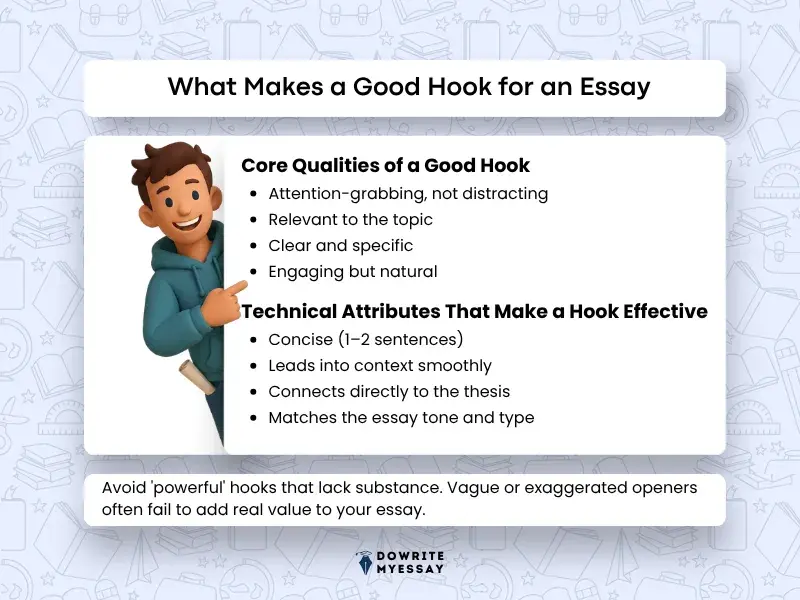
Core Qualities of a Good Hook
- Attention-grabbing, not distracting: A good hook should immediately pull the reader in, but it should do so with purpose. Many students confuse “attention-grabbing” with being dramatic or shocking. That’s a mistake. If the hook feels exaggerated or unrelated, it breaks trust instead of building curiosity.
A strong hook for essay writing creates interest while staying grounded in the topic, so the reader feels guided rather than confused. - Relevant to the topic: Relevance is non-negotiable. The hook must clearly connect to the subject of the essay. If the reader cannot see how the opening sentence relates to the topic within a few seconds, the hook fails structurally.
For example, starting with a random quote or story that does not link back to the topic weakens the introduction. A good hook always feels like the natural starting point of the discussion. - Clear and specific: Clarity is what separates a strong hook from a generic one. Avoid broad, overused lines like “Since the beginning of time…” or “In today’s modern world…”. These statements sound meaningful but carry no real information.
A strong essay hook focuses on something specific, an idea, a fact, or a situation that directly relates to the topic so the reader immediately understands the direction of the essay. - Engaging but natural: The hook should feel like a smooth beginning, not something forced just to impress. Overcomplicated wording, unnecessary adjectives, or overly formal language often make hooks sound artificial.
The best hook in an essay feels simple, readable, and human. It should sound like a natural start to a conversation, even in formal writing.
Technical Attributes That Make a Hook Effective
- Concise (1–2 sentences): A hook should be short but impactful. Long openings reduce clarity and dilute the main idea. If a hook takes too long to make its point, the reader loses focus before reaching the actual topic.
In most cases, a strong hook for essay writing delivers its impact in one sentence, with a second sentence used only if necessary. - Leads into context smoothly: The hook should not feel isolated from the rest of the introduction. It must flow naturally into the background or explanation that follows.
Think of it as a bridge: the hook grabs attention, then immediately transitions into context. If there is a sudden jump, the introduction feels disjointed. - Connects directly to the thesis: Every effective essay hook should support the main argument, even if indirectly. The hook sets up the idea that the thesis will later explain in detail.
If the hook introduces something unrelated, the transition to the thesis becomes awkward and forced. - Matches the essay tone and type: Different essays require different approaches. A narrative essay allows storytelling and emotion, while an argumentative essay relies more on logic, facts, or bold claims.
Choosing the wrong type of hook for the essay weakens its effectiveness. The tone of the hook should align with the purpose of the writing.
What Most Students Get Wrong
A common mistake is trying to make the essay hook sound “powerful” instead of making it useful. This leads to vague, exaggerated, or overly general statements that do not add real value.
This kind of writing often sounds important but lacks clarity or relevance, which is a known pattern in weak or AI-like content . A strong hook avoids this by staying specific, clear, and directly connected to the topic.
Once you understand what makes a hook effective, the next step is learning the different types of hooks you can use based on your essay and purpose.
Types of Hooks in Essays (With Examples)
Not every essay hook works for every topic. The type of hook in an essay you choose should match your purpose, subject, and tone. A good hook for essay writing is not just creative, it’s strategic. Below are the most effective types, when to use them, and how they actually work.

1. Question Hook (Rhetorical Question)
A question hook starts with a thought-provoking question that makes the reader pause and think. It works best when the question directly relates to the topic and cannot be answered with a simple yes or no.
When to use it:
- Argumentative essays
- Persuasive essays
- Topics that involve opinions or debate
Why it works:
It immediately involves the reader and creates curiosity. However, weak questions like “Do you like technology?” fail because they are too obvious and add no depth.
2. Statistic Hook
A statistic hook uses a fact or data point to introduce the topic. This type relies on Logos (logical appeal) and works well in academic or research-based writing.
When to use it:
- Argumentative essays
- Research papers
- Expository essays
Why it works:
It builds credibility and shows that the topic is grounded in real data. Just make sure the statistic is accurate and directly relevant.
3. Anecdote Hook
An anecdote hook uses a short, relevant story to draw the reader in. It is one of the most engaging hook writing techniques when done correctly.
When to use it:
- Narrative essays
- Personal essays
- Reflective writing
Why it works:
It creates relatability and emotional connection (Pathos). The key is to keep it short and clearly linked to the topic.
4. Quotation Hook
A quotation hook starts with a quote from a known figure or source. It adds authority and context to the essay.
When to use it:
- Analytical essays
- Literature essays
- Argumentative writing
Why it works:
It gives credibility and frames the topic. However, overused or generic quotes weaken the impact, so relevance is critical.
5. Bold Statement Hook
A bold statement hook presents a strong or surprising claim. It is designed to grab attention quickly.
When to use it:
- Persuasive essays
- Opinion essays
- Argumentative topics
Why it works:
It creates curiosity and sometimes shock. But it must be backed up in the essay, or it feels misleading.
How to Choose the Right Type
Choosing the right essay hook depends on:
- Your essay type
- Your audience
- Your topic
For example:
- Use statistics or bold statements for academic arguments
- Use anecdotes for personal or narrative writing
- Use questions when you want to engage the reader directly
The key is simple: the hook should feel like the natural starting point of your essay, not something added just to sound interesting.
Choosing the right type of hook is only part of the process; you also need to understand how it fits within the full essay introduction.
What Is the Difference Between a Hook and an Essay Introduction
A hook in an essay is the first sentence or first two sentences that grab the reader’s attention. The essay introduction is the full opening paragraph that gives context, explains the topic, and leads into the thesis. So, the hook is only one part of the introduction, not the whole introduction.
Think of it like this: the essay hook pulls the reader in, while the introduction tells them what the essay is about and why the topic matters. If the hook is interesting but the rest of the introduction does not build on it, the opening will still feel weak. That is why students need to understand how to write an essay introduction naturally, not just how to create one strong first sentence.
A good hook for essay writing should always connect to the introduction. It should not feel like a random quote, fact, or question placed at the top. The best structure is simple: hook → context → thesis. This keeps the opening clear, focused, and easy to follow.
Once you understand how the hook fits inside the full introduction, the next step is learning how to write one step by step
How to Write a Hook for an Essay (Step-by-Step Process)
Knowing the types of hooks is useful, but the real skill is knowing how to write a hook for an essay that actually works. A strong essay hook follows a clear process; it’s not something you guess or force. If you approach it step by step, writing a hook in an essay becomes much easier and more consistent.

Step 1: Understand Your Topic and Purpose
Before writing anything, be clear about what your essay is about. Your hook for essay writing depends entirely on the topic and the goal of your essay.
Ask yourself:
- What is my main idea?
- Is this essay argumentative, narrative, or expository?
- What do I want the reader to think or feel?
If you skip this step, your hook will likely feel random or disconnected.
Step 2: Identify Your Audience
A hook that works for one audience may not work for another. Academic writing requires clarity and relevance, while narrative writing allows more flexibility.
- For academic essays → use logic, facts, or clear statements
- For personal essays → use stories or relatable situations
A strong essay hook always matches the reader’s expectations.
Step 3: Choose the Right Hook Type
The next step is to match your subject matter with the type of hook that is most appropriate for it:
- Statistic → for logical, data-based topics
- Anecdote → for personal or narrative writing
- Question → for engaging the reader directly
- Bold statement → for strong arguments
This step prevents you from forcing a hook that doesn’t fit the essay.
Step 4: Write a Clear and Engaging Opening Line
Start writing your hook, but keep it simple. Focus on clarity first, then engagement.
Bad approach:
- Trying to sound “deep” or overly complex
Better approach:
- Say something clear, specific, and meaningful
Strong: “More than half of students struggle to write an effective essay introduction.”
A good hook in an essay should be easy to understand on the first read.
Step 5: Connect the Hook to Your Thesis
This is the step most students ignore. A hook is not complete unless it leads into the main argument.
Your structure should look like:
Hook → Context → Thesis
The hook introduces the idea, then the introduction explains it, and finally, the thesis presents the main point. If this connection is weak, the entire opening feels disjointed. To build a strong connection, you need a clear understanding of how a thesis statement in essay writing works and how it supports your argument.
Step 6: Review and Refine
After writing your hook, check it critically:
- Is it relevant to the topic?
- Is it clear and specific?
- Does it lead naturally into the introduction?
- Does it avoid being too long or too vague?
Most hooks improve after small revisions. Don’t treat the first draft as final.
Now that you know how to write a hook step by step, the next step is understanding the techniques that make hooks more engaging and effective.
Hook Writing Techniques (Practical Strategies)
Writing a strong essay hook is not just about choosing a type; it’s about how you execute it. The difference between an average and a strong hook in an essay comes down to technique. These strategies help you make your hook for essay writing more engaging, clear, and effective without overcomplicating it.
1. Use Emotional Appeal (Pathos) Carefully
Emotional hooks work by making the reader feel something: curiosity, concern, or relatability. This is especially useful in narrative and persuasive essays.
How to apply it:
- Focus on a real situation or experience
- Keep it simple and relatable
- Avoid exaggeration or drama
Why it works:
It creates an immediate connection. But if you overdo emotion, it starts to feel forced instead of natural.
2. Use Logical Appeal (Logos) for Credibility
Logical hooks rely on facts, statistics, or clear reasoning. These are strong in academic and argumentative writing.
How to apply it:
- Use accurate, relevant data
- Keep the number or fact directly tied to your topic
- Avoid random or unsupported claims
Why it works:
It builds trust and shows that your topic has real importance.
3. Create a Curiosity Gap
A curiosity-driven hook gives just enough information to make the reader want more, without explaining everything upfront.
How to apply it:
- Introduce an idea but don’t fully explain it
- Make the reader want to continue reading
Why it works:
It naturally pulls the reader forward without sounding exaggerated.
4. Use Relatability to Engage the Reader
A relatable hook makes the reader think, “I’ve experienced this.” This works well across almost all essay types.
How to apply it:
- Use common student experiences
- Keep it realistic and simple
- Avoid overly specific or niche scenarios
Why it works:
It builds instant connection without needing complex language.
5. Keep It Specific, Not Generic
Specific hooks always outperform vague ones. Generic lines feel empty because they could apply to any topic.
Strong: Many students lose marks simply because their essay starts weak.
Why it works:
Specificity improves clarity and relevance, which are key to a strong essay hook.
6. Avoid Overcomplication
Trying too hard to sound “advanced” often leads to unclear writing. A good hook in an essay should be easy to understand on the first read.
- Avoid complex vocabulary unless necessary
- Avoid long, layered sentences
- Focus on clarity over style
This is important because overly polished or exaggerated language often results in writing that sounds impressive but lacks real meaning .
Once you understand these techniques, the next step is learning how to choose the right hook based on your essay type.
How to Choose the Right Hook for Different Essay Types
Choosing the right essay hook is not about picking what sounds interesting; it’s about choosing what fits your essay. A hook in an essay must match the purpose, tone, and structure of the writing. If the hook does not align with the essay type, even a well-written opening will feel out of place.
1. Argumentative Essays
Argumentative writing focuses on logic, evidence, and clear claims. The best hook for essay writing here is one that introduces a problem or a strong position.
Best hook types:
- Statistic hook
- Bold statement hook
Why this works:
It immediately presents a problem and sets up an argument. Emotional or story-based hooks usually weaken argumentative writing unless used very carefully.
2. Narrative Essays
Narrative essays are personal and story-driven. The goal is to engage the reader emotionally and make the opening feel natural.
Best hook types:
- Anecdote hook
- Relatable situation
Why this works:
It creates a connection and draws the reader into a personal experience.
3. Expository Essays
Expository writing explains or informs. The hook should be clear, direct, and informative without being overly dramatic.
Best hook types:
- Fact-based hook
- Statistic hook
Why this works:
It introduces the topic clearly without unnecessary complexity.
4. Persuasive Essays
Persuasive essays aim to influence the reader’s opinion. The hook should be engaging and slightly emotional or thought-provoking.
Best hook types:
- Question hook
- Bold statement hook
Why this works:
It directly engages the reader and sets up persuasion.
Key Principle to Follow
No matter the type, a strong hook in an essay must:
- Match the tone of the essay
- Stay relevant to the topic
- Lead naturally into the introduction
If the hook feels like it belongs to a different type of essay, it will break the flow.
Once you know how to choose the right hook, the next step is seeing how these hooks actually look in real essay examples.
Examples of Hooks in Essays (Real Use Cases)
Understanding theory is useful, but seeing how a strong essay hook works in real examples is what actually improves your writing. Below are practical examples of a hook in an essay, along with why they work and how they connect to the topic.
1. Argumentative Essay Hook Example
Hook:
Over 60% of students struggle to write effective essay introductions.
Why it works:
This hook for essay writing uses a statistic to introduce a clear problem. It is specific, relevant, and immediately sets up an argument. The reader understands what the essay will discuss without confusion.
2. Narrative Essay Hook Example
Hook:
I spent nearly an hour staring at a blank page, unsure how to begin my essay.
Why it works:
This hook creates relatability and uses Pathos (emotional appeal). It draws the reader into a real situation and naturally leads into a personal story.
3. Expository Essay Hook Example
Hook:
Essay introductions play a key role in shaping how readers understand a topic.
Why it works:
This is a clear and direct opening. It avoids exaggeration and sets up an explanation, which is exactly what expository writing requires.
4. Persuasive Essay Hook Example
Hook:
What if the first sentence of your essay determined your entire grade?
Why it works:
This question hook engages the reader immediately and creates curiosity. It also sets up a persuasive argument.
5. Weak vs Strong Hook Comparison
Weak Hook:
Since the beginning of time, humans have always faced challenges.
Strong Hook:
Many students lose marks simply because their essay starts weak.
Why this matters:
The weak example is vague and generic. It could apply to any topic. The strong example is specific, clear, and directly connected to the subject. This is the difference between a filler opening and an effective essay hook.
Key Insight from These Examples
A strong hook in an essay always does three things:
- It is specific, not generic
- It relates directly to the topic
- It leads naturally into the introduction
Hooks that sound dramatic but lack clarity often feel empty and disconnected, which is a common issue in weak or AI-like writing .
Seeing examples makes it easier to understand what works, but avoiding common mistakes is just as important.
Common Mistakes in Writing a Hook
Even when students understand what a good essay hook looks like, they often repeat the same mistakes. These errors make a hook in an essay feel weak, generic, or disconnected from the topic. Fixing these issues usually improves the entire introduction immediately.
1. Using Generic Openings
Example:
Since the beginning of time, humans have always faced challenges.
Why it fails:
This type of hook for essay writing sounds broad but adds no real meaning. It could apply to almost any topic, so it doesn’t guide the reader in any clear direction.
2. Writing an Irrelevant Hook
Example:
Starting with a quote or story that has no clear link to the topic.
Why it fails:
Even if the hook is interesting, it becomes useless if it doesn’t connect to the essay. The reader should immediately see how the hook relates to the subject.
3. Making the Hook Too Long
Example:
A long story or explanation before getting to the main point.
Why it fails:
A hook should be concise. If it takes too long, the reader loses focus before reaching the actual topic. A strong essay hook usually stays within 1–2 sentences.
4. Using Misleading or Overly Dramatic Statements
Example:
This one mistake will destroy your entire academic career.
Why it fails:
This sounds exaggerated and unrealistic. If the opening statement makes a false promise or is misleading, it has a negative effect on the honesty level of your opening hook instead of helping build interest
5. Not Connecting the Hook to the Thesis
Example:
A good opening line followed by an unrelated introduction.
Why it fails:
A hook is not standalone. If your hook doesn’t connect with your main point, then your introduction won’t feel like it flows. The structure should always follow:
Hook → Context → Thesis
6. Focusing on Style Instead of Clarity
Many students try to make their hook in an essay sound “impressive” instead of making it clear and useful. This often leads to vague or overcomplicated sentences that sound important but lack real meaning.
This is a common issue in weak writing, where language is exaggerated but not specific. A strong hook avoids this by staying simple, direct, and relevant.
Most hook problems come down to one issue: trying to impress instead of communicating. A strong essay hook focuses on clarity, relevance, and connection, not just style.
Once you know what to avoid, the next step is understanding how long a hook should be to stay effective.
How Long Should a Hook Be
A strong essay hook should be short and focused. In most cases, the ideal length of a hook in an essay is one to two sentences. This is enough to grab attention without overwhelming the reader or delaying the main idea.
Why Short Hooks Work Better
- They get to the point quickly: Readers should understand the direction of your essay immediately. Long hooks often bury the main idea under unnecessary detail.
- They maintain clarity: A concise hook for essay writing is easier to read and understand on the first attempt. Long openings often become vague or confusing.
- They keep the introduction balanced: If the hook is too long, it takes over the introduction and weakens the transition into context and thesis.
When a Hook Can Be Slightly Longer
In some cases, especially with anecdote hooks, you may need two sentences:
- First sentence → introduces the situation
- Second sentence → connects it to the topic
Even then, it should stay controlled and directly relevant.
What to Avoid
- Writing a full paragraph as a hook
- Adding unnecessary background before introducing the topic
- Using multiple ideas in one hook
A hook is not meant to explain everything; it only needs to start the conversation.
Quick Rule to Follow
If your hook:
- Takes more than 2 sentences
- Feels like a full explanation
- Delays the main topic
→ It’s too long.
Now that you know the ideal length of a hook, the next step is to use a simple checklist to make sure your hook is actually effective.
Hook Writing Checklist (Quick Optimization)
At this point, you know what a strong essay hook looks like. The final step is making sure your hook in an essay actually meets the standard before you move on. This checklist helps you quickly test and improve your opening without overthinking it.
Use This Checklist Before Finalizing Your Hook
- Is it attention-grabbing?: Does it create curiosity or interest right away, or does it feel flat?
- Is it clearly relevant to the topic?: Can a reader immediately understand how this hook for essay writing connects to the subject?
- Is it concise (1–2 sentences)?: Does it stay focused, or does it drag into unnecessary detail?
- Is it clear and specific?: Avoid vague lines that could apply to any topic.
- Does it lead naturally into the introduction?: The hook should not feel isolated. It must flow into context smoothly.
- Does it connect to the thesis?: Even indirectly, the hook should support the main argument.
- Does it match the essay tone?: Formal for academic writing, slightly flexible for narrative.
How to Use This in Practice
Don’t just read the checklist, apply it:
- If your hook fails even one point, revise it
- If it feels forced or exaggerated, simplify it
- If it doesn’t connect to your topic clearly, rewrite it
Most strong essay hooks are not written the first time perfectly; they are improved through small, focused revisions.
Final Insight
A good hook is not about sounding impressive. It’s about being clear, relevant, and effective. When you focus on these basics, your hook in an essay naturally becomes stronger.
With a clear understanding of how to write, refine, and evaluate a hook, you can now approach your essay openings with confidence.

Final Thoughts on Writing an Effective Essay Hook
A strong essay hook shapes how your reader experiences the rest of the essay. It’s not just about grabbing attention; it’s about starting your argument in a way that feels clear, relevant, and purposeful. A well-written hook in an essay sets the tone and guides the reader smoothly into the introduction.
The most effective hook for essay writing is simple and focused. It does not rely on exaggerated language or generic ideas. Instead, it uses clarity, relevance, and connection to introduce the topic naturally. When your hook aligns with your essay type and leads into your thesis, the entire introduction becomes stronger.
In the end, writing a good hook is not about creativity alone; it’s about control. When you understand what works and avoid common mistakes, you can consistently write hooks that engage readers and support your argument from the very first line.
FAQs About Essay Hooks
Still unsure how to start your essay? These quick answers cover the most common questions students ask when writing a hook.